

C haptEr 9 design Environments and systems
308
spatial environments—normally interior—in which people live and
work; the second as thermal environments intrinsic to a product or
that surround it and influence the way they are designed. In each
of these primary cases, the thermal properties of materials play an
essential role.
In tempered spatial environments, the design objective is invariably to provide a thermal condition conducive to the health, wellbeing, and comfort of occupants, whether the environments are in
buildings, automobiles, or aircrafts. Surrounding material systems
form a boundary between the space and the exterior. The geometric
characteristics of the space, the thermal properties of surrounding
walls, or the kinds of glass present in fenestrations are all influential in defining the thermal environment actually perceived by
occupants. Physical mechanical systems that provide heating or
cooling are fundamental contributors to creating and maintaining
this environment.
In products, attention is invariably directed toward the way heat or
extreme temperature differentials affect the design of the product
and to assure that the product effectively continues to provide its
intended role. In some cases, the surrounding environment might
have extremes—especially high or low temperatures. Maintaining
the functioning of a product in an extreme environment is not
always an easy task, especially since many of the mechanical properties of materials, including strength and stiffness, are temperature
dependent. In other cases, the role of a product might necessitate
the inclusion of components that generate heat, which in turn must
be managed. Often there must be components that mitigate heat
transfer, provide cooling functions, or otherwise provide this heat
management. In these design situations, the intrinsic thermal properties of materials are of fundamental importance. Heat affects not
only mechanical properties but electrical and optical properties as
well (see the following discussion).
Basic heat transfer
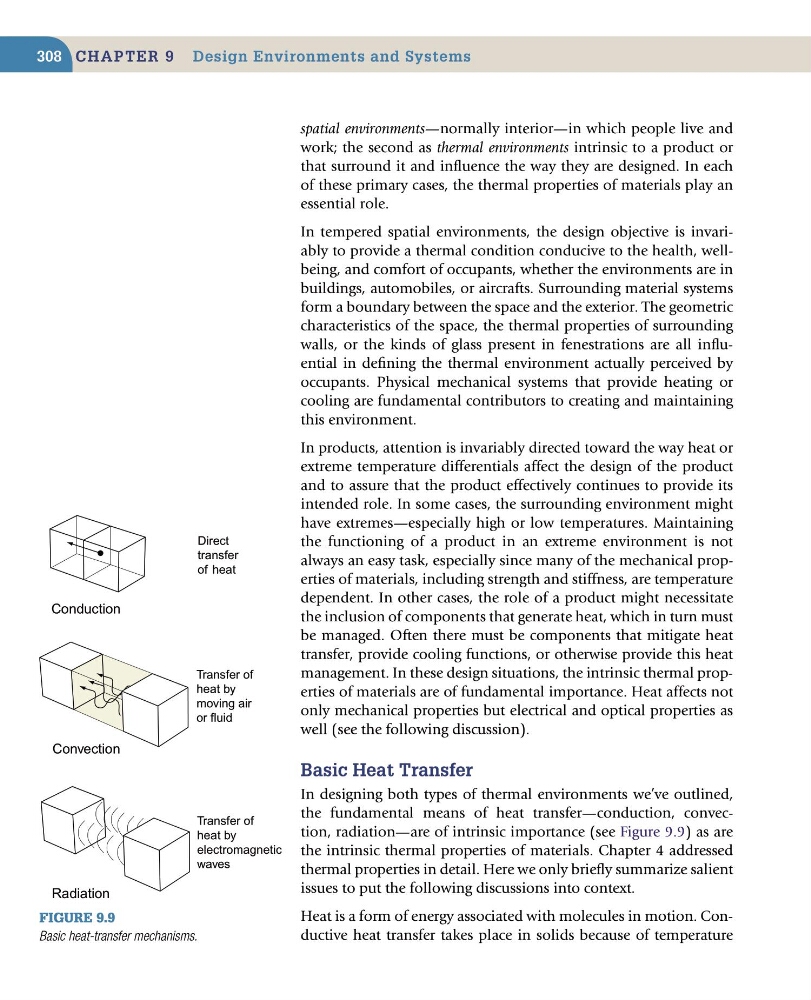
In designing both types of thermal environments we’ve outlined,
the fundamental means of heat transfer—conduction, convection, radiation—are of intrinsic importance (see Figure 9.9) as are
the intrinsic thermal properties of materials. Chapter 4 addressed
thermal properties in detail. Here we only briefly summarize salient
issues to put the following discussions into context.
Heat is a form of energy associated with molecules in motion. Conductive heat transfer takes place in solids because of temperature
Figure 9.9
Basic heat-transfer mechanisms.
Conduction
Direct
transfer
of heat
Convection
Radiation
Transfer of
heat by
moving air
or fluid
Transfer of
heat by
electromagnetic
waves
308
spatial environments—normally interior—in which people live and
work; the second as thermal environments intrinsic to a product or
that surround it and influence the way they are designed. In each
of these primary cases, the thermal properties of materials play an
essential role.
In tempered spatial environments, the design objective is invariably to provide a thermal condition conducive to the health, wellbeing, and comfort of occupants, whether the environments are in
buildings, automobiles, or aircrafts. Surrounding material systems
form a boundary between the space and the exterior. The geometric
characteristics of the space, the thermal properties of surrounding
walls, or the kinds of glass present in fenestrations are all influential in defining the thermal environment actually perceived by
occupants. Physical mechanical systems that provide heating or
cooling are fundamental contributors to creating and maintaining
this environment.
In products, attention is invariably directed toward the way heat or
extreme temperature differentials affect the design of the product
and to assure that the product effectively continues to provide its
intended role. In some cases, the surrounding environment might
have extremes—especially high or low temperatures. Maintaining
the functioning of a product in an extreme environment is not
always an easy task, especially since many of the mechanical properties of materials, including strength and stiffness, are temperature
dependent. In other cases, the role of a product might necessitate
the inclusion of components that generate heat, which in turn must
be managed. Often there must be components that mitigate heat
transfer, provide cooling functions, or otherwise provide this heat
management. In these design situations, the intrinsic thermal properties of materials are of fundamental importance. Heat affects not
only mechanical properties but electrical and optical properties as
well (see the following discussion).
Basic heat transfer
In designing both types of thermal environments we’ve outlined,
the fundamental means of heat transfer—conduction, convection, radiation—are of intrinsic importance (see Figure 9.9) as are
the intrinsic thermal properties of materials. Chapter 4 addressed
thermal properties in detail. Here we only briefly summarize salient
issues to put the following discussions into context.
Heat is a form of energy associated with molecules in motion. Conductive heat transfer takes place in solids because of temperature
Figure 9.9
Basic heat-transfer mechanisms.
Conduction
Direct
transfer
of heat
Convection
Radiation
Transfer of
heat by
moving air
or fluid
Transfer of
heat by
electromagnetic
waves