

307
motions associated with earthquake effects on building structures.
Various kinds of large conventional damping systems are already
in use, and interesting new devices based on magnetorheological or
electrorheological fluids that change their viscosities in the presence
or absence of an electrical or magnetic field are also being developed. As discussed in Chapter 7, the particularly interesting magnetic and electrical properties of nanoparticles promise to improve
the efficiency and responsiveness of these kinds of devices. They
would be particularly useful, for example, in large cable-supported
or cable-stayed structures for which wind-induced vibrations are a
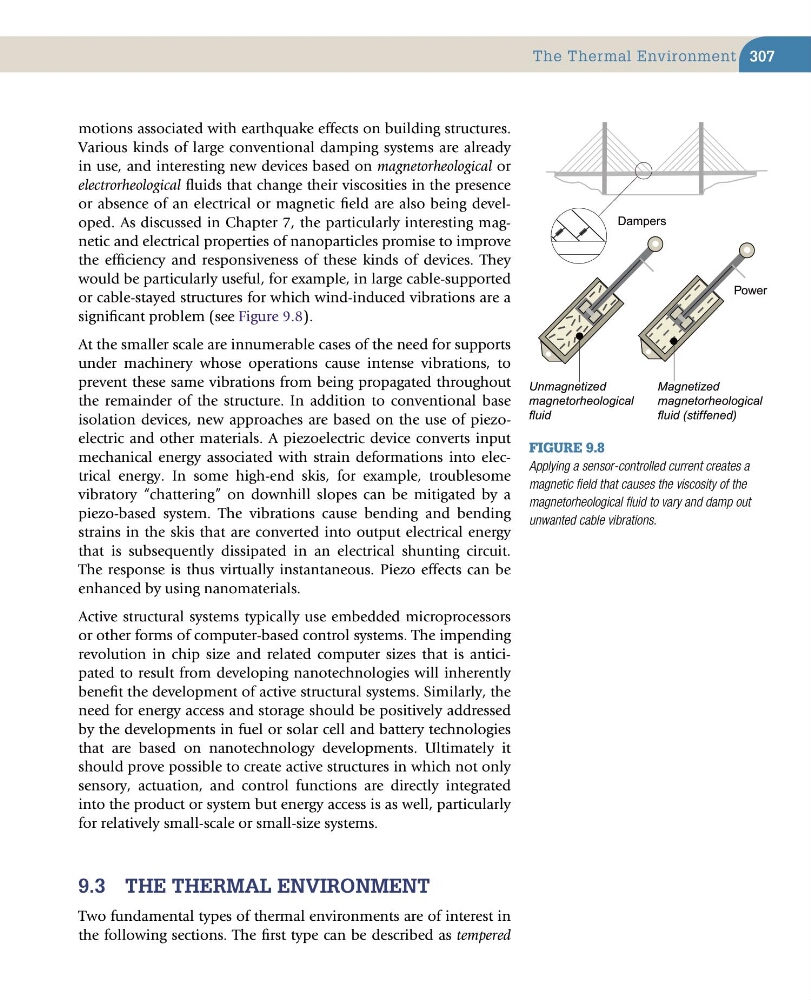
significant problem (see Figure 9.8).
At the smaller scale are innumerable cases of the need for supports
under machinery whose operations cause intense vibrations, to
prevent these same vibrations from being propagated throughout
the remainder of the structure. In addition to conventional base
isolation devices, new approaches are based on the use of piezoelectric and other materials. A piezoelectric device converts input
mechanical energy associated with strain deformations into electrical energy. In some high-end skis, for example, troublesome
vibratory “chattering” on downhill slopes can be mitigated by a
piezo-based system. The vibrations cause bending and bending
strains in the skis that are converted into output electrical energy
that is subsequently dissipated in an electrical shunting circuit.
The response is thus virtually instantaneous. Piezo effects can be
enhanced by using nanomaterials.
Active structural systems typically use embedded microprocessors
or other forms of computer-based control systems. The impending
revolution in chip size and related computer sizes that is anticipated to result from developing nanotechnologies will inherently
benefit the development of active structural systems. Similarly, the
need for energy access and storage should be positively addressed
by the developments in fuel or solar cell and battery technologies
that are based on nanotechnology developments. Ultimately it
should prove possible to create active structures in which not only
sensory, actuation, and control functions are directly integrated
into the product or system but energy access is as well, particularly
for relatively small-scale or small-size systems.
9.3 thE thErmal EnvironmEnt
Two fundamental types of thermal environments are of interest in
the following sections. The first type can be described as tempered
Figure 9.8
Applying a sensor-controlled current creates a
magnetic field that causes the viscosity of the
magnetorheological fluid to vary and damp out
unwanted cable vibrations.
Unmagnetized
magnetorheological
fluid
Magnetized
magnetorheological
fluid (stiffened)
Power
Dampers
The Thermal Environment
motions associated with earthquake effects on building structures.
Various kinds of large conventional damping systems are already
in use, and interesting new devices based on magnetorheological or
electrorheological fluids that change their viscosities in the presence
or absence of an electrical or magnetic field are also being developed. As discussed in Chapter 7, the particularly interesting magnetic and electrical properties of nanoparticles promise to improve
the efficiency and responsiveness of these kinds of devices. They
would be particularly useful, for example, in large cable-supported
or cable-stayed structures for which wind-induced vibrations are a
significant problem (see Figure 9.8).
At the smaller scale are innumerable cases of the need for supports
under machinery whose operations cause intense vibrations, to
prevent these same vibrations from being propagated throughout
the remainder of the structure. In addition to conventional base
isolation devices, new approaches are based on the use of piezoelectric and other materials. A piezoelectric device converts input
mechanical energy associated with strain deformations into electrical energy. In some high-end skis, for example, troublesome
vibratory “chattering” on downhill slopes can be mitigated by a
piezo-based system. The vibrations cause bending and bending
strains in the skis that are converted into output electrical energy
that is subsequently dissipated in an electrical shunting circuit.
The response is thus virtually instantaneous. Piezo effects can be
enhanced by using nanomaterials.
Active structural systems typically use embedded microprocessors
or other forms of computer-based control systems. The impending
revolution in chip size and related computer sizes that is anticipated to result from developing nanotechnologies will inherently
benefit the development of active structural systems. Similarly, the
need for energy access and storage should be positively addressed
by the developments in fuel or solar cell and battery technologies
that are based on nanotechnology developments. Ultimately it
should prove possible to create active structures in which not only
sensory, actuation, and control functions are directly integrated
into the product or system but energy access is as well, particularly
for relatively small-scale or small-size systems.
9.3 thE thErmal EnvironmEnt
Two fundamental types of thermal environments are of interest in
the following sections. The first type can be described as tempered
Figure 9.8
Applying a sensor-controlled current creates a
magnetic field that causes the viscosity of the
magnetorheological fluid to vary and damp out
unwanted cable vibrations.
Unmagnetized
magnetorheological
fluid
Magnetized
magnetorheological
fluid (stiffened)
Power
Dampers
The Thermal Environment