

C haptEr 9 design Environments and systems
302
lubricants are layered compounds (e.g., graphite or tungsten
disulfide) and work by molecules sliding past one another. The
use of nanoparticles of rounded or spherical shapes can potentially
allow an efficient rolling action instead.
surface hardness
The hardness of materials is crucial to the performance of many
kinds of products. In our preceding discussion of applications of
amorphous materials, we found that their high hardness made
them particularly appropriate for uses in tooling and other applications in which knife edges are important. There are other ways
that nanomaterials can be used to enhance hardness. Nanocoatings are particularly interesting here. Nanocrystalline powders that
have been used in metallic stainless steel coatings that are sprayed
on have been shown to improve surface hardness. Various kinds of
nanocrystalline metals have also been specially developed to use in
carbon fiber-reinforced plastic composites to increase surface hardness. Nanocrystalline nickels have been used in many products,
including golf club shafts, as hard protective shells. Many types of
nanocrystalline particles and alloys are available, each with differing properties, such as copper (Cu), gold (Au), cobalt (Co), zinc
(Zn), palladium (Pd), silver (Ag), iron (Fe), lead (Pb), tin (Sn),
nickel-cobalt (Ni-Co), nickel-molybdenum (Ni-Mo), and others.
Carbon-based nanofilms can be developed to not only increase
hardness values; using nanolaminates, tribological characteristics
can be addressed independently as well.
In cases where surface ductility is more important than strength, as
is often the case, various kinds of polymer and ceramic nanocomposites have been used as coatings. Nanocrystalline metals such as
nickel or nickel-iron also have good corrosion resistance and are
much stronger than traditional nickel coatings. Polymer-based coatings are also used extensively for corrosion protection on metals.
nanomaterials and concrete
Concrete and mortar remain the workhorses of civil and building construction industries throughout the world; over 2 billion
tons of cement are manufactured each year. Concrete can be used
in raw, bulk form when subjected to compression only or if cracking is not envisioned as a problem. More typically, it is used in
a composite form in conjunction with reinforcing steel to form
what is commonly called reinforced concrete. The steel provides the
necessary tensile strength when the material is used in beams and
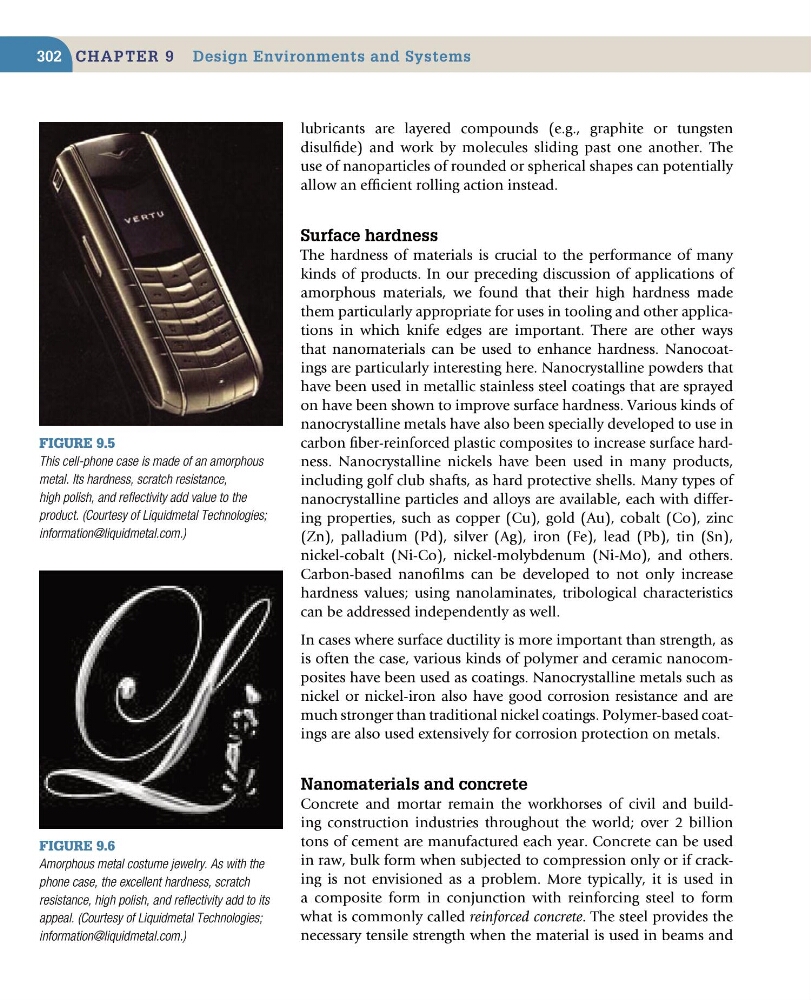
Figure 9.5
This cell-phone case is made of an amorphous
metal. Its hardness, scratch resistance,
high polish, and reflectivity add value to the
product. (Courtesy of Liquidmetal Technologies;
information@liquidmetal.com.)
Figure 9.6
Amorphous metal costume jewelry. As with the
phone case, the excellent hardness, scratch
resistance, high polish, and reflectivity add to its
appeal. (Courtesy of Liquidmetal Technologies;
information@liquidmetal.com.)
302
lubricants are layered compounds (e.g., graphite or tungsten
disulfide) and work by molecules sliding past one another. The
use of nanoparticles of rounded or spherical shapes can potentially
allow an efficient rolling action instead.
surface hardness
The hardness of materials is crucial to the performance of many
kinds of products. In our preceding discussion of applications of
amorphous materials, we found that their high hardness made
them particularly appropriate for uses in tooling and other applications in which knife edges are important. There are other ways
that nanomaterials can be used to enhance hardness. Nanocoatings are particularly interesting here. Nanocrystalline powders that
have been used in metallic stainless steel coatings that are sprayed
on have been shown to improve surface hardness. Various kinds of
nanocrystalline metals have also been specially developed to use in
carbon fiber-reinforced plastic composites to increase surface hardness. Nanocrystalline nickels have been used in many products,
including golf club shafts, as hard protective shells. Many types of
nanocrystalline particles and alloys are available, each with differing properties, such as copper (Cu), gold (Au), cobalt (Co), zinc
(Zn), palladium (Pd), silver (Ag), iron (Fe), lead (Pb), tin (Sn),
nickel-cobalt (Ni-Co), nickel-molybdenum (Ni-Mo), and others.
Carbon-based nanofilms can be developed to not only increase
hardness values; using nanolaminates, tribological characteristics
can be addressed independently as well.
In cases where surface ductility is more important than strength, as
is often the case, various kinds of polymer and ceramic nanocomposites have been used as coatings. Nanocrystalline metals such as
nickel or nickel-iron also have good corrosion resistance and are
much stronger than traditional nickel coatings. Polymer-based coatings are also used extensively for corrosion protection on metals.
nanomaterials and concrete
Concrete and mortar remain the workhorses of civil and building construction industries throughout the world; over 2 billion
tons of cement are manufactured each year. Concrete can be used
in raw, bulk form when subjected to compression only or if cracking is not envisioned as a problem. More typically, it is used in
a composite form in conjunction with reinforcing steel to form
what is commonly called reinforced concrete. The steel provides the
necessary tensile strength when the material is used in beams and
Figure 9.5
This cell-phone case is made of an amorphous
metal. Its hardness, scratch resistance,
high polish, and reflectivity add value to the
product. (Courtesy of Liquidmetal Technologies;
information@liquidmetal.com.)
Figure 9.6
Amorphous metal costume jewelry. As with the
phone case, the excellent hardness, scratch
resistance, high polish, and reflectivity add to its
appeal. (Courtesy of Liquidmetal Technologies;
information@liquidmetal.com.)