

301
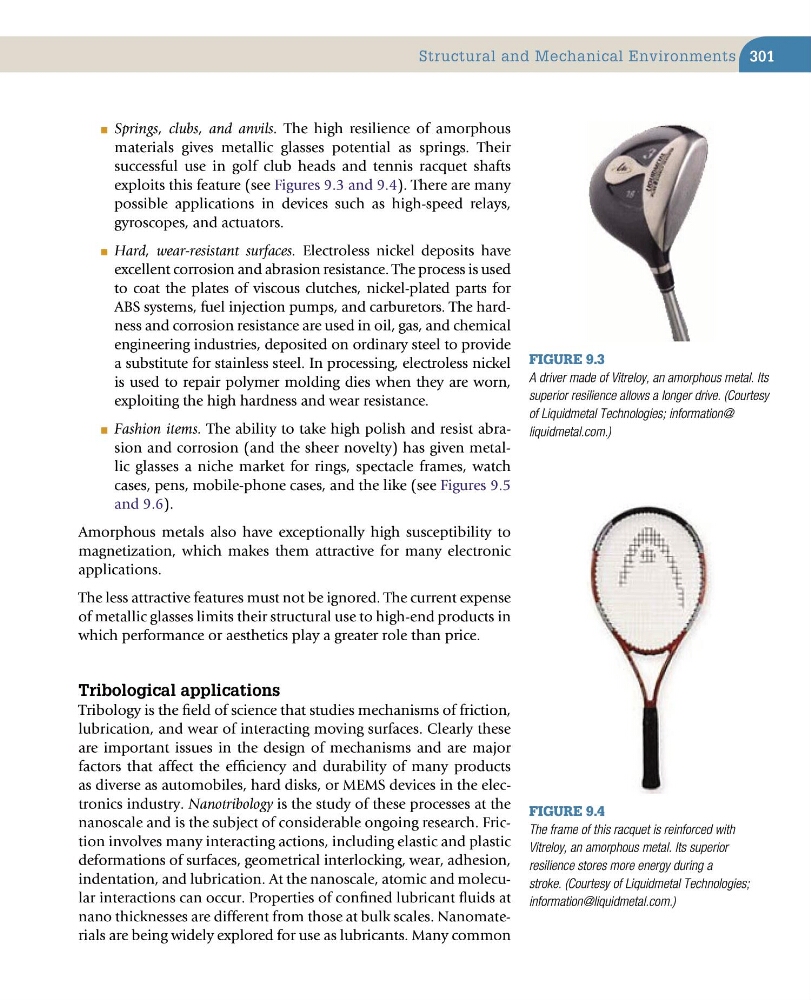
■ Springs, clubs, and anvils. The high resilience of amorphous
materials gives metallic glasses potential as springs. Their
successful use in golf club heads and tennis racquet shafts
exploits this feature (see Figures 9.3 and 9.4). There are many
possible applications in devices such as high-speed relays,
gyroscopes, and actuators.
■ Hard, wear-resistant surfaces. Electroless nickel deposits have
excellent corrosion and abrasion resistance. The process is used
to coat the plates of viscous clutches, nickel-plated parts for
ABS systems, fuel injection pumps, and carburetors. The hardness and corrosion resistance are used in oil, gas, and chemical
engineering industries, deposited on ordinary steel to provide
a substitute for stainless steel. In processing, electroless nickel
is used to repair polymer molding dies when they are worn,
exploiting the high hardness and wear resistance.
■ Fashion items. The ability to take high polish and resist abrasion and corrosion (and the sheer novelty) has given metallic glasses a niche market for rings, spectacle frames, watch
cases, pens, mobile-phone cases, and the like (see Figures 9.5
and 9.6).
Amorphous metals also have exceptionally high susceptibility to
magnetization, which makes them attractive for many electronic
applications.
The less attractive features must not be ignored. The current expense
of metallic glasses limits their structural use to high-end products in
which performance or aesthetics play a greater role than price.
tribological applications
Tribology is the field of science that studies mechanisms of friction,
lubrication, and wear of interacting moving surfaces. Clearly these
are important issues in the design of mechanisms and are major
factors that affect the efficiency and durability of many products
as diverse as automobiles, hard disks, or MEMS devices in the electronics industry. Nanotribology is the study of these processes at the
nanoscale and is the subject of considerable ongoing research. Friction involves many interacting actions, including elastic and plastic
deformations of surfaces, geometrical interlocking, wear, adhesion,
indentation, and lubrication. At the nanoscale, atomic and molecular interactions can occur. Properties of confined lubricant fluids at
nano thicknesses are different from those at bulk scales. Nanomaterials are being widely explored for use as lubricants. Many common
Figure 9.3
A driver made of Vitreloy, an amorphous metal. Its
superior resilience allows a longer drive. (Courtesy
of Liquidmetal Technologies; information@
liquidmetal.com.)
Figure 9.4
The frame of this racquet is reinforced with
Vitreloy, an amorphous metal. Its superior
resilience stores more energy during a
stroke. (Courtesy of Liquidmetal Technologies;
information@liquidmetal.com.)
Structural and Mechanical Environments
■ Springs, clubs, and anvils. The high resilience of amorphous
materials gives metallic glasses potential as springs. Their
successful use in golf club heads and tennis racquet shafts
exploits this feature (see Figures 9.3 and 9.4). There are many
possible applications in devices such as high-speed relays,
gyroscopes, and actuators.
■ Hard, wear-resistant surfaces. Electroless nickel deposits have
excellent corrosion and abrasion resistance. The process is used
to coat the plates of viscous clutches, nickel-plated parts for
ABS systems, fuel injection pumps, and carburetors. The hardness and corrosion resistance are used in oil, gas, and chemical
engineering industries, deposited on ordinary steel to provide
a substitute for stainless steel. In processing, electroless nickel
is used to repair polymer molding dies when they are worn,
exploiting the high hardness and wear resistance.
■ Fashion items. The ability to take high polish and resist abrasion and corrosion (and the sheer novelty) has given metallic glasses a niche market for rings, spectacle frames, watch
cases, pens, mobile-phone cases, and the like (see Figures 9.5
and 9.6).
Amorphous metals also have exceptionally high susceptibility to
magnetization, which makes them attractive for many electronic
applications.
The less attractive features must not be ignored. The current expense
of metallic glasses limits their structural use to high-end products in
which performance or aesthetics play a greater role than price.
tribological applications
Tribology is the field of science that studies mechanisms of friction,
lubrication, and wear of interacting moving surfaces. Clearly these
are important issues in the design of mechanisms and are major
factors that affect the efficiency and durability of many products
as diverse as automobiles, hard disks, or MEMS devices in the electronics industry. Nanotribology is the study of these processes at the
nanoscale and is the subject of considerable ongoing research. Friction involves many interacting actions, including elastic and plastic
deformations of surfaces, geometrical interlocking, wear, adhesion,
indentation, and lubrication. At the nanoscale, atomic and molecular interactions can occur. Properties of confined lubricant fluids at
nano thicknesses are different from those at bulk scales. Nanomaterials are being widely explored for use as lubricants. Many common
Figure 9.3
A driver made of Vitreloy, an amorphous metal. Its
superior resilience allows a longer drive. (Courtesy
of Liquidmetal Technologies; information@
liquidmetal.com.)
Figure 9.4
The frame of this racquet is reinforced with
Vitreloy, an amorphous metal. Its superior
resilience stores more energy during a
stroke. (Courtesy of Liquidmetal Technologies;
information@liquidmetal.com.)
Structural and Mechanical Environments