

chapter 8 nanomaterials: Synthesis and characterization
268
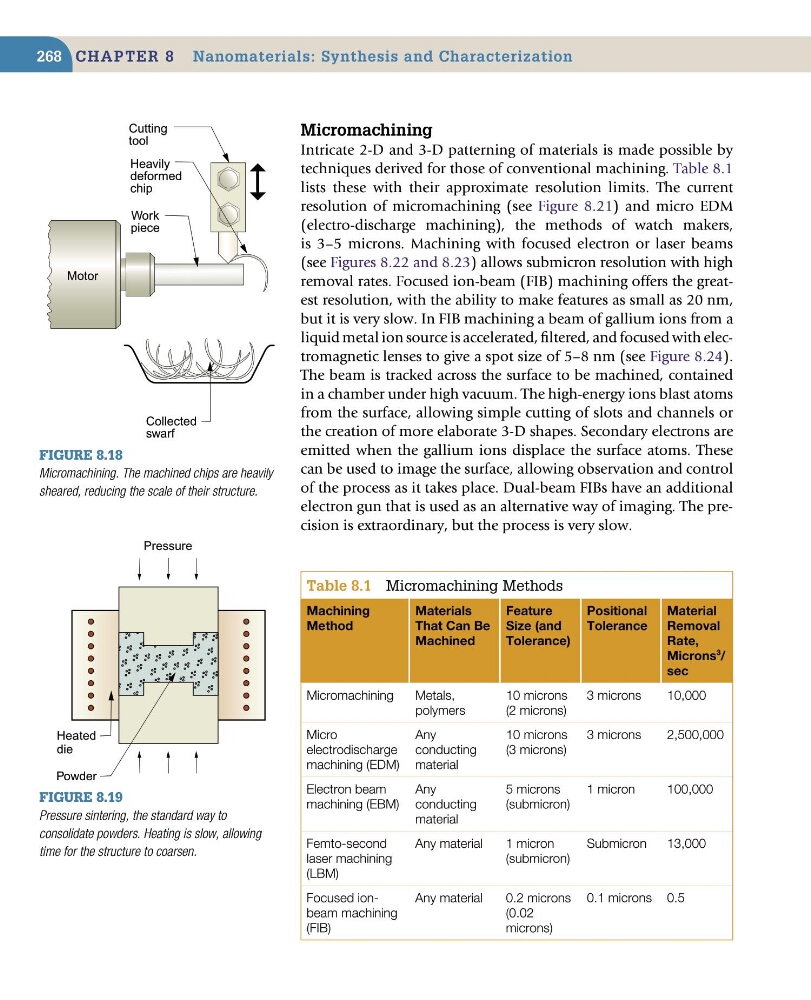
Micromachining
Intricate 2-D and 3-D patterning of materials is made possible by
techniques derived for those of conventional machining. Table 8.1
lists these with their approximate resolution limits. The current
resolution of micromachining (see Figure 8.21) and micro EDM
(electro-discharge machining), the methods of watch makers,
is 3–5 microns. Machining with focused electron or laser beams
(see Figures 8.22 and 8.23) allows submicron resolution with high
removal rates. Focused ion-beam (FIB) machining offers the greatest resolution, with the ability to make features as small as 20 nm,
but it is very slow. In FIB machining a beam of gallium ions from a
liquid metal ion source is accelerated, filtered, and focused with electromagnetic lenses to give a spot size of 5–8 nm (see Figure 8.24).
The beam is tracked across the surface to be machined, contained
in a chamber under high vacuum. The high-energy ions blast atoms
from the surface, allowing simple cutting of slots and channels or
the creation of more elaborate 3-D shapes. Secondary electrons are
emitted when the gallium ions displace the surface atoms. These
can be used to image the surface, allowing observation and control
of the process as it takes place. Dual-beam FIBs have an additional
electron gun that is used as an alternative way of imaging. The precision is extraordinary, but the process is very slow.
Figure 8.18
Micromachining. The machined chips are heavily
sheared, reducing the scale of their structure.
Work
piece
Motor
Heavily
deformed
chip
Cutting
tool
Collected
swarf
Figure 8.19
Pressure sintering, the standard way to
consolidate powders. Heating is slow, allowing
time for the structure to coarsen.
Powder
Heated
die
Pressure
table 8.1 Micromachining Methods
Machining
Method
Materials
That Can Be
Machined
Feature
Size (and
Tolerance)
Positional
Tolerance
Material
Removal
Rate,
Microns
3 /
sec
Micromachining
Metals,
polymers
10 microns
(2 microns)
3 microns
10,000
Micro
electrodischarge
machining (EDM)
Any
conducting
material
10 microns
(3 microns)
3 microns
2,500,000
Electron beam
machining (EBM)
Any
conducting
material
5 microns
(submicron)
1 micron
100,000
Femto-second
laser machining
(LBM)
Any material
1 micron
(submicron)
Submicron
13,000
Focused ionbeam machining
(FIB)
Any material
0.2 microns
(0.02
microns)
0.1 microns 0.5
268
Micromachining
Intricate 2-D and 3-D patterning of materials is made possible by
techniques derived for those of conventional machining. Table 8.1
lists these with their approximate resolution limits. The current
resolution of micromachining (see Figure 8.21) and micro EDM
(electro-discharge machining), the methods of watch makers,
is 3–5 microns. Machining with focused electron or laser beams
(see Figures 8.22 and 8.23) allows submicron resolution with high
removal rates. Focused ion-beam (FIB) machining offers the greatest resolution, with the ability to make features as small as 20 nm,
but it is very slow. In FIB machining a beam of gallium ions from a
liquid metal ion source is accelerated, filtered, and focused with electromagnetic lenses to give a spot size of 5–8 nm (see Figure 8.24).
The beam is tracked across the surface to be machined, contained
in a chamber under high vacuum. The high-energy ions blast atoms
from the surface, allowing simple cutting of slots and channels or
the creation of more elaborate 3-D shapes. Secondary electrons are
emitted when the gallium ions displace the surface atoms. These
can be used to image the surface, allowing observation and control
of the process as it takes place. Dual-beam FIBs have an additional
electron gun that is used as an alternative way of imaging. The precision is extraordinary, but the process is very slow.
Figure 8.18
Micromachining. The machined chips are heavily
sheared, reducing the scale of their structure.
Work
piece
Motor
Heavily
deformed
chip
Cutting
tool
Collected
swarf
Figure 8.19
Pressure sintering, the standard way to
consolidate powders. Heating is slow, allowing
time for the structure to coarsen.
Powder
Heated
die
Pressure
table 8.1 Micromachining Methods
Machining
Method
Materials
That Can Be
Machined
Feature
Size (and
Tolerance)
Positional
Tolerance
Material
Removal
Rate,
Microns
3 /
sec
Micromachining
Metals,
polymers
10 microns
(2 microns)
3 microns
10,000
Micro
electrodischarge
machining (EDM)
Any
conducting
material
10 microns
(3 microns)
3 microns
2,500,000
Electron beam
machining (EBM)
Any
conducting
material
5 microns
(submicron)
1 micron
100,000
Femto-second
laser machining
(LBM)
Any material
1 micron
(submicron)
Submicron
13,000
Focused ionbeam machining
(FIB)
Any material
0.2 microns
(0.02
microns)
0.1 microns 0.5