

chapter 8 nanomaterials: Synthesis and characterization
266
There are other ways to make amorphous structures. One is to grab
the atoms or molecules not from the melt but from solution. Electrodeposition, already described (Figure 8.9), can be driven at such a
rate that the ions, dragged to the surface of the cathode (negative electrode), are hurled onto it so fast that they have no time
to rearrange and build crystals. More remarkably, the deposition
can be done, in one case, without any electric current. Electroless
nickel (really a nickel-phosphorous alloy) deposits spontaneously
onto almost anything plunged into a bath containing nickel ions
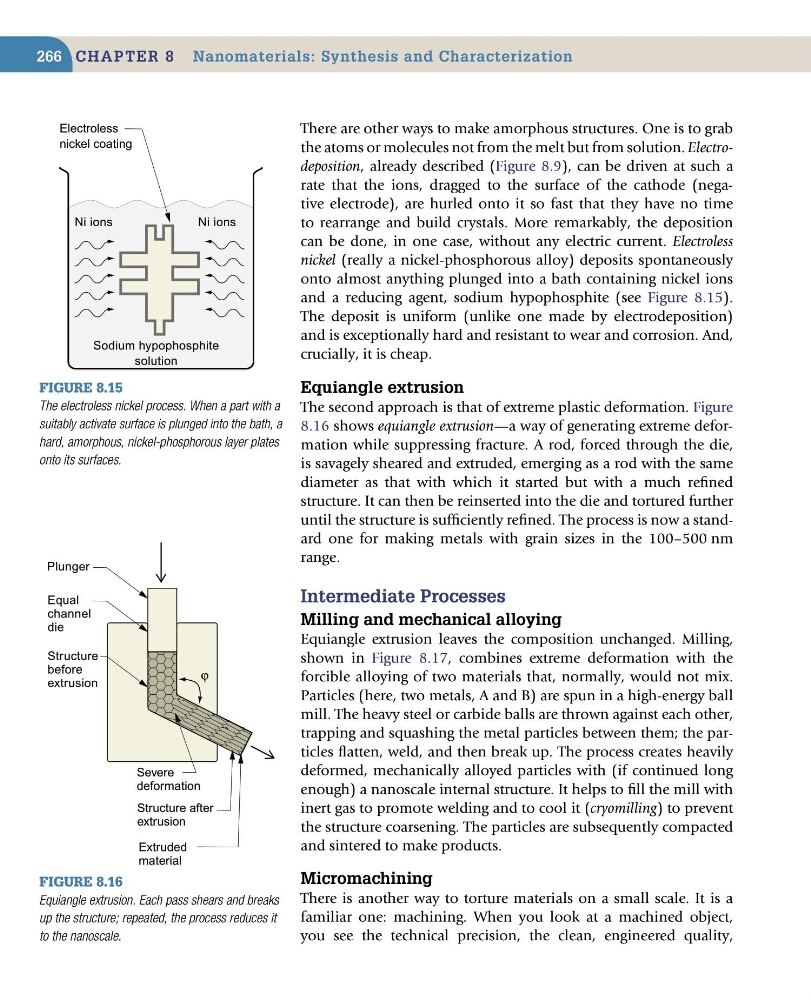
and a reducing agent, sodium hypophosphite (see Figure 8.15).
The deposit is uniform (unlike one made by electrodeposition)
and is exceptionally hard and resistant to wear and corrosion. And,
crucially, it is cheap.
equiangle extrusion
The second approach is that of extreme plastic deformation. Figure
8.16 shows equiangle extrusion—a way of generating extreme deformation while suppressing fracture. A rod, forced through the die,
is savagely sheared and extruded, emerging as a rod with the same
diameter as that with which it started but with a much refined
structure. It can then be reinserted into the die and tortured further
until the structure is sufficiently refined. The process is now a standard one for making metals with grain sizes in the 100–500 nm
range.
intermediate processes
Milling and mechanical alloying
Equiangle extrusion leaves the composition unchanged. Milling,
shown in Figure 8.17, combines extreme deformation with the
forcible alloying of two materials that, normally, would not mix.
Particles (here, two metals, A and B) are spun in a high-energy ball
mill. The heavy steel or carbide balls are thrown against each other,
trapping and squashing the metal particles between them; the particles flatten, weld, and then break up. The process creates heavily
deformed, mechanically alloyed particles with (if continued long
enough) a nanoscale internal structure. It helps to fill the mill with
inert gas to promote welding and to cool it (cryomilling) to prevent
the structure coarsening. The particles are subsequently compacted
and sintered to make products.
Micromachining
There is another way to torture materials on a small scale. It is a
familiar one: machining. When you look at a machined object,
you see the technical precision, the clean, engineered quality,
Figure 8.15
The electroless nickel process. When a part with a
suitably activate surface is plunged into the bath, a
hard, amorphous, nickel-phosphorous layer plates
onto its surfaces.
Ni ions
Sodium hypophosphite
solution
Electroless
nickel coating
Ni ions
Figure 8.16
Equiangle extrusion. Each pass shears and breaks
up the structure; repeated, the process reduces it
to the nanoscale.
ϕ
Plunger
Equal
channel
die
Extruded
material
Severe
deformation
Structure
before
extrusion
Structure after
extrusion
266
There are other ways to make amorphous structures. One is to grab
the atoms or molecules not from the melt but from solution. Electrodeposition, already described (Figure 8.9), can be driven at such a
rate that the ions, dragged to the surface of the cathode (negative electrode), are hurled onto it so fast that they have no time
to rearrange and build crystals. More remarkably, the deposition
can be done, in one case, without any electric current. Electroless
nickel (really a nickel-phosphorous alloy) deposits spontaneously
onto almost anything plunged into a bath containing nickel ions
and a reducing agent, sodium hypophosphite (see Figure 8.15).
The deposit is uniform (unlike one made by electrodeposition)
and is exceptionally hard and resistant to wear and corrosion. And,
crucially, it is cheap.
equiangle extrusion
The second approach is that of extreme plastic deformation. Figure
8.16 shows equiangle extrusion—a way of generating extreme deformation while suppressing fracture. A rod, forced through the die,
is savagely sheared and extruded, emerging as a rod with the same
diameter as that with which it started but with a much refined
structure. It can then be reinserted into the die and tortured further
until the structure is sufficiently refined. The process is now a standard one for making metals with grain sizes in the 100–500 nm
range.
intermediate processes
Milling and mechanical alloying
Equiangle extrusion leaves the composition unchanged. Milling,
shown in Figure 8.17, combines extreme deformation with the
forcible alloying of two materials that, normally, would not mix.
Particles (here, two metals, A and B) are spun in a high-energy ball
mill. The heavy steel or carbide balls are thrown against each other,
trapping and squashing the metal particles between them; the particles flatten, weld, and then break up. The process creates heavily
deformed, mechanically alloyed particles with (if continued long
enough) a nanoscale internal structure. It helps to fill the mill with
inert gas to promote welding and to cool it (cryomilling) to prevent
the structure coarsening. The particles are subsequently compacted
and sintered to make products.
Micromachining
There is another way to torture materials on a small scale. It is a
familiar one: machining. When you look at a machined object,
you see the technical precision, the clean, engineered quality,
Figure 8.15
The electroless nickel process. When a part with a
suitably activate surface is plunged into the bath, a
hard, amorphous, nickel-phosphorous layer plates
onto its surfaces.
Ni ions
Sodium hypophosphite
solution
Electroless
nickel coating
Ni ions
Figure 8.16
Equiangle extrusion. Each pass shears and breaks
up the structure; repeated, the process reduces it
to the nanoscale.
ϕ
Plunger
Equal
channel
die
Extruded
material
Severe
deformation
Structure
before
extrusion
Structure after
extrusion