

Synthesis of Nanoscale Materials and Structures 263
Almost any metal or compound that doesn’t decompose chemically can be sputtered, making this a very flexible (though expensive) process. Targets can be changed during the process, allowing
multilayers to be built up. These multilayers can have remarkable
mechanical and electronic properties.
chemical vapor deposition (cVd)
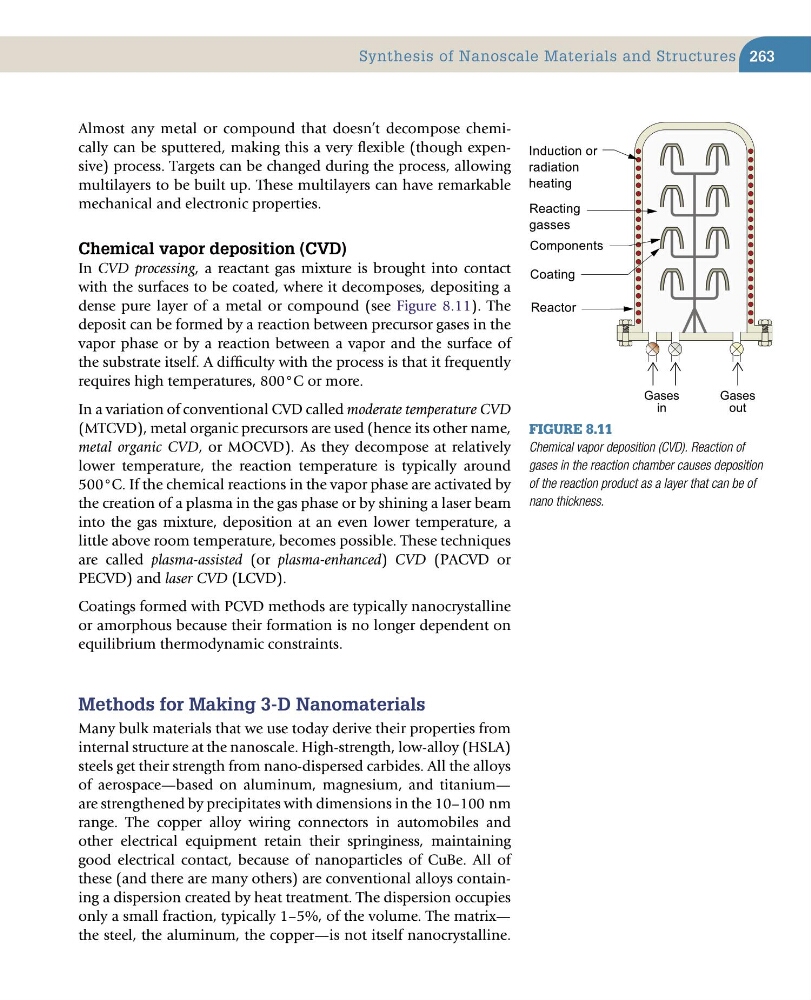
In CVD processing, a reactant gas mixture is brought into contact
with the surfaces to be coated, where it decomposes, depositing a
dense pure layer of a metal or compound (see Figure 8.11). The
deposit can be formed by a reaction between precursor gases in the
vapor phase or by a reaction between a vapor and the surface of
the substrate itself. A difficulty with the process is that it frequently
requires high temperatures, 800°C or more.
In a variation of conventional CVD called moderate temperature CVD
(MTCVD), metal organic precursors are used (hence its other name,
metal organic CVD, or MOCVD). As they decompose at relatively
lower temperature, the reaction temperature is typically around
500°C. If the chemical reactions in the vapor phase are activated by
the creation of a plasma in the gas phase or by shining a laser beam
into the gas mixture, deposition at an even lower temperature, a
little above room temperature, becomes possible. These techniques
are called plasma-assisted (or plasma-enhanced) CVD (PACVD or
PECVD) and laser CVD (LCVD).
Coatings formed with PCVD methods are typically nanocrystalline
or amorphous because their formation is no longer dependent on
equilibrium thermodynamic constraints.
Methods for Making 3-d nanomaterials
Many bulk materials that we use today derive their properties from
internal structure at the nanoscale. High-strength, low-alloy (HSLA)
steels get their strength from nano-dispersed carbides. All the alloys
of aerospace—based on aluminum, magnesium, and titanium—
are strengthened by precipitates with dimensions in the 10–100 nm
range. The copper alloy wiring connectors in automobiles and
other electrical equipment retain their springiness, maintaining
good electrical contact, because of nanoparticles of CuBe. All of
these (and there are many others) are conventional alloys containing a dispersion created by heat treatment. The dispersion occupies
only a small fraction, typically 1–5%, of the volume. The matrix—
the steel, the aluminum, the copper—is not itself nanocrystalline.
Figure 8.11
Chemical vapor deposition (CVD). Reaction of
gases in the reaction chamber causes deposition
of the reaction product as a layer that can be of
nano thickness.
Induction or
radiation
heating
Gases
in
Gases
out
Components
Reactor
Reacting
gasses
Coating
Almost any metal or compound that doesn’t decompose chemically can be sputtered, making this a very flexible (though expensive) process. Targets can be changed during the process, allowing
multilayers to be built up. These multilayers can have remarkable
mechanical and electronic properties.
chemical vapor deposition (cVd)
In CVD processing, a reactant gas mixture is brought into contact
with the surfaces to be coated, where it decomposes, depositing a
dense pure layer of a metal or compound (see Figure 8.11). The
deposit can be formed by a reaction between precursor gases in the
vapor phase or by a reaction between a vapor and the surface of
the substrate itself. A difficulty with the process is that it frequently
requires high temperatures, 800°C or more.
In a variation of conventional CVD called moderate temperature CVD
(MTCVD), metal organic precursors are used (hence its other name,
metal organic CVD, or MOCVD). As they decompose at relatively
lower temperature, the reaction temperature is typically around
500°C. If the chemical reactions in the vapor phase are activated by
the creation of a plasma in the gas phase or by shining a laser beam
into the gas mixture, deposition at an even lower temperature, a
little above room temperature, becomes possible. These techniques
are called plasma-assisted (or plasma-enhanced) CVD (PACVD or
PECVD) and laser CVD (LCVD).
Coatings formed with PCVD methods are typically nanocrystalline
or amorphous because their formation is no longer dependent on
equilibrium thermodynamic constraints.
Methods for Making 3-d nanomaterials
Many bulk materials that we use today derive their properties from
internal structure at the nanoscale. High-strength, low-alloy (HSLA)
steels get their strength from nano-dispersed carbides. All the alloys
of aerospace—based on aluminum, magnesium, and titanium—
are strengthened by precipitates with dimensions in the 10–100 nm
range. The copper alloy wiring connectors in automobiles and
other electrical equipment retain their springiness, maintaining
good electrical contact, because of nanoparticles of CuBe. All of
these (and there are many others) are conventional alloys containing a dispersion created by heat treatment. The dispersion occupies
only a small fraction, typically 1–5%, of the volume. The matrix—
the steel, the aluminum, the copper—is not itself nanocrystalline.
Figure 8.11
Chemical vapor deposition (CVD). Reaction of
gases in the reaction chamber causes deposition
of the reaction product as a layer that can be of
nano thickness.
Induction or
radiation
heating
Gases
in
Gases
out
Components
Reactor
Reacting
gasses
Coating