

217
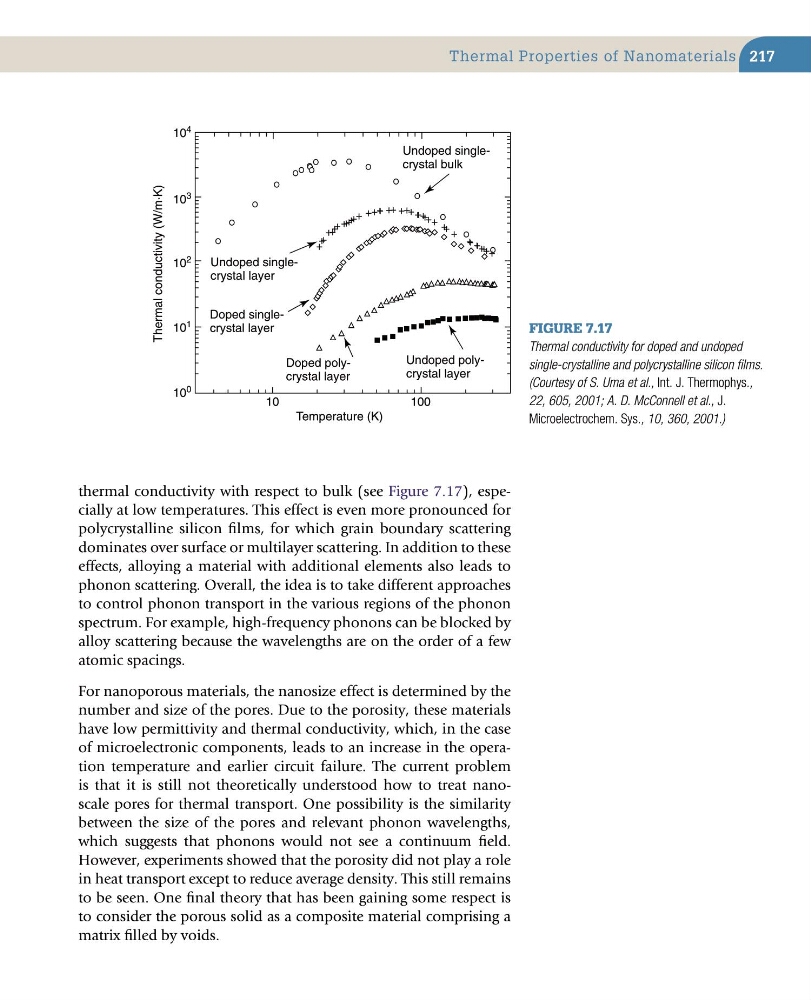
thermal conductivity with respect to bulk (see Figure 7.17), especially at low temperatures. This effect is even more pronounced for
polycrystalline silicon films, for which grain boundary scattering
dominates over surface or multilayer scattering. In addition to these
effects, alloying a material with additional elements also leads to
phonon scattering. Overall, the idea is to take different approaches
to control phonon transport in the various regions of the phonon
spectrum. For example, high-frequency phonons can be blocked by
alloy scattering because the wavelengths are on the order of a few
atomic spacings.
For nanoporous materials, the nanosize effect is determined by the
number and size of the pores. Due to the porosity, these materials
have low permittivity and thermal conductivity, which, in the case
of microelectronic components, leads to an increase in the operation temperature and earlier circuit failure. The current problem
is that it is still not theoretically understood how to treat nanoscale pores for thermal transport. One possibility is the similarity
between the size of the pores and relevant phonon wavelengths,
which suggests that phonons would not see a continuum field.
However, experiments showed that the porosity did not play a role
in heat transport except to reduce average density. This still remains
to be seen. One final theory that has been gaining some respect is
to consider the porous solid as a composite material comprising a
matrix filled by voids.
Figure 7.17
Thermal conductivity for doped and undoped
single-crystalline and polycrystalline silicon films.
(Courtesy of S. Uma et al., Int. J. Thermophys.,
22, 605, 2001; A. D. McConnell et al., J.
Microelectrochem. Sys., 10, 360, 2001.)
10
10
0
10
1
10
2
10
3
10
4
100
Temperature (K)
Doped polycrystal layer
Doped singlecrystal layer
Undoped singlecrystal layer
Undoped singlecrystal bulk
Undoped polycrystal layer
Thermal conductivity (W/m·K)
Thermal Properties of Nanomaterials
thermal conductivity with respect to bulk (see Figure 7.17), especially at low temperatures. This effect is even more pronounced for
polycrystalline silicon films, for which grain boundary scattering
dominates over surface or multilayer scattering. In addition to these
effects, alloying a material with additional elements also leads to
phonon scattering. Overall, the idea is to take different approaches
to control phonon transport in the various regions of the phonon
spectrum. For example, high-frequency phonons can be blocked by
alloy scattering because the wavelengths are on the order of a few
atomic spacings.
For nanoporous materials, the nanosize effect is determined by the
number and size of the pores. Due to the porosity, these materials
have low permittivity and thermal conductivity, which, in the case
of microelectronic components, leads to an increase in the operation temperature and earlier circuit failure. The current problem
is that it is still not theoretically understood how to treat nanoscale pores for thermal transport. One possibility is the similarity
between the size of the pores and relevant phonon wavelengths,
which suggests that phonons would not see a continuum field.
However, experiments showed that the porosity did not play a role
in heat transport except to reduce average density. This still remains
to be seen. One final theory that has been gaining some respect is
to consider the porous solid as a composite material comprising a
matrix filled by voids.
Figure 7.17
Thermal conductivity for doped and undoped
single-crystalline and polycrystalline silicon films.
(Courtesy of S. Uma et al., Int. J. Thermophys.,
22, 605, 2001; A. D. McConnell et al., J.
Microelectrochem. Sys., 10, 360, 2001.)
10
10
0
10
1
10
2
10
3
10
4
100
Temperature (K)
Doped polycrystal layer
Doped singlecrystal layer
Undoped singlecrystal layer
Undoped singlecrystal bulk
Undoped polycrystal layer
Thermal conductivity (W/m·K)
Thermal Properties of Nanomaterials