

chaPter 7 nanomaterials: Properties
216
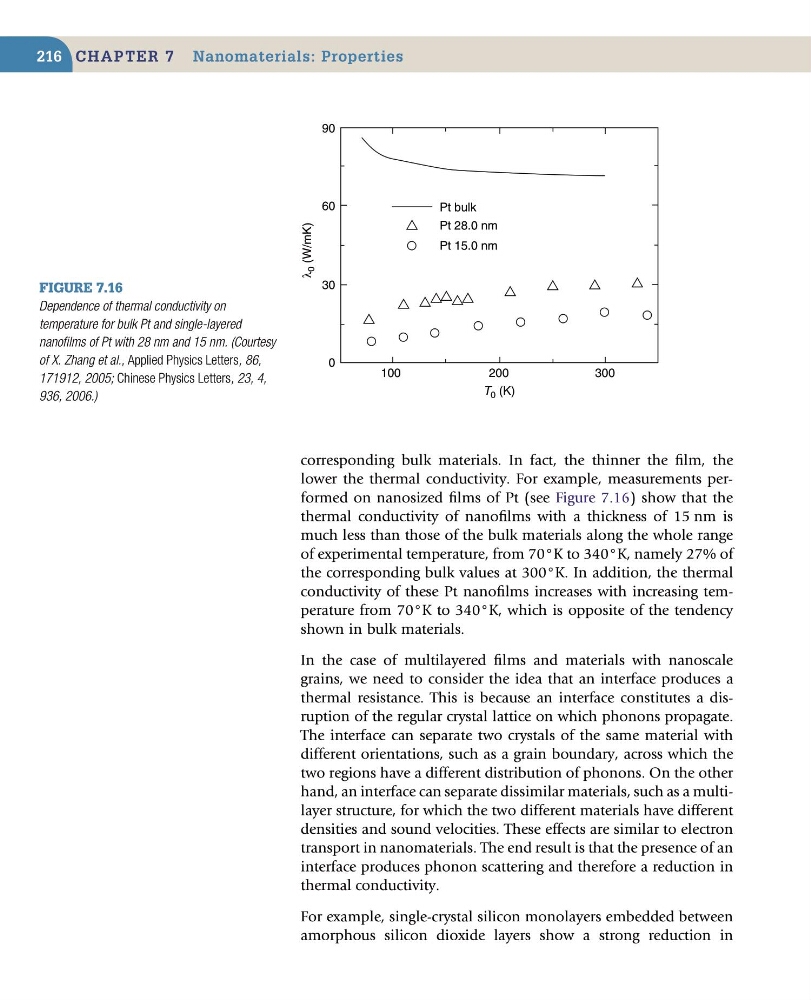
corresponding bulk materials. In fact, the thinner the film, the
lower the thermal conductivity. For example, measurements performed on nanosized films of Pt (see Figure 7.16) show that the
thermal conductivity of nanofilms with a thickness of 15 nm is
much less than those of the bulk materials along the whole range
of experimental temperature, from 70°K to 340°K, namely 27% of
the corresponding bulk values at 300°K. In addition, the thermal
conductivity of these Pt nanofilms increases with increasing temperature from 70°K to 340°K, which is opposite of the tendency
shown in bulk materials.
In the case of multilayered films and materials with nanoscale
grains, we need to consider the idea that an interface produces a
thermal resistance. This is because an interface constitutes a disruption of the regular crystal lattice on which phonons propagate.
The interface can separate two crystals of the same material with
different orientations, such as a grain boundary, across which the
two regions have a different distribution of phonons. On the other
hand, an interface can separate dissimilar materials, such as a multilayer structure, for which the two different materials have different
densities and sound velocities. These effects are similar to electron
transport in nanomaterials. The end result is that the presence of an
interface produces phonon scattering and therefore a reduction in
thermal conductivity.
For example, single-crystal silicon monolayers embedded between
amorphous silicon dioxide layers show a strong reduction in
100
0
30
60
90
Pt bulk
Pt 28.0 nm
Pt 15.0 nm
200
300
T 0 (K)
λ
0 (W/mK)
Figure 7.16
Dependence of thermal conductivity on
temperature for bulk Pt and single-layered
nanofilms of Pt with 28 nm and 15 nm. (Courtesy
of X. Zhang et al., Applied Physics Letters, 86,
171912, 2005; Chinese Physics Letters, 23, 4,
936, 2006.)
216
corresponding bulk materials. In fact, the thinner the film, the
lower the thermal conductivity. For example, measurements performed on nanosized films of Pt (see Figure 7.16) show that the
thermal conductivity of nanofilms with a thickness of 15 nm is
much less than those of the bulk materials along the whole range
of experimental temperature, from 70°K to 340°K, namely 27% of
the corresponding bulk values at 300°K. In addition, the thermal
conductivity of these Pt nanofilms increases with increasing temperature from 70°K to 340°K, which is opposite of the tendency
shown in bulk materials.
In the case of multilayered films and materials with nanoscale
grains, we need to consider the idea that an interface produces a
thermal resistance. This is because an interface constitutes a disruption of the regular crystal lattice on which phonons propagate.
The interface can separate two crystals of the same material with
different orientations, such as a grain boundary, across which the
two regions have a different distribution of phonons. On the other
hand, an interface can separate dissimilar materials, such as a multilayer structure, for which the two different materials have different
densities and sound velocities. These effects are similar to electron
transport in nanomaterials. The end result is that the presence of an
interface produces phonon scattering and therefore a reduction in
thermal conductivity.
For example, single-crystal silicon monolayers embedded between
amorphous silicon dioxide layers show a strong reduction in
100
0
30
60
90
Pt bulk
Pt 28.0 nm
Pt 15.0 nm
200
300
T 0 (K)
λ
0 (W/mK)
Figure 7.16
Dependence of thermal conductivity on
temperature for bulk Pt and single-layered
nanofilms of Pt with 28 nm and 15 nm. (Courtesy
of X. Zhang et al., Applied Physics Letters, 86,
171912, 2005; Chinese Physics Letters, 23, 4,
936, 2006.)