

chaPter 7 nanomaterials: Properties
214
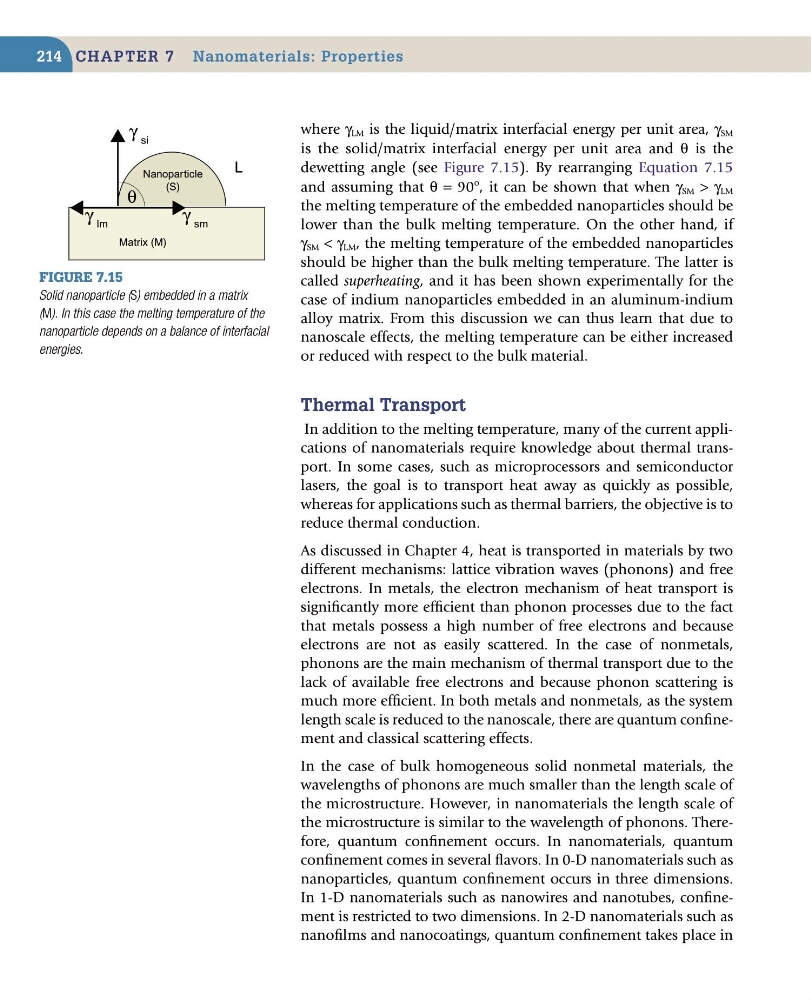
where γ LM is the liquid/matrix interfacial energy per unit area, γ SM
is the solid/matrix interfacial energy per unit area and θ is the
dewetting angle (see Figure 7.15). By rearranging Equation 7.15
and assuming that θ = 90
o
, it can be shown that when γ SM > γ LM
the melting temperature of the embedded nanoparticles should be
lower than the bulk melting temperature. On the other hand, if
γ SM < γ LM , the melting temperature of the embedded nanoparticles
should be higher than the bulk melting temperature. The latter is
called superheating, and it has been shown experimentally for the
case of indium nanoparticles embedded in an aluminum-indium
alloy matrix. From this discussion we can thus learn that due to
nanoscale effects, the melting temperature can be either increased
or reduced with respect to the bulk material.
thermal transport
In addition to the melting temperature, many of the current applications of nanomaterials require knowledge about thermal transport. In some cases, such as microprocessors and semiconductor
lasers, the goal is to transport heat away as quickly as possible,
whereas for applications such as thermal barriers, the objective is to
reduce thermal conduction.
As discussed in Chapter 4, heat is transported in materials by two
different mechanisms: lattice vibration waves (phonons) and free
electrons. In metals, the electron mechanism of heat transport is
significantly more efficient than phonon processes due to the fact
that metals possess a high number of free electrons and because
electrons are not as easily scattered. In the case of nonmetals,
phonons are the main mechanism of thermal transport due to the
lack of available free electrons and because phonon scattering is
much more efficient. In both metals and nonmetals, as the system
length scale is reduced to the nanoscale, there are quantum confinement and classical scattering effects.
In the case of bulk homogeneous solid nonmetal materials, the
wavelengths of phonons are much smaller than the length scale of
the microstructure. However, in nanomaterials the length scale of
the microstructure is similar to the wavelength of phonons. Therefore, quantum confinement occurs. In nanomaterials, quantum
confinement comes in several flavors. In 0-D nanomaterials such as
nanoparticles, quantum confinement occurs in three dimensions.
In 1-D nanomaterials such as nanowires and nanotubes, confinement is restricted to two dimensions. In 2-D nanomaterials such as
nanofilms and nanocoatings, quantum confinement takes place in
Figure 7.15
Solid nanoparticle (S) embedded in a matrix
(M). In this case the melting temperature of the
nanoparticle depends on a balance of interfacial
energies.
g lm
g sm
g si
Matrix (M)
Nanoparticle
(S)
L
q
214
where γ LM is the liquid/matrix interfacial energy per unit area, γ SM
is the solid/matrix interfacial energy per unit area and θ is the
dewetting angle (see Figure 7.15). By rearranging Equation 7.15
and assuming that θ = 90
o
, it can be shown that when γ SM > γ LM
the melting temperature of the embedded nanoparticles should be
lower than the bulk melting temperature. On the other hand, if
γ SM < γ LM , the melting temperature of the embedded nanoparticles
should be higher than the bulk melting temperature. The latter is
called superheating, and it has been shown experimentally for the
case of indium nanoparticles embedded in an aluminum-indium
alloy matrix. From this discussion we can thus learn that due to
nanoscale effects, the melting temperature can be either increased
or reduced with respect to the bulk material.
thermal transport
In addition to the melting temperature, many of the current applications of nanomaterials require knowledge about thermal transport. In some cases, such as microprocessors and semiconductor
lasers, the goal is to transport heat away as quickly as possible,
whereas for applications such as thermal barriers, the objective is to
reduce thermal conduction.
As discussed in Chapter 4, heat is transported in materials by two
different mechanisms: lattice vibration waves (phonons) and free
electrons. In metals, the electron mechanism of heat transport is
significantly more efficient than phonon processes due to the fact
that metals possess a high number of free electrons and because
electrons are not as easily scattered. In the case of nonmetals,
phonons are the main mechanism of thermal transport due to the
lack of available free electrons and because phonon scattering is
much more efficient. In both metals and nonmetals, as the system
length scale is reduced to the nanoscale, there are quantum confinement and classical scattering effects.
In the case of bulk homogeneous solid nonmetal materials, the
wavelengths of phonons are much smaller than the length scale of
the microstructure. However, in nanomaterials the length scale of
the microstructure is similar to the wavelength of phonons. Therefore, quantum confinement occurs. In nanomaterials, quantum
confinement comes in several flavors. In 0-D nanomaterials such as
nanoparticles, quantum confinement occurs in three dimensions.
In 1-D nanomaterials such as nanowires and nanotubes, confinement is restricted to two dimensions. In 2-D nanomaterials such as
nanofilms and nanocoatings, quantum confinement takes place in
Figure 7.15
Solid nanoparticle (S) embedded in a matrix
(M). In this case the melting temperature of the
nanoparticle depends on a balance of interfacial
energies.
g lm
g sm
g si
Matrix (M)
Nanoparticle
(S)
L
q