

213
T
T
L r
M
upper
SL
=
−
0
0
1
2γ
(7.14)
in which the term 2γ SL /r is associated with the increase in internal
pressure resulting from an increase in the curvature of the particle
with decreasing particle size. Because in Equation 7.14, the variables γ SL , L 0 , and r are all positive quantities, this means that the
upper melting temperature of a spherical nanoparticle decreases
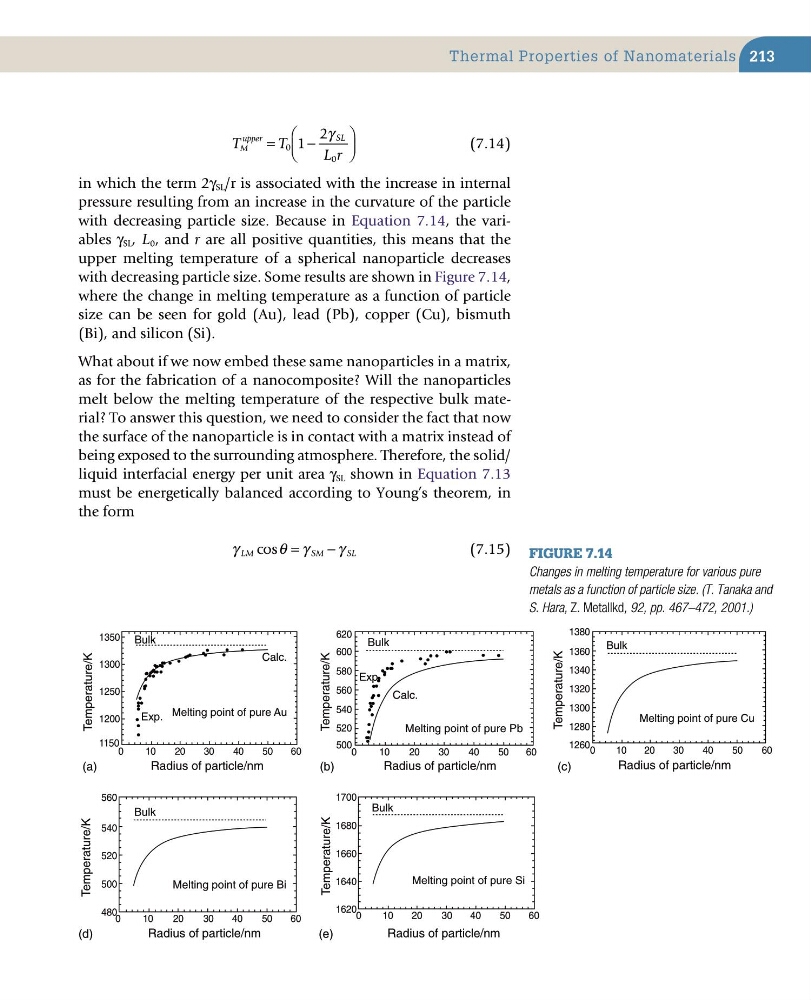
with decreasing particle size. Some results are shown in Figure 7.14,
where the change in melting temperature as a function of particle
size can be seen for gold (Au), lead (Pb), copper (Cu), bismuth
(Bi), and silicon (Si).
What about if we now embed these same nanoparticles in a matrix,
as for the fabrication of a nanocomposite? Will the nanoparticles
melt below the melting temperature of the respective bulk material? To answer this question, we need to consider the fact that now
the surface of the nanoparticle is in contact with a matrix instead of
being exposed to the surrounding atmosphere. Therefore, the solid/
liquid interfacial energy per unit area γ SL shown in Equation 7.13
must be energetically balanced according to Young’s theorem, in
the form
γ
θ γ
γ
LM
SM
SL
cos =
−
(7.15) Figure 7.14
Changes in melting temperature for various pure
metals as a function of particle size. (T. Tanaka and
S. Hara, Z. Metallkd, 92, pp. 467–472, 2001.)
Radius of particle/nm
0
Bulk
Calc.
Melting point of pure Au
Exp.
1150
1200
1300
1350
1250
10
20
30
40
50
60
(a)
Temperature/K
Radius of particle/nm
0
Bulk
Melting point of pure Bi
480
500
520
540
560
10
20
30
40
50
60
(d)
Temperature/K
Radius of particle/nm
0
Bulk
Calc.
Melting point of pure Pb
Exp.
500
520
580
600
620
540
560
10
20
30
40
50
60
(b)
Temperature/K
Radius of particle/nm
0
Bulk
Melting point of pure Cu
1260
1280
1300
1320
1340
1360
1380
10
20
30
40
50
60
(c)
Temperature/K
Radius of particle/nm
0
Bulk
Melting point of pure Si
1620
1640
1660
1680
1700
10
20
30
40
50
60
(e)
Temperature/K
Thermal Properties of Nanomaterials
T
T
L r
M
upper
SL
=
−
0
0
1
2γ
(7.14)
in which the term 2γ SL /r is associated with the increase in internal
pressure resulting from an increase in the curvature of the particle
with decreasing particle size. Because in Equation 7.14, the variables γ SL , L 0 , and r are all positive quantities, this means that the
upper melting temperature of a spherical nanoparticle decreases
with decreasing particle size. Some results are shown in Figure 7.14,
where the change in melting temperature as a function of particle
size can be seen for gold (Au), lead (Pb), copper (Cu), bismuth
(Bi), and silicon (Si).
What about if we now embed these same nanoparticles in a matrix,
as for the fabrication of a nanocomposite? Will the nanoparticles
melt below the melting temperature of the respective bulk material? To answer this question, we need to consider the fact that now
the surface of the nanoparticle is in contact with a matrix instead of
being exposed to the surrounding atmosphere. Therefore, the solid/
liquid interfacial energy per unit area γ SL shown in Equation 7.13
must be energetically balanced according to Young’s theorem, in
the form
γ
θ γ
γ
LM
SM
SL
cos =
−
(7.15) Figure 7.14
Changes in melting temperature for various pure
metals as a function of particle size. (T. Tanaka and
S. Hara, Z. Metallkd, 92, pp. 467–472, 2001.)
Radius of particle/nm
0
Bulk
Calc.
Melting point of pure Au
Exp.
1150
1200
1300
1350
1250
10
20
30
40
50
60
(a)
Temperature/K
Radius of particle/nm
0
Bulk
Melting point of pure Bi
480
500
520
540
560
10
20
30
40
50
60
(d)
Temperature/K
Radius of particle/nm
0
Bulk
Calc.
Melting point of pure Pb
Exp.
500
520
580
600
620
540
560
10
20
30
40
50
60
(b)
Temperature/K
Radius of particle/nm
0
Bulk
Melting point of pure Cu
1260
1280
1300
1320
1340
1360
1380
10
20
30
40
50
60
(c)
Temperature/K
Radius of particle/nm
0
Bulk
Melting point of pure Si
1620
1640
1660
1680
1700
10
20
30
40
50
60
(e)
Temperature/K
Thermal Properties of Nanomaterials