

chaPter 7 nanomaterials: Properties
200
material. One might expect that its properties, too, would represent
limits. As we shall see, this is, broadly speaking, true.
scale Dependence of Material Properties
The bulk properties of materials (density, modulus, yield strength,
thermal and electrical conductivity) are intrinsic; a small piece of
the material has the same values for these properties as a large
one. It is a basic assumption of continuum mechanics that materials behave in this way, that is, that their mechanical properties
are scale independent. It has been a useful and for the most part
adequately accurate assumption, greatly simplifying the analysis of
structures. The micromechanical description of materials (the use
of classical mechanics to model the way the internal structure of
a material influences its properties) has followed the same path,
assuming that the properties of the individual grains or crystals that
make up the material could be averaged to get the overall properties
without taking account of their scale. The classical property bounds
(upper and lower estimates) of solid mechanics rest entirely on this
assumption.
This description served well throughout the 19
th century and the
first part of the 20
th
. But as material scientists created higher strength
steels and aluminum alloys, it became apparent that the continuum
approximation does not always work. The exceptions have given us
some of the strongest and most useful materials we now possess. It
is at the extremes of scale that the properties become most remarkable, and that means the submicron or, more effective yet, the nano.
Such is the hype that has attached itself to the prefix nano that it is
easy to forget that almost all the high-strength steels, aluminum,
magnesium, and titanium alloys on which we now depend for
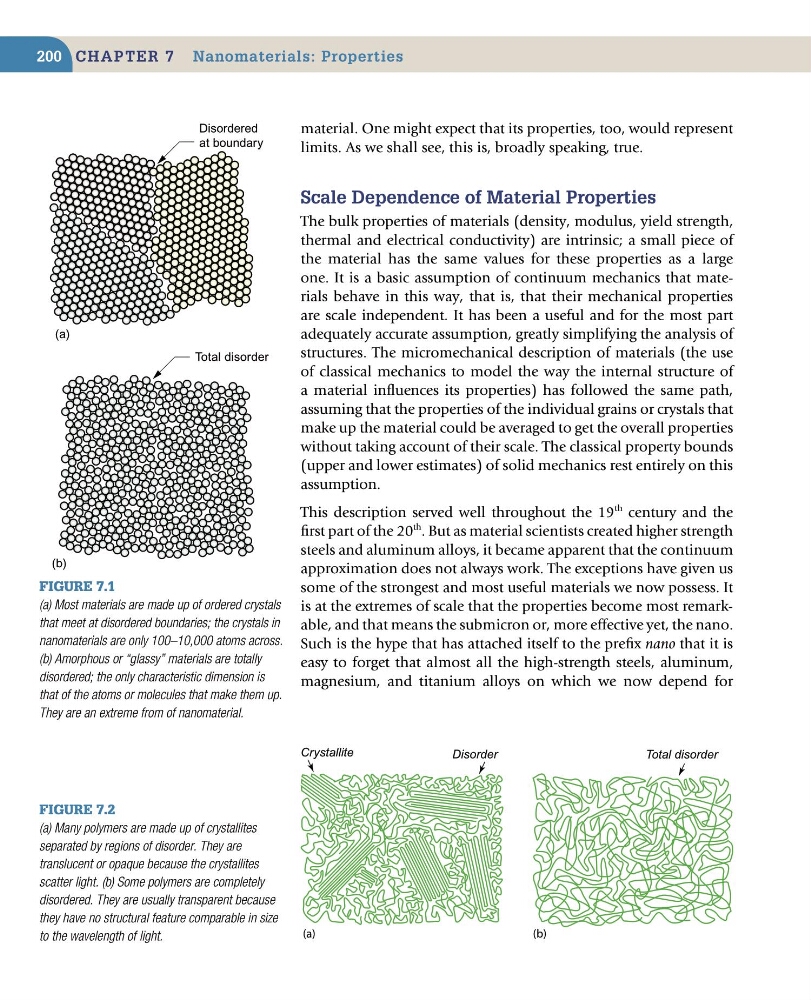
Figure 7.1
(a) Most materials are made up of ordered crystals
that meet at disordered boundaries; the crystals in
nanomaterials are only 100–10,000 atoms across.
(b) Amorphous or “glassy” materials are totally
disordered; the only characteristic dimension is
that of the atoms or molecules that make them up.
They are an extreme from of nanomaterial.
Total disorder
Disordered
at boundary
(a)
(b)
Figure 7.2
(a) Many polymers are made up of crystallites
separated by regions of disorder. They are
translucent or opaque because the crystallites
scatter light. (b) Some polymers are completely
disordered. They are usually transparent because
they have no structural feature comparable in size
to the wavelength of light.
Disorder
Crystallite
Total disorder
(a)
(b)
200
material. One might expect that its properties, too, would represent
limits. As we shall see, this is, broadly speaking, true.
scale Dependence of Material Properties
The bulk properties of materials (density, modulus, yield strength,
thermal and electrical conductivity) are intrinsic; a small piece of
the material has the same values for these properties as a large
one. It is a basic assumption of continuum mechanics that materials behave in this way, that is, that their mechanical properties
are scale independent. It has been a useful and for the most part
adequately accurate assumption, greatly simplifying the analysis of
structures. The micromechanical description of materials (the use
of classical mechanics to model the way the internal structure of
a material influences its properties) has followed the same path,
assuming that the properties of the individual grains or crystals that
make up the material could be averaged to get the overall properties
without taking account of their scale. The classical property bounds
(upper and lower estimates) of solid mechanics rest entirely on this
assumption.
This description served well throughout the 19
th century and the
first part of the 20
th
. But as material scientists created higher strength
steels and aluminum alloys, it became apparent that the continuum
approximation does not always work. The exceptions have given us
some of the strongest and most useful materials we now possess. It
is at the extremes of scale that the properties become most remarkable, and that means the submicron or, more effective yet, the nano.
Such is the hype that has attached itself to the prefix nano that it is
easy to forget that almost all the high-strength steels, aluminum,
magnesium, and titanium alloys on which we now depend for
Figure 7.1
(a) Most materials are made up of ordered crystals
that meet at disordered boundaries; the crystals in
nanomaterials are only 100–10,000 atoms across.
(b) Amorphous or “glassy” materials are totally
disordered; the only characteristic dimension is
that of the atoms or molecules that make them up.
They are an extreme from of nanomaterial.
Total disorder
Disordered
at boundary
(a)
(b)
Figure 7.2
(a) Many polymers are made up of crystallites
separated by regions of disorder. They are
translucent or opaque because the crystallites
scatter light. (b) Some polymers are completely
disordered. They are usually transparent because
they have no structural feature comparable in size
to the wavelength of light.
Disorder
Crystallite
Total disorder
(a)
(b)