

C hapter 6 nanomaterials: Classes and fundamentals
186
Thus, the surface-to-volume ratio of a sphere is given by
A
V
r
r
r
=
=
4
4
3
3
2
3
π
π
(6.3)
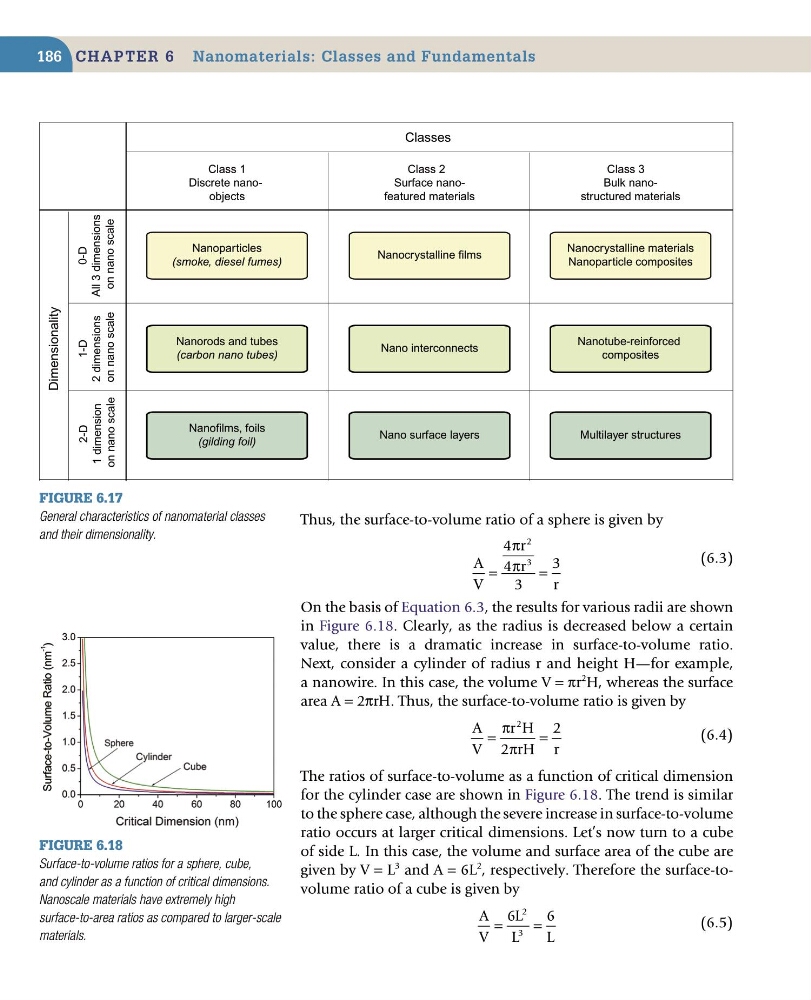
On the basis of Equation 6.3, the results for various radii are shown
in Figure 6.18. Clearly, as the radius is decreased below a certain
value, there is a dramatic increase in surface-to-volume ratio.
Next, consider a cylinder of radius r and height H—for example,
a nanowire. In this case, the volume V = πr
2 H, whereas the surface
area A = 2πrH. Thus, the surface-to-volume ratio is given by
A
V
r H
rH r
=
=
π
π
2
2
2
(6.4)
The ratios of surface-to-volume as a function of critical dimension
for the cylinder case are shown in Figure 6.18. The trend is similar
to the sphere case, although the severe increase in surface-to-volume
ratio occurs at larger critical dimensions. Let’s now turn to a cube
of side L. In this case, the volume and surface area of the cube are
given by V = L
3 and A = 6L
2 , respectively. Therefore the surface-tovolume ratio of a cube is given by
A
V
L
L
L
=
=
6
6
2
3
(6.5)
Figure 6.17
General characteristics of nanomaterial classes
and their dimensionality.
Classes
Dimensionality
Class 1
Discrete nanoobjects
Class 2
Surface nanofeatured materials
Class 3
Bulk nanostructured materials
Nanoparticles
(smoke, diesel fumes)
Nanocrystalline films
Nanocrystalline materials
Nanoparticle composites
Nanorods and tubes
(carbon nano tubes)
Nano interconnects
Nanotube-reinforced
composites
Nano surface layers
Multilayer structures
0-D
All 3 dimensions
on nano scale
1-D
2 dimensions
on nano scale
2-D
1 dimension
on nano scale
Nanofilms, foils
(gilding foil)
Figure 6.18
Surface-to-volume ratios for a sphere, cube,
and cylinder as a function of critical dimensions.
Nanoscale materials have extremely high
surface-to-area ratios as compared to larger-scale
materials.
186
Thus, the surface-to-volume ratio of a sphere is given by
A
V
r
r
r
=
=
4
4
3
3
2
3
π
π
(6.3)
On the basis of Equation 6.3, the results for various radii are shown
in Figure 6.18. Clearly, as the radius is decreased below a certain
value, there is a dramatic increase in surface-to-volume ratio.
Next, consider a cylinder of radius r and height H—for example,
a nanowire. In this case, the volume V = πr
2 H, whereas the surface
area A = 2πrH. Thus, the surface-to-volume ratio is given by
A
V
r H
rH r
=
=
π
π
2
2
2
(6.4)
The ratios of surface-to-volume as a function of critical dimension
for the cylinder case are shown in Figure 6.18. The trend is similar
to the sphere case, although the severe increase in surface-to-volume
ratio occurs at larger critical dimensions. Let’s now turn to a cube
of side L. In this case, the volume and surface area of the cube are
given by V = L
3 and A = 6L
2 , respectively. Therefore the surface-tovolume ratio of a cube is given by
A
V
L
L
L
=
=
6
6
2
3
(6.5)
Figure 6.17
General characteristics of nanomaterial classes
and their dimensionality.
Classes
Dimensionality
Class 1
Discrete nanoobjects
Class 2
Surface nanofeatured materials
Class 3
Bulk nanostructured materials
Nanoparticles
(smoke, diesel fumes)
Nanocrystalline films
Nanocrystalline materials
Nanoparticle composites
Nanorods and tubes
(carbon nano tubes)
Nano interconnects
Nanotube-reinforced
composites
Nano surface layers
Multilayer structures
0-D
All 3 dimensions
on nano scale
1-D
2 dimensions
on nano scale
2-D
1 dimension
on nano scale
Nanofilms, foils
(gilding foil)
Figure 6.18
Surface-to-volume ratios for a sphere, cube,
and cylinder as a function of critical dimensions.
Nanoscale materials have extremely high
surface-to-area ratios as compared to larger-scale
materials.