

C hapter 6 nanomaterials: Classes and fundamentals
184
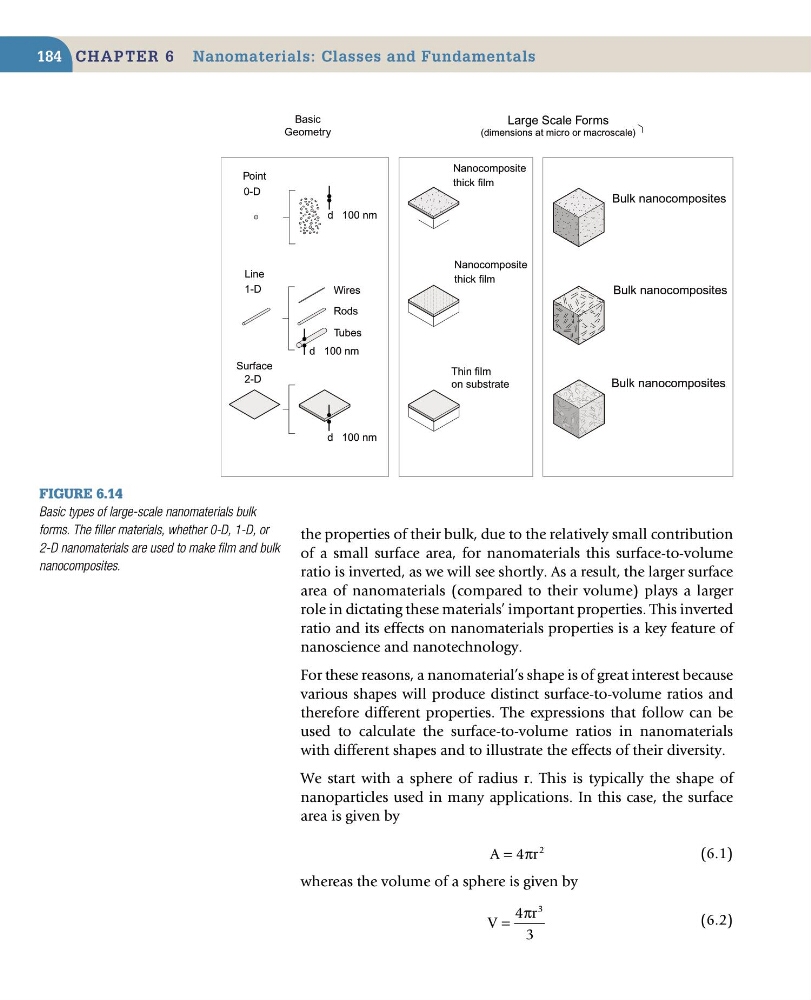
Figure 6.14
Basic types of large-scale nanomaterials bulk
forms. The filler materials, whether 0-D, 1-D, or
2-D nanomaterials are used to make film and bulk
nanocomposites.
d 100 nm
d 100 nm
d 100 nm
Wires
Rods
Tubes
Basic
Geometry
Large Scale Forms
(dimensions at micro or macroscale)
Point
Line
Surface
Thin film
on substrate
0-D
1-D
2-D
Nanocomposite
thick film
Nanocomposite
thick film
Bulk nanocomposites
Bulk nanocomposites
Bulk nanocomposites
the properties of their bulk, due to the relatively small contribution
of a small surface area, for nanomaterials this surface-to-volume
ratio is inverted, as we will see shortly. As a result, the larger surface
area of nanomaterials (compared to their volume) plays a larger
role in dictating these materials’ important properties. This inverted
ratio and its effects on nanomaterials properties is a key feature of
nanoscience and nanotechnology.
For these reasons, a nanomaterial’s shape is of great interest because
various shapes will produce distinct surface-to-volume ratios and
therefore different properties. The expressions that follow can be
used to calculate the surface-to-volume ratios in nanomaterials
with different shapes and to illustrate the effects of their diversity.
We start with a sphere of radius r. This is typically the shape of
nanoparticles used in many applications. In this case, the surface
area is given by
A
r
= 4
2
π
(6.1)
whereas the volume of a sphere is given by
V
r
=
4
3
3
π
(6.2)
184
Figure 6.14
Basic types of large-scale nanomaterials bulk
forms. The filler materials, whether 0-D, 1-D, or
2-D nanomaterials are used to make film and bulk
nanocomposites.
d 100 nm
d 100 nm
d 100 nm
Wires
Rods
Tubes
Basic
Geometry
Large Scale Forms
(dimensions at micro or macroscale)
Point
Line
Surface
Thin film
on substrate
0-D
1-D
2-D
Nanocomposite
thick film
Nanocomposite
thick film
Bulk nanocomposites
Bulk nanocomposites
Bulk nanocomposites
the properties of their bulk, due to the relatively small contribution
of a small surface area, for nanomaterials this surface-to-volume
ratio is inverted, as we will see shortly. As a result, the larger surface
area of nanomaterials (compared to their volume) plays a larger
role in dictating these materials’ important properties. This inverted
ratio and its effects on nanomaterials properties is a key feature of
nanoscience and nanotechnology.
For these reasons, a nanomaterial’s shape is of great interest because
various shapes will produce distinct surface-to-volume ratios and
therefore different properties. The expressions that follow can be
used to calculate the surface-to-volume ratios in nanomaterials
with different shapes and to illustrate the effects of their diversity.
We start with a sphere of radius r. This is typically the shape of
nanoparticles used in many applications. In this case, the surface
area is given by
A
r
= 4
2
π
(6.1)
whereas the volume of a sphere is given by
V
r
=
4
3
3
π
(6.2)