

C hapter 1 Nanomaterials and Nanotechnologies: an overview
10
the particles so small? Because below a critical dimension, typically
at the nanoscale, ferromagnetic crystals become single domain (see
section 7.4) which helps increase the effectiveness of the bacteria
as a compass.
Following a similar approach, magnetic nanoparticles are now
being employed to detect particular biological species, such as
microorganisms that cause disease. Magnetic nanoparticles are
coupled with antibodies that bind to their target. In this case the
magnetization vector of all nanoparticles becomes parallel, which
results in a strong magnetic signal. On the other hand, if the illness
is not present, the antibodies do not recognize the target and do
not bind. Thus, all magnetization vectors will remain randomly
oriented, leading to a weak magnetic signal. Another interesting
application in nanomedicine is related to the use of gold particles for bio-identification. One set of gold particles carries DNA
that binds to one half of the target sequence. A second set carries
DNA that binds to the other half. The DNA with the complete
target sequence will couple to both sets of particles, binding them
together. As gold nanoparticles aggregate, there is a shift in the
wavelength of light from red to blue. Thus, the red and blue lights
can be used to probe whether a certain DNA corresponds to a particular individual.
These examples are only a small fraction of what will become possible in the future. Though still in their infancy, nanoscience and
nanotechnology have already demonstrated that they will have
a tremendous impact on various aspects of human life, such as
health, environment, energy, transportation, information technology, and space exploration. This fact has been recognized by most
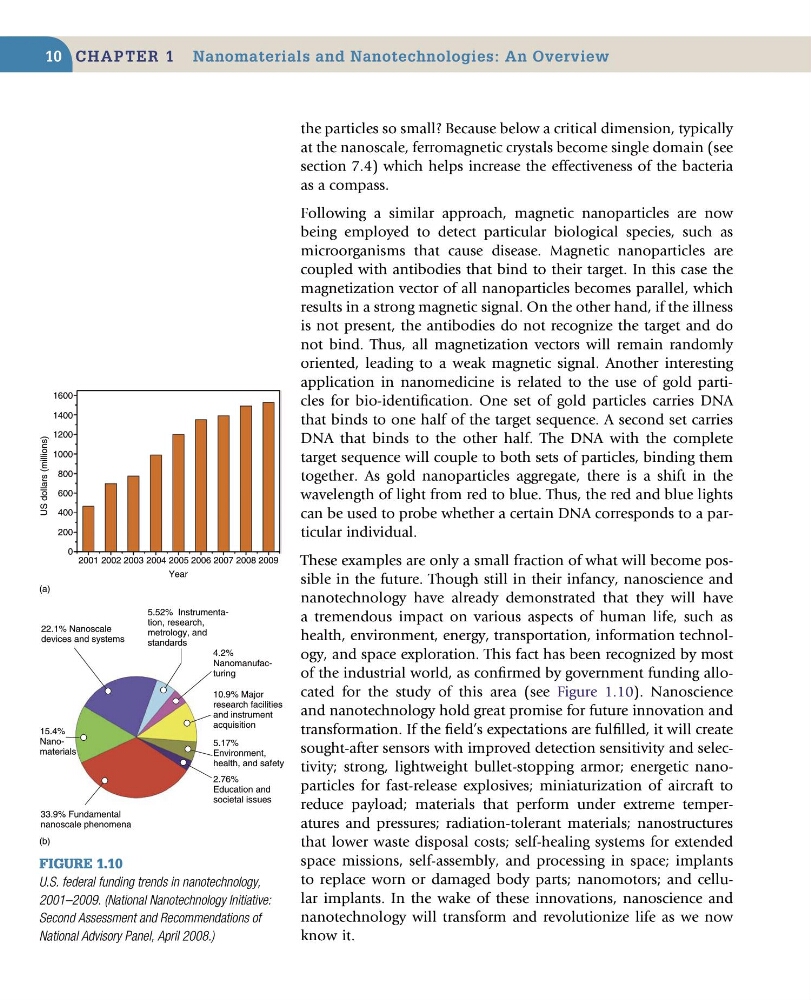
of the industrial world, as confirmed by government funding allocated for the study of this area (see Figure 1.10). Nanoscience
and nanotechnology hold great promise for future innovation and
transformation. If the field’s expectations are fulfilled, it will create
sought-after sensors with improved detection sensitivity and selectivity; strong, lightweight bullet-stopping armor; energetic nanoparticles for fast-release explosives; miniaturization of aircraft to
reduce payload; materials that perform under extreme temperatures and pressures; radiation-tolerant materials; nanostructures
that lower waste disposal costs; self-healing systems for extended
space missions, self-assembly, and processing in space; implants
to replace worn or damaged body parts; nanomotors; and cellular implants. In the wake of these innovations, nanoscience and
nanotechnology will transform and revolutionize life as we now
know it.
Figure 1.10
U.S. federal funding trends in nanotechnology,
2001–2009. (National Nanotechnology Initiative:
Second Assessment and Recommendations of
National Advisory Panel, April 2008.)
33.9% Fundamental
nanoscale phenomena
15.4%
Nanomaterials
22.1% Nanoscale
devices and systems
5.52% Instrumentation, research,
metrology, and
standards
4.2%
Nanomanufacturing
10.9% Major
research facilities
and instrument
acquisition
5.17%
Environment,
health, and safety
2.76%
Education and
societal issues
(a)
(b)
1600
1400
US dollars (millions)
1200
1000
800
600
400
200
0
2001 2002 2003 2004 2005
Year
2006 2007 2008 2009
10
the particles so small? Because below a critical dimension, typically
at the nanoscale, ferromagnetic crystals become single domain (see
section 7.4) which helps increase the effectiveness of the bacteria
as a compass.
Following a similar approach, magnetic nanoparticles are now
being employed to detect particular biological species, such as
microorganisms that cause disease. Magnetic nanoparticles are
coupled with antibodies that bind to their target. In this case the
magnetization vector of all nanoparticles becomes parallel, which
results in a strong magnetic signal. On the other hand, if the illness
is not present, the antibodies do not recognize the target and do
not bind. Thus, all magnetization vectors will remain randomly
oriented, leading to a weak magnetic signal. Another interesting
application in nanomedicine is related to the use of gold particles for bio-identification. One set of gold particles carries DNA
that binds to one half of the target sequence. A second set carries
DNA that binds to the other half. The DNA with the complete
target sequence will couple to both sets of particles, binding them
together. As gold nanoparticles aggregate, there is a shift in the
wavelength of light from red to blue. Thus, the red and blue lights
can be used to probe whether a certain DNA corresponds to a particular individual.
These examples are only a small fraction of what will become possible in the future. Though still in their infancy, nanoscience and
nanotechnology have already demonstrated that they will have
a tremendous impact on various aspects of human life, such as
health, environment, energy, transportation, information technology, and space exploration. This fact has been recognized by most
of the industrial world, as confirmed by government funding allocated for the study of this area (see Figure 1.10). Nanoscience
and nanotechnology hold great promise for future innovation and
transformation. If the field’s expectations are fulfilled, it will create
sought-after sensors with improved detection sensitivity and selectivity; strong, lightweight bullet-stopping armor; energetic nanoparticles for fast-release explosives; miniaturization of aircraft to
reduce payload; materials that perform under extreme temperatures and pressures; radiation-tolerant materials; nanostructures
that lower waste disposal costs; self-healing systems for extended
space missions, self-assembly, and processing in space; implants
to replace worn or damaged body parts; nanomotors; and cellular implants. In the wake of these innovations, nanoscience and
nanotechnology will transform and revolutionize life as we now
know it.
Figure 1.10
U.S. federal funding trends in nanotechnology,
2001–2009. (National Nanotechnology Initiative:
Second Assessment and Recommendations of
National Advisory Panel, April 2008.)
33.9% Fundamental
nanoscale phenomena
15.4%
Nanomaterials
22.1% Nanoscale
devices and systems
5.52% Instrumentation, research,
metrology, and
standards
4.2%
Nanomanufacturing
10.9% Major
research facilities
and instrument
acquisition
5.17%
Environment,
health, and safety
2.76%
Education and
societal issues
(a)
(b)
1600
1400
US dollars (millions)
1200
1000
800
600
400
200
0
2001 2002 2003 2004 2005
Year
2006 2007 2008 2009