

9
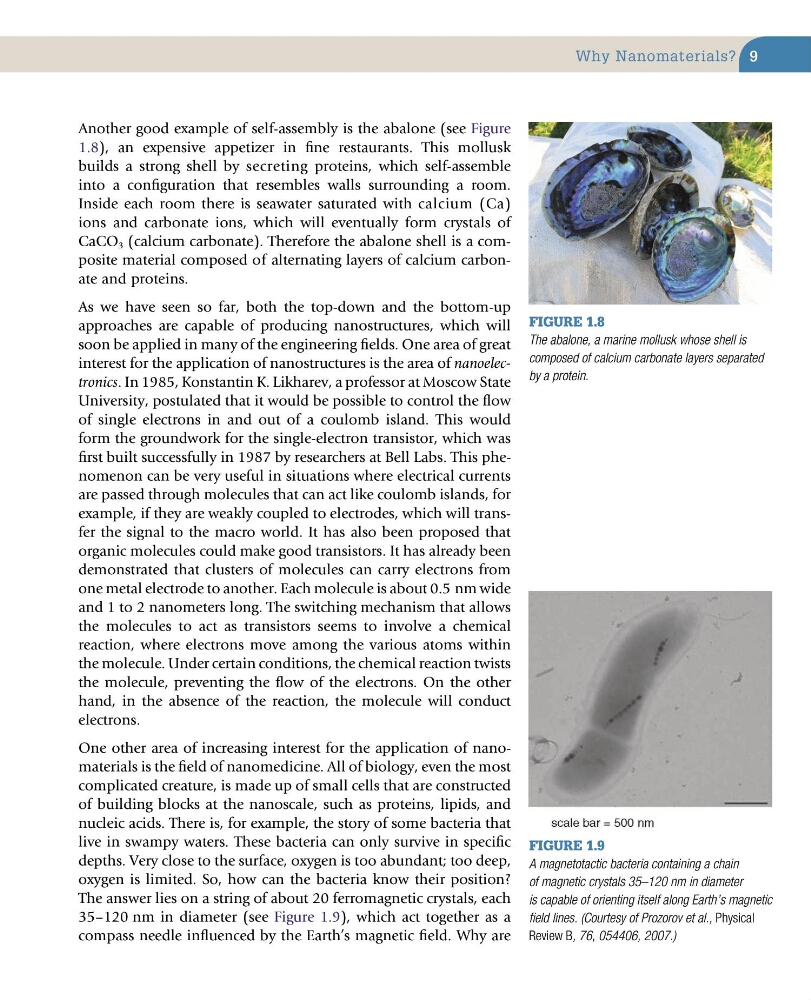
Another good example of self-assembly is the abalone (see Figure
1.8), an expensive appetizer in fine restaurants. This mollusk
builds a strong shell by secreting proteins, which self-assemble
into a configuration that resembles walls surrounding a room.
Inside each room there is seawater saturated with calcium (Ca)
ions and carbonate ions, which will eventually form crystals of
CaCO 3 (calcium carbonate). Therefore the abalone shell is a composite material composed of alternating layers of calcium carbonate and proteins.
As we have seen so far, both the top-down and the bottom-up
approaches are capable of producing nanostructures, which will
soon be applied in many of the engineering fields. One area of great
interest for the application of nanostructures is the area of nanoelectronics. In 1985, Konstantin K. Likharev, a professor at Moscow State
University, postulated that it would be possible to control the flow
of single electrons in and out of a coulomb island. This would
form the groundwork for the single-electron transistor, which was
first built successfully in 1987 by researchers at Bell Labs. This phenomenon can be very useful in situations where electrical currents
are passed through molecules that can act like coulomb islands, for
example, if they are weakly coupled to electrodes, which will transfer the signal to the macro world. It has also been proposed that
organic molecules could make good transistors. It has already been
demonstrated that clusters of molecules can carry electrons from
one metal electrode to another. Each molecule is about 0.5 nm wide
and 1 to 2 nanometers long. The switching mechanism that allows
the molecules to act as transistors seems to involve a chemical
reaction, where electrons move among the various atoms within
the molecule. Under certain conditions, the chemical reaction twists
the molecule, preventing the flow of the electrons. On the other
hand, in the absence of the reaction, the molecule will conduct
electrons.
One other area of increasing interest for the application of nanomaterials is the field of nanomedicine. All of biology, even the most
complicated creature, is made up of small cells that are constructed
of building blocks at the nanoscale, such as proteins, lipids, and
nucleic acids. There is, for example, the story of some bacteria that
live in swampy waters. These bacteria can only survive in specific
depths. Very close to the surface, oxygen is too abundant; too deep,
oxygen is limited. So, how can the bacteria know their position?
The answer lies on a string of about 20 ferromagnetic crystals, each
35–120 nm in diameter (see Figure 1.9), which act together as a
compass needle influenced by the Earth’s magnetic field. Why are
Figure 1.8
The abalone, a marine mollusk whose shell is
composed of calcium carbonate layers separated
by a protein.
Figure 1.9
A magnetotactic bacteria containing a chain
of magnetic crystals 35–120 nm in diameter
is capable of orienting itself along Earth’s magnetic
field lines. (Courtesy of Prozorov et al., Physical
Review B, 76, 054406, 2007.)
Why Nanomaterials?
Another good example of self-assembly is the abalone (see Figure
1.8), an expensive appetizer in fine restaurants. This mollusk
builds a strong shell by secreting proteins, which self-assemble
into a configuration that resembles walls surrounding a room.
Inside each room there is seawater saturated with calcium (Ca)
ions and carbonate ions, which will eventually form crystals of
CaCO 3 (calcium carbonate). Therefore the abalone shell is a composite material composed of alternating layers of calcium carbonate and proteins.
As we have seen so far, both the top-down and the bottom-up
approaches are capable of producing nanostructures, which will
soon be applied in many of the engineering fields. One area of great
interest for the application of nanostructures is the area of nanoelectronics. In 1985, Konstantin K. Likharev, a professor at Moscow State
University, postulated that it would be possible to control the flow
of single electrons in and out of a coulomb island. This would
form the groundwork for the single-electron transistor, which was
first built successfully in 1987 by researchers at Bell Labs. This phenomenon can be very useful in situations where electrical currents
are passed through molecules that can act like coulomb islands, for
example, if they are weakly coupled to electrodes, which will transfer the signal to the macro world. It has also been proposed that
organic molecules could make good transistors. It has already been
demonstrated that clusters of molecules can carry electrons from
one metal electrode to another. Each molecule is about 0.5 nm wide
and 1 to 2 nanometers long. The switching mechanism that allows
the molecules to act as transistors seems to involve a chemical
reaction, where electrons move among the various atoms within
the molecule. Under certain conditions, the chemical reaction twists
the molecule, preventing the flow of the electrons. On the other
hand, in the absence of the reaction, the molecule will conduct
electrons.
One other area of increasing interest for the application of nanomaterials is the field of nanomedicine. All of biology, even the most
complicated creature, is made up of small cells that are constructed
of building blocks at the nanoscale, such as proteins, lipids, and
nucleic acids. There is, for example, the story of some bacteria that
live in swampy waters. These bacteria can only survive in specific
depths. Very close to the surface, oxygen is too abundant; too deep,
oxygen is limited. So, how can the bacteria know their position?
The answer lies on a string of about 20 ferromagnetic crystals, each
35–120 nm in diameter (see Figure 1.9), which act together as a
compass needle influenced by the Earth’s magnetic field. Why are
Figure 1.8
The abalone, a marine mollusk whose shell is
composed of calcium carbonate layers separated
by a protein.
Figure 1.9
A magnetotactic bacteria containing a chain
of magnetic crystals 35–120 nm in diameter
is capable of orienting itself along Earth’s magnetic
field lines. (Courtesy of Prozorov et al., Physical
Review B, 76, 054406, 2007.)
Why Nanomaterials?