

C haPter 5 Material Property Charts and their Uses
168
application. Thus the utility of weight saving in a family car is small,
though significant; in aerospace it is much larger. The utility of heat
transfer in house insulation is directly related to the cost of the
energy used to heat the house; that in a heat exchanger for power
electronics can be much higher because high heat transfer means
faster computing. The utility can be real, meaning that it measures a true saving of cost. But it can also sometimes be perceived,
meaning that the consumer, influenced by scarcity, advertising, or
fashion, will pay more or less than the true value of the metric.
In many engineering applications the exchange constants can be
derived approximately from technical models for the life cost of
a system. Thus the utility of weight saving in transport systems is
derived from the value of the fuel saved or that of the increased
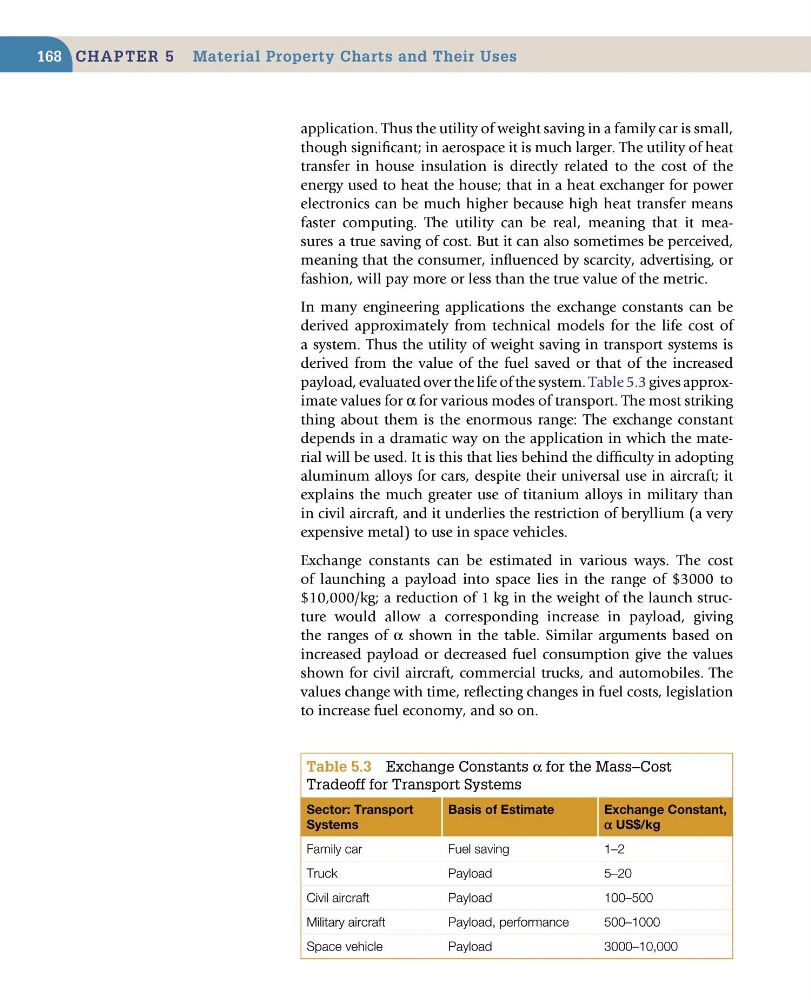
payload, evaluated over the life of the system. Table 5.3 gives approximate values for α for various modes of transport. The most striking
thing about them is the enormous range: The exchange constant
depends in a dramatic way on the application in which the material will be used. It is this that lies behind the difficulty in adopting
aluminum alloys for cars, despite their universal use in aircraft; it
explains the much greater use of titanium alloys in military than
in civil aircraft, and it underlies the restriction of beryllium (a very
expensive metal) to use in space vehicles.
Exchange constants can be estimated in various ways. The cost
of launching a payload into space lies in the range of $3000 to
$10,000/kg; a reduction of 1 kg in the weight of the launch structure would allow a corresponding increase in payload, giving
the ranges of α shown in the table. Similar arguments based on
increased payload or decreased fuel consumption give the values
shown for civil aircraft, commercial trucks, and automobiles. The
values change with time, reflecting changes in fuel costs, legislation
to increase fuel economy, and so on.
table 5.3 Exchange Constants α for the Mass–Cost
Tradeoff for Transport Systems
Sector: Transport
Systems
Basis of Estimate
Exchange Constant,
α US$/kg
Family car
Fuel saving
1–2
Truck
Payload
5–20
Civil aircraft
Payload
100–500
Military aircraft
Payload, performance
500–1000
Space vehicle
Payload
3000–10,000
168
application. Thus the utility of weight saving in a family car is small,
though significant; in aerospace it is much larger. The utility of heat
transfer in house insulation is directly related to the cost of the
energy used to heat the house; that in a heat exchanger for power
electronics can be much higher because high heat transfer means
faster computing. The utility can be real, meaning that it measures a true saving of cost. But it can also sometimes be perceived,
meaning that the consumer, influenced by scarcity, advertising, or
fashion, will pay more or less than the true value of the metric.
In many engineering applications the exchange constants can be
derived approximately from technical models for the life cost of
a system. Thus the utility of weight saving in transport systems is
derived from the value of the fuel saved or that of the increased
payload, evaluated over the life of the system. Table 5.3 gives approximate values for α for various modes of transport. The most striking
thing about them is the enormous range: The exchange constant
depends in a dramatic way on the application in which the material will be used. It is this that lies behind the difficulty in adopting
aluminum alloys for cars, despite their universal use in aircraft; it
explains the much greater use of titanium alloys in military than
in civil aircraft, and it underlies the restriction of beryllium (a very
expensive metal) to use in space vehicles.
Exchange constants can be estimated in various ways. The cost
of launching a payload into space lies in the range of $3000 to
$10,000/kg; a reduction of 1 kg in the weight of the launch structure would allow a corresponding increase in payload, giving
the ranges of α shown in the table. Similar arguments based on
increased payload or decreased fuel consumption give the values
shown for civil aircraft, commercial trucks, and automobiles. The
values change with time, reflecting changes in fuel costs, legislation
to increase fuel economy, and so on.
table 5.3 Exchange Constants α for the Mass–Cost
Tradeoff for Transport Systems
Sector: Transport
Systems
Basis of Estimate
Exchange Constant,
α US$/kg
Family car
Fuel saving
1–2
Truck
Payload
5–20
Civil aircraft
Payload
100–500
Military aircraft
Payload, performance
500–1000
Space vehicle
Payload
3000–10,000