

165
So we have four common objectives, each characterized by a performance metric P i . At least two are involved in the design of almost
any product. Conflict arises because the choice that optimizes one
objective will not, in general, do the same for the others; then the
best choice is a compromise, optimizing none but pushing all as
close to their optima as their interdependence allows. This highlights the central problem: How is mass to be compared with cost,
or volume with environmental impact? Each is measured in different units; they are incommensurate. We need a way of expressing
both in a common currency. This comes in a moment. First, some
definitions.
tradeoff strategies
Consider the choice of material to minimize both mass (performance metric P 1 ) and cost (performance metric P 2 ) while also
meeting a set of constraints such as a required strength or durability in a certain environment. Following the standard terminology
of optimizations theory, we define a solution as a viable choice of
material, meeting all the constraints but not necessarily optimal
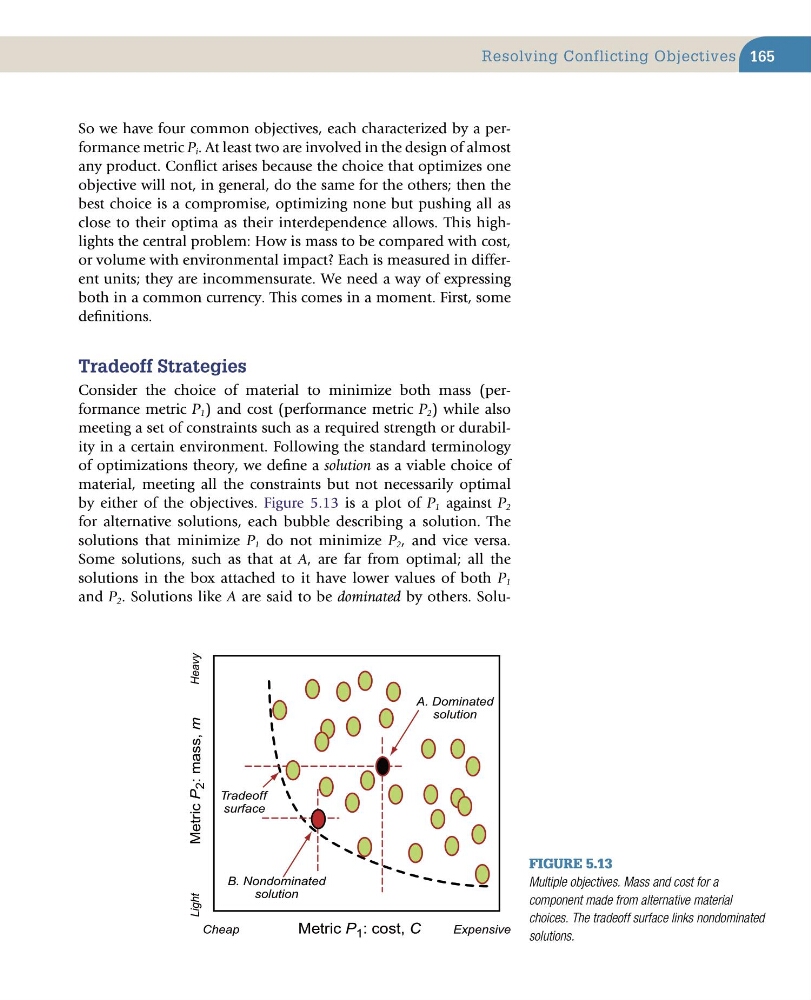
by either of the objectives. Figure 5.13 is a plot of P 1 against P 2
for alternative solutions, each bubble describing a solution. The
solutions that minimize P 1 do not minimize P 2 , and vice versa.
Some solutions, such as that at A, are far from optimal; all the
solutions in the box attached to it have lower values of both P 1
and P 2 . Solutions like A are said to be dominated by others. SoluFigure 5.13
Multiple objectives. Mass and cost for a
component made from alternative material
choices. The tradeoff surface links nondominated
solutions.
A. Dominated
solution
B. Nondominated
solution
Tradeoff
surface
Cheap
Metric P 1 : cost, C
Expensive
Light
Metric P
2 : mass, m
Heavy
Resolving Conflicting Objectives
So we have four common objectives, each characterized by a performance metric P i . At least two are involved in the design of almost
any product. Conflict arises because the choice that optimizes one
objective will not, in general, do the same for the others; then the
best choice is a compromise, optimizing none but pushing all as
close to their optima as their interdependence allows. This highlights the central problem: How is mass to be compared with cost,
or volume with environmental impact? Each is measured in different units; they are incommensurate. We need a way of expressing
both in a common currency. This comes in a moment. First, some
definitions.
tradeoff strategies
Consider the choice of material to minimize both mass (performance metric P 1 ) and cost (performance metric P 2 ) while also
meeting a set of constraints such as a required strength or durability in a certain environment. Following the standard terminology
of optimizations theory, we define a solution as a viable choice of
material, meeting all the constraints but not necessarily optimal
by either of the objectives. Figure 5.13 is a plot of P 1 against P 2
for alternative solutions, each bubble describing a solution. The
solutions that minimize P 1 do not minimize P 2 , and vice versa.
Some solutions, such as that at A, are far from optimal; all the
solutions in the box attached to it have lower values of both P 1
and P 2 . Solutions like A are said to be dominated by others. SoluFigure 5.13
Multiple objectives. Mass and cost for a
component made from alternative material
choices. The tradeoff surface links nondominated
solutions.
A. Dominated
solution
B. Nondominated
solution
Tradeoff
surface
Cheap
Metric P 1 : cost, C
Expensive
Light
Metric P
2 : mass, m
Heavy
Resolving Conflicting Objectives