

C haPter 5 Material Property Charts and their Uses
162
5.4 resolving ConFliCting
oBjeCtives
The choice of material that best meets one objective will not
usually be that which best meets the others. The designer charged
with selecting a material for a portable building that must be both
as light and as cheap as possible faces an obvious difficulty: The
lightest material will certainly not be the cheapest, and vice versa.
To make any progress, the designer needs a way of trading weight
against cost. This section describes ways of resolving this and other
conflicts of objective.
Suppose you want a component with a required stiffness (Constraint 1) and strength (Constraint 2) that must be as light as possible (one objective). You could choose materials with high modulus
E for stiffness, and then the subset of these that have high elastic
limits σ y for strength, and the subset of those that have low density
ρ for light weight. Then again, if you wanted a material with a
required stiffness (one constraint) that was simultaneously as light
(Objective 1) and as cheap (Objective 2) as possible, you could
apply the constraint and then find the subset of survivors that were
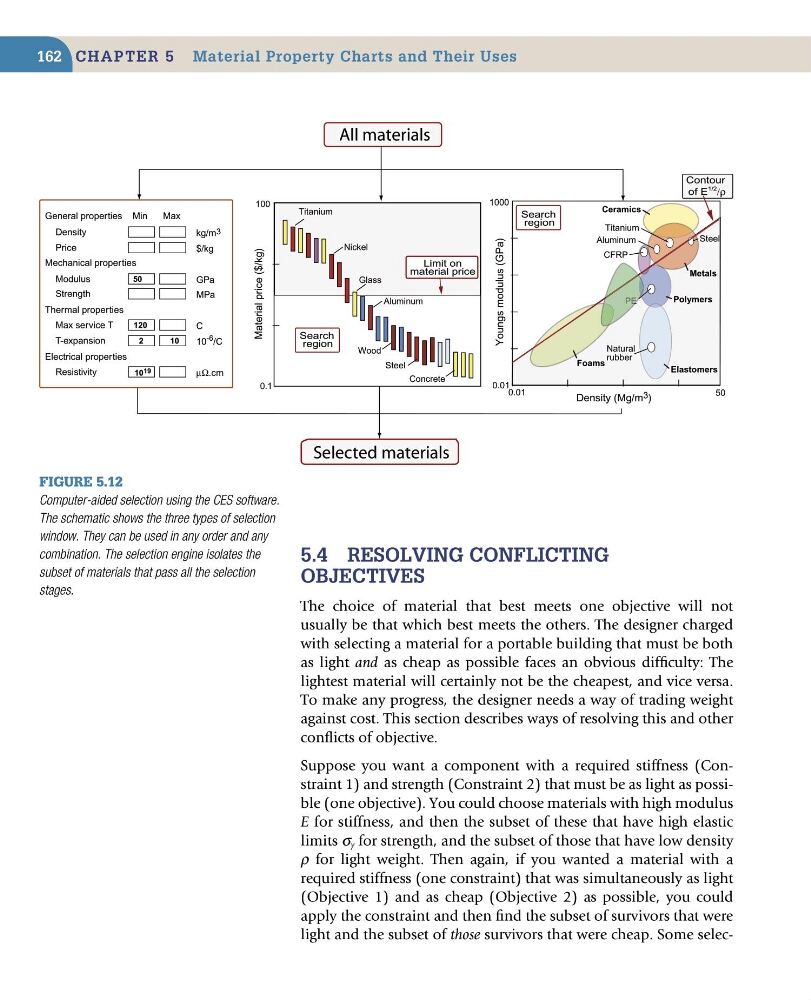
light and the subset of those survivors that were cheap. Some selecFigure 5.12
Computer-aided selection using the CES software.
The schematic shows the three types of selection
window. They can be used in any order and any
combination. The selection engine isolates the
subset of materials that pass all the selection
stages.
All materials
Selected materials
Density
kg/m 3
Price
$/kg
Modulus
GPa
Strength
MPa
Max service T
C
T-expansion
10
-6
/C
Resistivity
µΩ.cm
General properties Min
Max
Mechanical properties
Thermal properties
Electrical properties
10 19
2
10
120
50
0.1
100
Material price ($/kg)
Titanium
Nickel
Glass
Aluminum
Search
region
Limit on
material price
Titanium
Aluminum
CFRP
Steel
PE
Search
region
Contour
of E
1/2 /ρ
0.01
1000
Youngs modulus (GPa)
Density (Mg/m 3 )
0.01
50
Foams
Polymers
Elastomers
Ceramics
Metals
Steel
Wood
Concrete
Natural
rubber
PE E E
162
5.4 resolving ConFliCting
oBjeCtives
The choice of material that best meets one objective will not
usually be that which best meets the others. The designer charged
with selecting a material for a portable building that must be both
as light and as cheap as possible faces an obvious difficulty: The
lightest material will certainly not be the cheapest, and vice versa.
To make any progress, the designer needs a way of trading weight
against cost. This section describes ways of resolving this and other
conflicts of objective.
Suppose you want a component with a required stiffness (Constraint 1) and strength (Constraint 2) that must be as light as possible (one objective). You could choose materials with high modulus
E for stiffness, and then the subset of these that have high elastic
limits σ y for strength, and the subset of those that have low density
ρ for light weight. Then again, if you wanted a material with a
required stiffness (one constraint) that was simultaneously as light
(Objective 1) and as cheap (Objective 2) as possible, you could
apply the constraint and then find the subset of survivors that were
light and the subset of those survivors that were cheap. Some selecFigure 5.12
Computer-aided selection using the CES software.
The schematic shows the three types of selection
window. They can be used in any order and any
combination. The selection engine isolates the
subset of materials that pass all the selection
stages.
All materials
Selected materials
Density
kg/m 3
Price
$/kg
Modulus
GPa
Strength
MPa
Max service T
C
T-expansion
10
-6
/C
Resistivity
µΩ.cm
General properties Min
Max
Mechanical properties
Thermal properties
Electrical properties
10 19
2
10
120
50
0.1
100
Material price ($/kg)
Titanium
Nickel
Glass
Aluminum
Search
region
Limit on
material price
Titanium
Aluminum
CFRP
Steel
PE
Search
region
Contour
of E
1/2 /ρ
0.01
1000
Youngs modulus (GPa)
Density (Mg/m 3 )
0.01
50
Foams
Polymers
Elastomers
Ceramics
Metals
Steel
Wood
Concrete
Natural
rubber
PE E E