

C haPter 5 Material Property Charts and their Uses
156
failure, the need to insulate against or to conduct heat or electricity, that it can function in a certain range of temperature and in a
given environment, and many more. In designing the component,
the designer has one or more objectives: to make it as cheap as
possible, perhaps, or as light, or as safe, or some combination of
these. Certain parameters can be adjusted to optimize the objective; the designer is free to vary dimensions that are not constrained
by design requirements and, most important, is free to choose the
material for the component. We refer to these as free variables. Constraints, objectives, and free variables (see Table 5.1) define the
boundary conditions for selecting a material and, in the case of
load-bearing components, a shape for its cross-section.
It is important to be clear about the distinction between constraints
and objectives. A constraint is an essential condition that must be
met, usually expressed as a limit on a material attribute. An objective
is a quantity for which an extreme value (a maximum or minimum)
is sought, frequently the minimization of cost, mass, or volume,
but there are others (see Table 5.2).
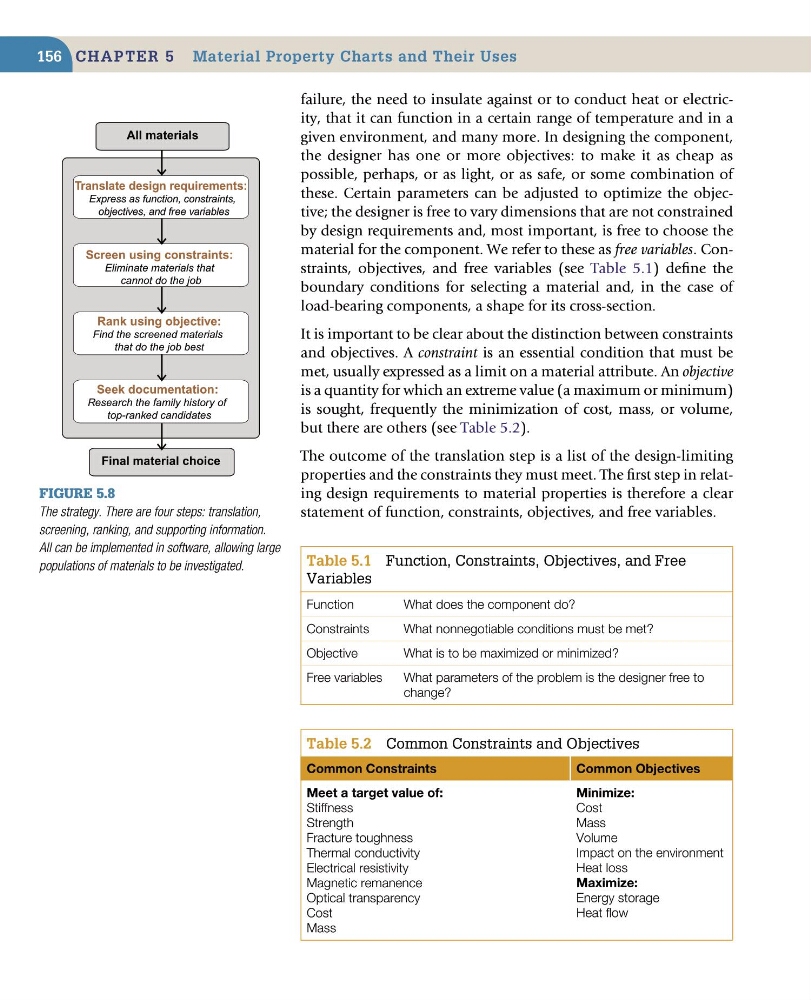
The outcome of the translation step is a list of the design-limiting
properties and the constraints they must meet. The first step in relating design requirements to material properties is therefore a clear
statement of function, constraints, objectives, and free variables.
table 5.1 Function, Constraints, Objectives, and Free
Variables
Function
What does the component do?
Constraints
What nonnegotiable conditions must be met?
Objective
What is to be maximized or minimized?
Free variables
What parameters of the problem is the designer free to
change?
table 5.2 Common Constraints and Objectives
Common Constraints
Common Objectives
Meet a target value of:
Stiffness
Strength
Fracture toughness
Thermal conductivity
Electrical resistivity
Magnetic remanence
Optical transparency
Cost
Mass
Minimize:
Cost
Mass
Volume
Impact on the environment
Heat loss
Maximize:
Energy storage
Heat flow
Figure 5.8
The strategy. There are four steps: translation,
screening, ranking, and supporting information.
All can be implemented in software, allowing large
populations of materials to be investigated.
Translate design requirements:
Express as function, constraints,
objectives, and free variables
All materials
Final material choice
Screen using constraints:
Eliminate materials that
cannot do the job
Rank using objective:
Find the screened materials
that do the job best
Seek documentation:
Research the family history of
top-ranked candidates
156
failure, the need to insulate against or to conduct heat or electricity, that it can function in a certain range of temperature and in a
given environment, and many more. In designing the component,
the designer has one or more objectives: to make it as cheap as
possible, perhaps, or as light, or as safe, or some combination of
these. Certain parameters can be adjusted to optimize the objective; the designer is free to vary dimensions that are not constrained
by design requirements and, most important, is free to choose the
material for the component. We refer to these as free variables. Constraints, objectives, and free variables (see Table 5.1) define the
boundary conditions for selecting a material and, in the case of
load-bearing components, a shape for its cross-section.
It is important to be clear about the distinction between constraints
and objectives. A constraint is an essential condition that must be
met, usually expressed as a limit on a material attribute. An objective
is a quantity for which an extreme value (a maximum or minimum)
is sought, frequently the minimization of cost, mass, or volume,
but there are others (see Table 5.2).
The outcome of the translation step is a list of the design-limiting
properties and the constraints they must meet. The first step in relating design requirements to material properties is therefore a clear
statement of function, constraints, objectives, and free variables.
table 5.1 Function, Constraints, Objectives, and Free
Variables
Function
What does the component do?
Constraints
What nonnegotiable conditions must be met?
Objective
What is to be maximized or minimized?
Free variables
What parameters of the problem is the designer free to
change?
table 5.2 Common Constraints and Objectives
Common Constraints
Common Objectives
Meet a target value of:
Stiffness
Strength
Fracture toughness
Thermal conductivity
Electrical resistivity
Magnetic remanence
Optical transparency
Cost
Mass
Minimize:
Cost
Mass
Volume
Impact on the environment
Heat loss
Maximize:
Energy storage
Heat flow
Figure 5.8
The strategy. There are four steps: translation,
screening, ranking, and supporting information.
All can be implemented in software, allowing large
populations of materials to be investigated.
Translate design requirements:
Express as function, constraints,
objectives, and free variables
All materials
Final material choice
Screen using constraints:
Eliminate materials that
cannot do the job
Rank using objective:
Find the screened materials
that do the job best
Seek documentation:
Research the family history of
top-ranked candidates