

155
and rank highly in their ability to fulfill the objectives are potential
candidates for the design. The second task, then, is that of screening:
eliminating the material that cannot meet the constraints. This is
followed by the ranking step, ordering the survivors by their ability
to meet a criterion of excellence, such as that of minimizing cost.
The final task is to explore the most promising candidates in depth,
examining how they are used at present, case histories of failures,
and how best to design with them, a step we call documentation.
translation
Any engineering component has one or more functions: to support
a load, to contain a pressure, to transmit heat, and so forth. This
must be achieved subject to constraints: that certain dimensions
are fixed, that the component must carry the design loads without
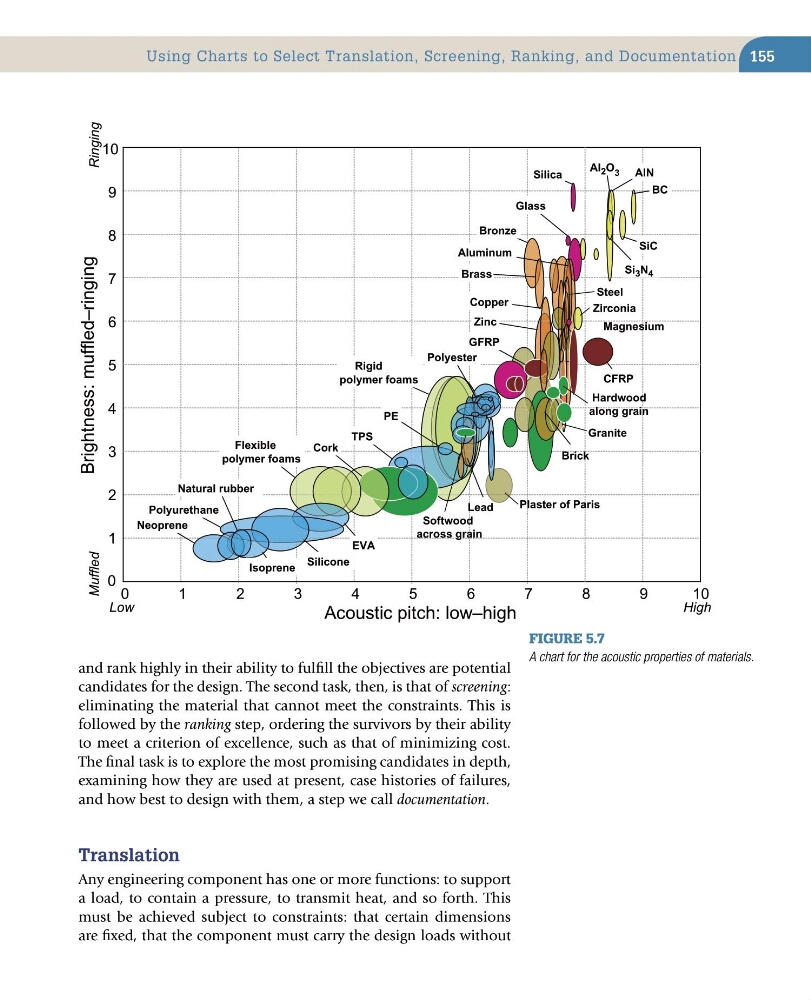
Figure 5.7
A chart for the acoustic properties of materials.
1
10
2
3
4
5
6
7
8
9
0
1
10
2
3
4
5
6
7
8
9
0
Acoustic pitch: low–high
Low
High
Brightness: muffled–ringing
Muffled
Ringing
Neoprene
Polyurethane
Natural rubber
Isoprene
Silicone
EVA
Flexible
polymer foams
Cork
TPS
PE
Rigid
polymer foams
Polyester
CFRP
Brass
Silica
Bronze
Glass
Al 2 O 3 AlN
BC
SiC
Si 3 N 4
GFRP
Aluminum
Copper
Brick
Lead
Zirconia
Magnesium
Steel
Granite
Softwood
across grain
Plaster of Paris
Hardwood
along grain
Zinc
Using Charts to Select Translation, Screening, Ranking, and Documentation
and rank highly in their ability to fulfill the objectives are potential
candidates for the design. The second task, then, is that of screening:
eliminating the material that cannot meet the constraints. This is
followed by the ranking step, ordering the survivors by their ability
to meet a criterion of excellence, such as that of minimizing cost.
The final task is to explore the most promising candidates in depth,
examining how they are used at present, case histories of failures,
and how best to design with them, a step we call documentation.
translation
Any engineering component has one or more functions: to support
a load, to contain a pressure, to transmit heat, and so forth. This
must be achieved subject to constraints: that certain dimensions
are fixed, that the component must carry the design loads without
Figure 5.7
A chart for the acoustic properties of materials.
1
10
2
3
4
5
6
7
8
9
0
1
10
2
3
4
5
6
7
8
9
0
Acoustic pitch: low–high
Low
High
Brightness: muffled–ringing
Muffled
Ringing
Neoprene
Polyurethane
Natural rubber
Isoprene
Silicone
EVA
Flexible
polymer foams
Cork
TPS
PE
Rigid
polymer foams
Polyester
CFRP
Brass
Silica
Bronze
Glass
Al 2 O 3 AlN
BC
SiC
Si 3 N 4
GFRP
Aluminum
Copper
Brick
Lead
Zirconia
Magnesium
Steel
Granite
Softwood
across grain
Plaster of Paris
Hardwood
along grain
Zinc
Using Charts to Select Translation, Screening, Ranking, and Documentation