

C haPter 5 Material Property Charts and their Uses
148
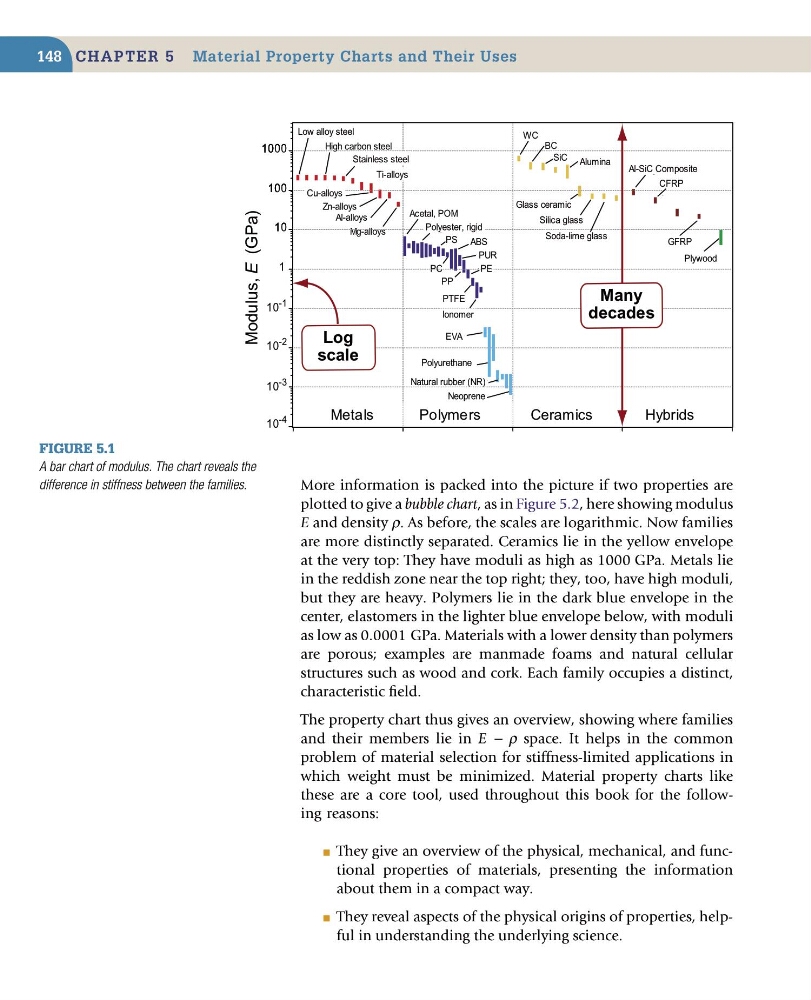
More information is packed into the picture if two properties are
plotted to give a bubble chart, as in Figure 5.2, here showing modulus
E and density ρ. As before, the scales are logarithmic. Now families
are more distinctly separated. Ceramics lie in the yellow envelope
at the very top: They have moduli as high as 1000 GPa. Metals lie
in the reddish zone near the top right; they, too, have high moduli,
but they are heavy. Polymers lie in the dark blue envelope in the
center, elastomers in the lighter blue envelope below, with moduli
as low as 0.0001 GPa. Materials with a lower density than polymers
are porous; examples are manmade foams and natural cellular
structures such as wood and cork. Each family occupies a distinct,
characteristic field.
The property chart thus gives an overview, showing where families
and their members lie in E − ρ space. It helps in the common
problem of material selection for stiffness-limited applications in
which weight must be minimized. Material property charts like
these are a core tool, used throughout this book for the following reasons:
■ They give an overview of the physical, mechanical, and functional properties of materials, presenting the information
about them in a compact way.
■ They reveal aspects of the physical origins of properties, helpful in understanding the underlying science.
Figure 5.1
A bar chart of modulus. The chart reveals the
difference in stiffness between the families.
10
100
1000
Low alloy steel
Mg-alloys
Al-alloys
Zn-alloys
Cu-alloys
Stainless steel
High carbon steel
Acetal, POM
Polyurethane
EVA
Ionomer
PTFE
WC
Alumina
Glass Ceramic
Silica glass
Soda-Lime glass
Polyester, rigid
PC
PS
PUR
PE
ABS
PP
BC
SiC
Al-SiC Composite
CFRP
GFRP
Plywood
Natural Rubber (NR)
Composites
Polymers
Metals
Ceramics & glass
Metals
Po lymers
Ceramics
Hybrids
10
100
1000
Low alloy steel
Zn-alloys
Cu-alloys
Acetal, POM
EVA
Ionomer
PTFE
WC
Alumina
Glass ceramic
Soda-lime glass
Polyester, rigid
PC
PS
PUR
PE
ABS
PP
BC
SiC
Al-SiC Composite
CFRP
Neoprene
Natural rubber (NR)
Composites
Polymers
Metals
Ceramics & glass
10
100
1000
Cu-alloys
Acetal, POM
EVA
Ionomer
PTFE
Alumina
Polyester, rigid
PS
PUR
PE
ABS
PP
SiC
Al-SiC Composite
Composites
Polymers
Metals
Ceramics & glass
1
10
10
-1
100
1000
Acetal, POM
EVA
PTFE
Polyester, rigid
PP
Composites
Polymers
Metals
Ceramics & glass
Modulus,
E (GPa)
Metals
Polymers
Ceramics
Hybrids
10 -2
10 -3
10
-4
Stainless steel
Ti-alloys
Log
scale
Many
decades
148
More information is packed into the picture if two properties are
plotted to give a bubble chart, as in Figure 5.2, here showing modulus
E and density ρ. As before, the scales are logarithmic. Now families
are more distinctly separated. Ceramics lie in the yellow envelope
at the very top: They have moduli as high as 1000 GPa. Metals lie
in the reddish zone near the top right; they, too, have high moduli,
but they are heavy. Polymers lie in the dark blue envelope in the
center, elastomers in the lighter blue envelope below, with moduli
as low as 0.0001 GPa. Materials with a lower density than polymers
are porous; examples are manmade foams and natural cellular
structures such as wood and cork. Each family occupies a distinct,
characteristic field.
The property chart thus gives an overview, showing where families
and their members lie in E − ρ space. It helps in the common
problem of material selection for stiffness-limited applications in
which weight must be minimized. Material property charts like
these are a core tool, used throughout this book for the following reasons:
■ They give an overview of the physical, mechanical, and functional properties of materials, presenting the information
about them in a compact way.
■ They reveal aspects of the physical origins of properties, helpful in understanding the underlying science.
Figure 5.1
A bar chart of modulus. The chart reveals the
difference in stiffness between the families.
10
100
1000
Low alloy steel
Mg-alloys
Al-alloys
Zn-alloys
Cu-alloys
Stainless steel
High carbon steel
Acetal, POM
Polyurethane
EVA
Ionomer
PTFE
WC
Alumina
Glass Ceramic
Silica glass
Soda-Lime glass
Polyester, rigid
PC
PS
PUR
PE
ABS
PP
BC
SiC
Al-SiC Composite
CFRP
GFRP
Plywood
Natural Rubber (NR)
Composites
Polymers
Metals
Ceramics & glass
Metals
Po lymers
Ceramics
Hybrids
10
100
1000
Low alloy steel
Zn-alloys
Cu-alloys
Acetal, POM
EVA
Ionomer
PTFE
WC
Alumina
Glass ceramic
Soda-lime glass
Polyester, rigid
PC
PS
PUR
PE
ABS
PP
BC
SiC
Al-SiC Composite
CFRP
Neoprene
Natural rubber (NR)
Composites
Polymers
Metals
Ceramics & glass
10
100
1000
Cu-alloys
Acetal, POM
EVA
Ionomer
PTFE
Alumina
Polyester, rigid
PS
PUR
PE
ABS
PP
SiC
Al-SiC Composite
Composites
Polymers
Metals
Ceramics & glass
1
10
10
-1
100
1000
Acetal, POM
EVA
PTFE
Polyester, rigid
PP
Composites
Polymers
Metals
Ceramics & glass
Modulus,
E (GPa)
Metals
Polymers
Ceramics
Hybrids
10 -2
10 -3
10
-4
Stainless steel
Ti-alloys
Log
scale
Many
decades