

3
currently mature scientific and engineering areas are based on concepts described in Feynman’s lecture 50 years ago.
The term nanotechnology was first used in 1974 by Norio Taniguchi
to refer to the precise and accurate tolerances required for machining and finishing materials. In 1981, K. E. Drexler, now at the Foresight Nanotech Institute for Molecular Manufacturing, described
a new “bottom-up” approach, instead of the top-down approach
discussed earlier by Feynman and Taniguchi. The bottom-up
approach involved molecular manipulation and molecular
engineering to build molecular machines and molecular devices
with atomic precision. In 1986, Drexler published a book, Engines
of Creation, which finally popularized the term nanotechnology.
The term nano derives from the Greek word for dwarf. It is used as
a prefix for any unit such as a second or a meter, and it means a
billionth of that unit. Hence, a nanometer (nm) is a billionth of a
meter, or 10
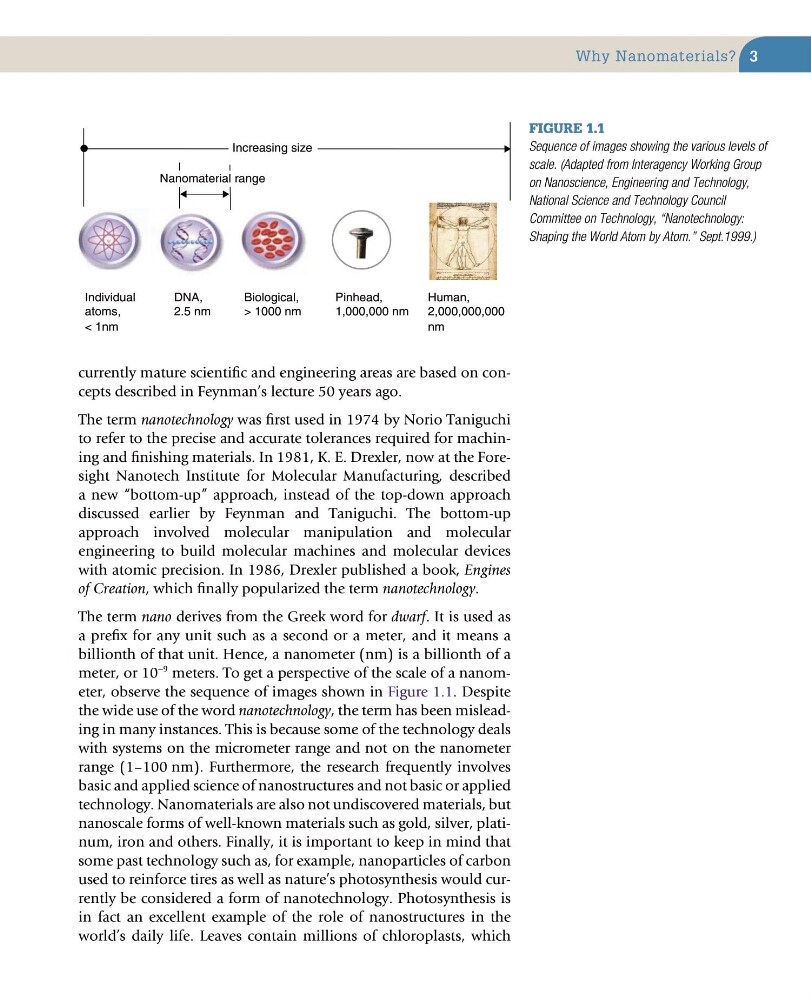
−9 meters. To get a perspective of the scale of a nanometer, observe the sequence of images shown in Figure 1.1. Despite
the wide use of the word nanotechnology, the term has been misleading in many instances. This is because some of the technology deals
with systems on the micrometer range and not on the nanometer
range (1–100 nm). Furthermore, the research frequently involves
basic and applied science of nanostructures and not basic or applied
technology. Nanomaterials are also not undiscovered materials, but
nanoscale forms of well-known materials such as gold, silver, platinum, iron and others. Finally, it is important to keep in mind that
some past technology such as, for example, nanoparticles of carbon
used to reinforce tires as well as nature’s photosynthesis would currently be considered a form of nanotechnology. Photosynthesis is
in fact an excellent example of the role of nanostructures in the
world’s daily life. Leaves contain millions of chloroplasts, which
Figure 1.1
Sequence of images showing the various levels of
scale. (Adapted from Interagency Working Group
on Nanoscience, Engineering and Technology,
National Science and Technology Council
Committee on Technology, “Nanotechnology:
Shaping the World Atom by Atom.” Sept.1999.)
Individual
atoms,
< 1nm
DNA,
2.5 nm
Biological,
> 1000 nm
Pinhead,
1,000,000 nm
Human,
2,000,000,000
nm
Nanomaterial range
Increasing size
Why Nanomaterials?
currently mature scientific and engineering areas are based on concepts described in Feynman’s lecture 50 years ago.
The term nanotechnology was first used in 1974 by Norio Taniguchi
to refer to the precise and accurate tolerances required for machining and finishing materials. In 1981, K. E. Drexler, now at the Foresight Nanotech Institute for Molecular Manufacturing, described
a new “bottom-up” approach, instead of the top-down approach
discussed earlier by Feynman and Taniguchi. The bottom-up
approach involved molecular manipulation and molecular
engineering to build molecular machines and molecular devices
with atomic precision. In 1986, Drexler published a book, Engines
of Creation, which finally popularized the term nanotechnology.
The term nano derives from the Greek word for dwarf. It is used as
a prefix for any unit such as a second or a meter, and it means a
billionth of that unit. Hence, a nanometer (nm) is a billionth of a
meter, or 10
−9 meters. To get a perspective of the scale of a nanometer, observe the sequence of images shown in Figure 1.1. Despite
the wide use of the word nanotechnology, the term has been misleading in many instances. This is because some of the technology deals
with systems on the micrometer range and not on the nanometer
range (1–100 nm). Furthermore, the research frequently involves
basic and applied science of nanostructures and not basic or applied
technology. Nanomaterials are also not undiscovered materials, but
nanoscale forms of well-known materials such as gold, silver, platinum, iron and others. Finally, it is important to keep in mind that
some past technology such as, for example, nanoparticles of carbon
used to reinforce tires as well as nature’s photosynthesis would currently be considered a form of nanotechnology. Photosynthesis is
in fact an excellent example of the role of nanostructures in the
world’s daily life. Leaves contain millions of chloroplasts, which
Figure 1.1
Sequence of images showing the various levels of
scale. (Adapted from Interagency Working Group
on Nanoscience, Engineering and Technology,
National Science and Technology Council
Committee on Technology, “Nanotechnology:
Shaping the World Atom by Atom.” Sept.1999.)
Individual
atoms,
< 1nm
DNA,
2.5 nm
Biological,
> 1000 nm
Pinhead,
1,000,000 nm
Human,
2,000,000,000
nm
Nanomaterial range
Increasing size
Why Nanomaterials?