

C hapter 4 Material Classes, structure, and properties
102
ρ D
D
=
L
V
(4.3)
where L D is the total length of dislocations and V is the volume.
Another class of defects is that of interfacial defects. Among these,
we’ll first discuss the free surfaces. All solid materials have finite
sizes. As a result, the atomic arrangement at the surface is different
from within the bulk. Typically, surface atoms form the same crystal
structure as in the bulk, but the unit cells have slightly larger lattice
parameters. In addition, surface atoms have more freedom to move
and thus have higher entropy. We can now understand that different crystal surfaces should have different energies, depending on
the number of broken bonds.
The second type of interfacial defect is the grain boundary. This
boundary separates regions of different crystallographic orientation. The simplest form of a grain boundary is called a tilt boundary
because the misorientation is in the form of a simple tilt about an
axis (see Figure 4.27).
We know that grain boundaries have also an interfacial energy due
to the disruption of atomic periodicity. However, will they have
higher or lower energies than free surfaces? The answer is lower
energies. This is because grain boundaries exhibit some distortion
in the type of bonds they form, but there are no absent bonds. Most
of the materials utilized in our daily lives are polycrystalline materials. This means that the materials are composed of many crystals with different orientations, separated by grain boundaries (see
Figure 4.28). It turns out that this network of grains significantly
affects several of the material properties.
The last type of interfacial defect is the interphase boundary. These
are the boundaries that separate regions of materials with different
structure and/or composition. An example is a dentist’s drill, which
is a mixture of small crystals of tungsten carbide surrounded by a
matrix of cobalt. The interfaces between the tungsten carbide and
the cobalt matrix are interphase boundaries.
Finally, we are left to discuss bulk defects. Most of the time these
volume defects are introduced during the production of materials.
In some cases, impurities in a material combine with each other
and form inclusions. These are second-phase particles that can considerably affect the mechanical properties of materials.
One other type of defect is the casting defect. These can be cavities
and gas holes produced under certain conditions of temperature
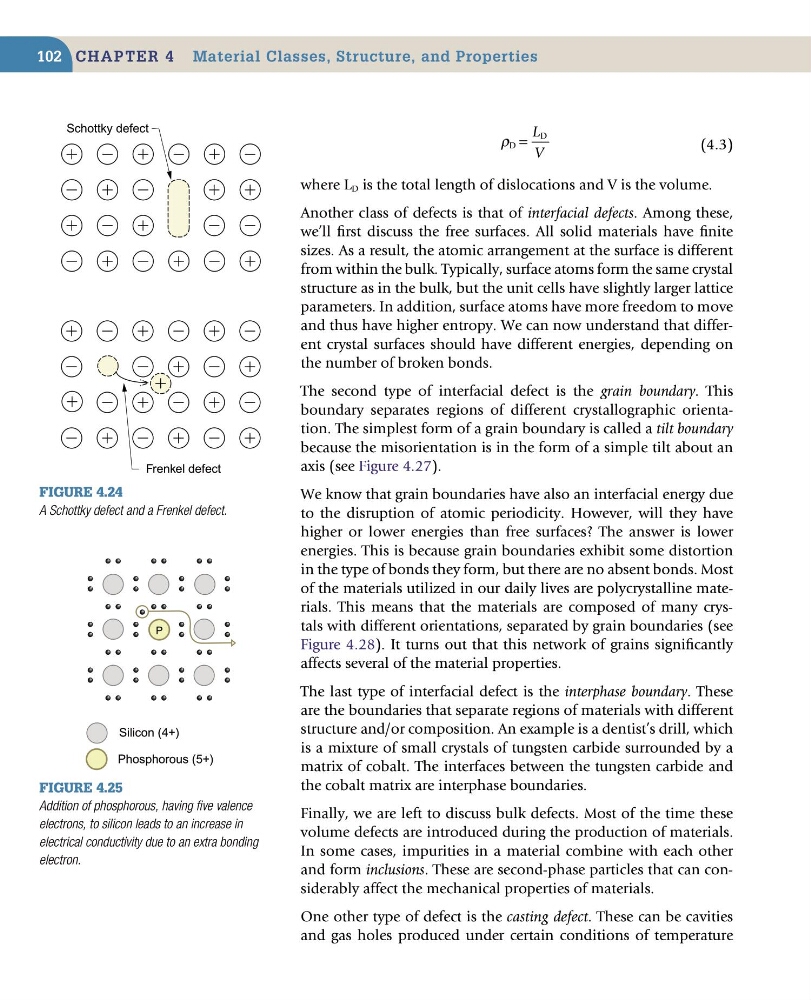
Figure 4.24
A Schottky defect and a Frenkel defect.
Schottky defect
Frenkel defect
Figure 4.25
Addition of phosphorous, having five valence
electrons, to silicon leads to an increase in
electrical conductivity due to an extra bonding
electron.
Silicon (4+)
Phosphorous (5+)
P
102
ρ D
D
=
L
V
(4.3)
where L D is the total length of dislocations and V is the volume.
Another class of defects is that of interfacial defects. Among these,
we’ll first discuss the free surfaces. All solid materials have finite
sizes. As a result, the atomic arrangement at the surface is different
from within the bulk. Typically, surface atoms form the same crystal
structure as in the bulk, but the unit cells have slightly larger lattice
parameters. In addition, surface atoms have more freedom to move
and thus have higher entropy. We can now understand that different crystal surfaces should have different energies, depending on
the number of broken bonds.
The second type of interfacial defect is the grain boundary. This
boundary separates regions of different crystallographic orientation. The simplest form of a grain boundary is called a tilt boundary
because the misorientation is in the form of a simple tilt about an
axis (see Figure 4.27).
We know that grain boundaries have also an interfacial energy due
to the disruption of atomic periodicity. However, will they have
higher or lower energies than free surfaces? The answer is lower
energies. This is because grain boundaries exhibit some distortion
in the type of bonds they form, but there are no absent bonds. Most
of the materials utilized in our daily lives are polycrystalline materials. This means that the materials are composed of many crystals with different orientations, separated by grain boundaries (see
Figure 4.28). It turns out that this network of grains significantly
affects several of the material properties.
The last type of interfacial defect is the interphase boundary. These
are the boundaries that separate regions of materials with different
structure and/or composition. An example is a dentist’s drill, which
is a mixture of small crystals of tungsten carbide surrounded by a
matrix of cobalt. The interfaces between the tungsten carbide and
the cobalt matrix are interphase boundaries.
Finally, we are left to discuss bulk defects. Most of the time these
volume defects are introduced during the production of materials.
In some cases, impurities in a material combine with each other
and form inclusions. These are second-phase particles that can considerably affect the mechanical properties of materials.
One other type of defect is the casting defect. These can be cavities
and gas holes produced under certain conditions of temperature
Figure 4.24
A Schottky defect and a Frenkel defect.
Schottky defect
Frenkel defect
Figure 4.25
Addition of phosphorous, having five valence
electrons, to silicon leads to an increase in
electrical conductivity due to an extra bonding
electron.
Silicon (4+)
Phosphorous (5+)
P