

between the proton and the hydride on the iron center, thus improving the efficiency
of hydrogen evolution. These models can also react with PMe 2 Ph to form the
corresponding mononuclear iron models R70–73 with phosphine ligand
[162, 163]. In addition, based on dibenzothiophene derivatives, the team has developed some other similar models R74–76 [163], which will not be discussed here
(Fig. 26).
2.3 Assembled Catalysts
In order to effectively transfer the electrons of photo-induced charge separation to
the active sites of catalysts, a method of covalent bonding between photosensitizers
and catalysts was proposed to promote the transfer of electrons in the catalytic
process.
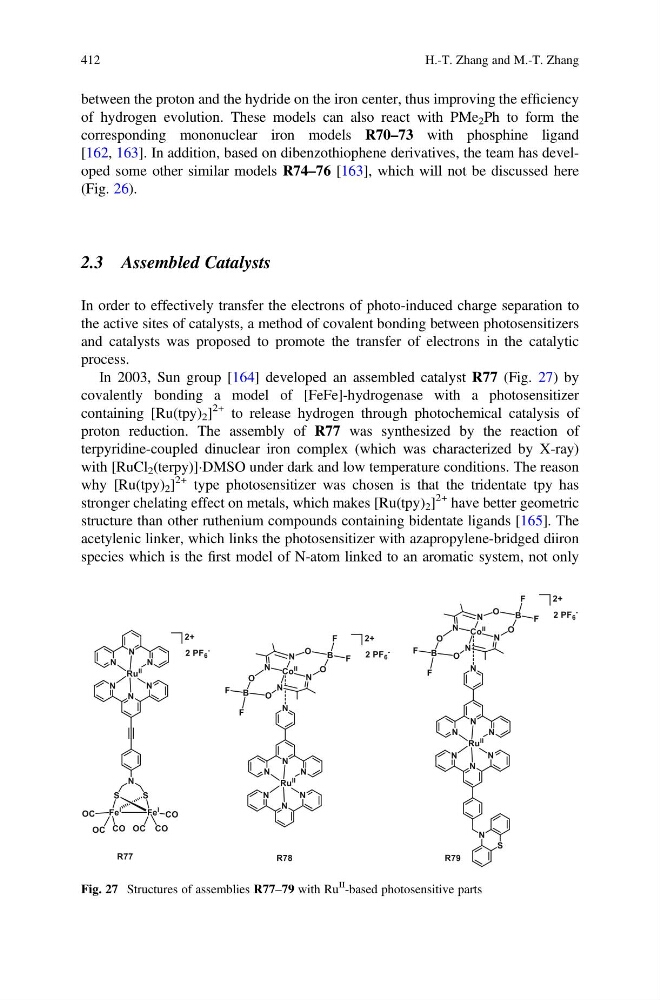
In 2003, Sun group [164] developed an assembled catalyst R77 (Fig. 27) by
covalently bonding a model of [FeFe]-hydrogenase with a photosensitizer
containing [Ru(tpy) 2 ]
2+ to release hydrogen through photochemical catalysis of
proton reduction. The assembly of R77 was synthesized by the reaction of
terpyridine-coupled dinuclear iron complex (which was characterized by X-ray)
with [RuCl 2 (terpy)]ÁDMSO under dark and low temperature conditions. The reason
why [Ru(tpy) 2 ]
2+ type photosensitizer was chosen is that the tridentate tpy has
stronger chelating effect on metals, which makes [Ru(tpy) 2 ]
2+ have better geometric
structure than other ruthenium compounds containing bidentate ligands [165]. The
acetylenic linker, which links the photosensitizer with azapropylene-bridged diiron
species which is the first model of N-atom linked to an aromatic system, not only
Fig. 27 Structures of assemblies R77–79 with Ru
II
-based photosensitive parts
412
H.-T. Zhang and M.-T. Zhang
of hydrogen evolution. These models can also react with PMe 2 Ph to form the
corresponding mononuclear iron models R70–73 with phosphine ligand
[162, 163]. In addition, based on dibenzothiophene derivatives, the team has developed some other similar models R74–76 [163], which will not be discussed here
(Fig. 26).
2.3 Assembled Catalysts
In order to effectively transfer the electrons of photo-induced charge separation to
the active sites of catalysts, a method of covalent bonding between photosensitizers
and catalysts was proposed to promote the transfer of electrons in the catalytic
process.
In 2003, Sun group [164] developed an assembled catalyst R77 (Fig. 27) by
covalently bonding a model of [FeFe]-hydrogenase with a photosensitizer
containing [Ru(tpy) 2 ]
2+ to release hydrogen through photochemical catalysis of
proton reduction. The assembly of R77 was synthesized by the reaction of
terpyridine-coupled dinuclear iron complex (which was characterized by X-ray)
with [RuCl 2 (terpy)]ÁDMSO under dark and low temperature conditions. The reason
why [Ru(tpy) 2 ]
2+ type photosensitizer was chosen is that the tridentate tpy has
stronger chelating effect on metals, which makes [Ru(tpy) 2 ]
2+ have better geometric
structure than other ruthenium compounds containing bidentate ligands [165]. The
acetylenic linker, which links the photosensitizer with azapropylene-bridged diiron
species which is the first model of N-atom linked to an aromatic system, not only
Fig. 27 Structures of assemblies R77–79 with Ru
II
-based photosensitive parts
412
H.-T. Zhang and M.-T. Zhang