

[FeFe]-hydrogenase is a natural enzyme with a catalytic efficiency of 9,000 s
À1
about hydrogen evolution [38], and its active center is a binuclear iron structure with
polycarbonyl coordination. In 2012, Hirotsu group [160] synthesized a series of
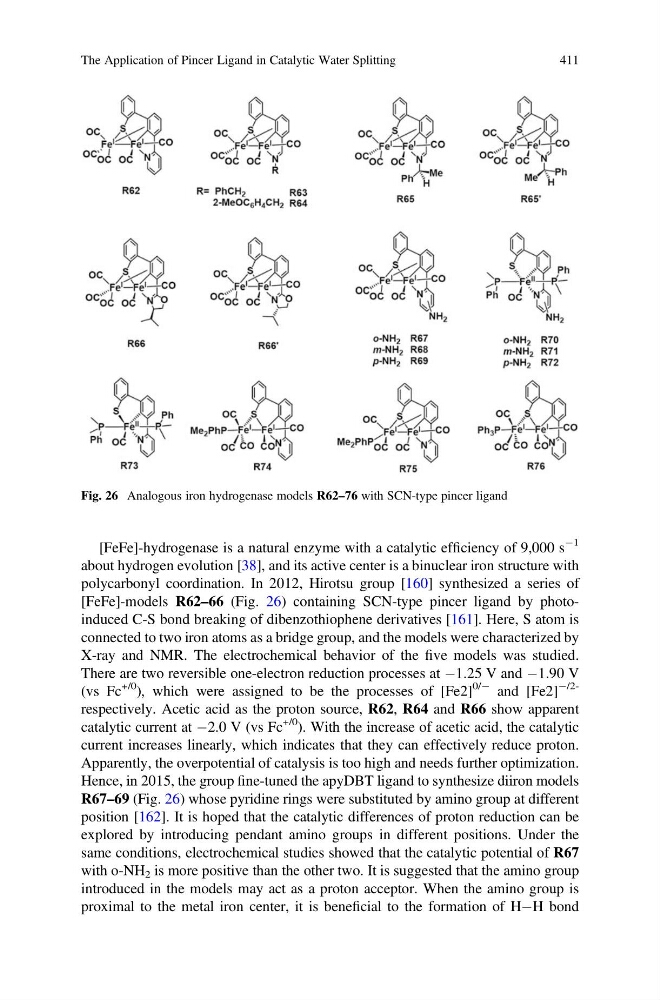
[FeFe]-models R62–66 (Fig. 26) containing SCN-type pincer ligand by photoinduced C-S bond breaking of dibenzothiophene derivatives [161]. Here, S atom is
connected to two iron atoms as a bridge group, and the models were characterized by
X-ray and NMR. The electrochemical behavior of the five models was studied.
There are two reversible one-electron reduction processes at À1.25 V and À1.90 V
(vs Fc
+/0
), which were assigned to be the processes of [Fe2]
0/À and [Fe2]
À/2respectively. Acetic acid as the proton source, R62, R64 and R66 show apparent
catalytic current at À2.0 V (vs Fc
+/0 ). With the increase of acetic acid, the catalytic
current increases linearly, which indicates that they can effectively reduce proton.
Apparently, the overpotential of catalysis is too high and needs further optimization.
Hence, in 2015, the group fine-tuned the apyDBT ligand to synthesize diiron models
R67–69 (Fig. 26) whose pyridine rings were substituted by amino group at different
position [162]. It is hoped that the catalytic differences of proton reduction can be
explored by introducing pendant amino groups in different positions. Under the
same conditions, electrochemical studies showed that the catalytic potential of R67
with o-NH 2 is more positive than the other two. It is suggested that the amino group
introduced in the models may act as a proton acceptor. When the amino group is
proximal to the metal iron center, it is beneficial to the formation of HÀH bond
Fig. 26 Analogous iron hydrogenase models R62–76 with SCN-type pincer ligand
The Application of Pincer Ligand in Catalytic Water Splitting
411
À1
about hydrogen evolution [38], and its active center is a binuclear iron structure with
polycarbonyl coordination. In 2012, Hirotsu group [160] synthesized a series of
[FeFe]-models R62–66 (Fig. 26) containing SCN-type pincer ligand by photoinduced C-S bond breaking of dibenzothiophene derivatives [161]. Here, S atom is
connected to two iron atoms as a bridge group, and the models were characterized by
X-ray and NMR. The electrochemical behavior of the five models was studied.
There are two reversible one-electron reduction processes at À1.25 V and À1.90 V
(vs Fc
+/0
), which were assigned to be the processes of [Fe2]
0/À and [Fe2]
À/2respectively. Acetic acid as the proton source, R62, R64 and R66 show apparent
catalytic current at À2.0 V (vs Fc
+/0 ). With the increase of acetic acid, the catalytic
current increases linearly, which indicates that they can effectively reduce proton.
Apparently, the overpotential of catalysis is too high and needs further optimization.
Hence, in 2015, the group fine-tuned the apyDBT ligand to synthesize diiron models
R67–69 (Fig. 26) whose pyridine rings were substituted by amino group at different
position [162]. It is hoped that the catalytic differences of proton reduction can be
explored by introducing pendant amino groups in different positions. Under the
same conditions, electrochemical studies showed that the catalytic potential of R67
with o-NH 2 is more positive than the other two. It is suggested that the amino group
introduced in the models may act as a proton acceptor. When the amino group is
proximal to the metal iron center, it is beneficial to the formation of HÀH bond
Fig. 26 Analogous iron hydrogenase models R62–76 with SCN-type pincer ligand
The Application of Pincer Ligand in Catalytic Water Splitting
411