

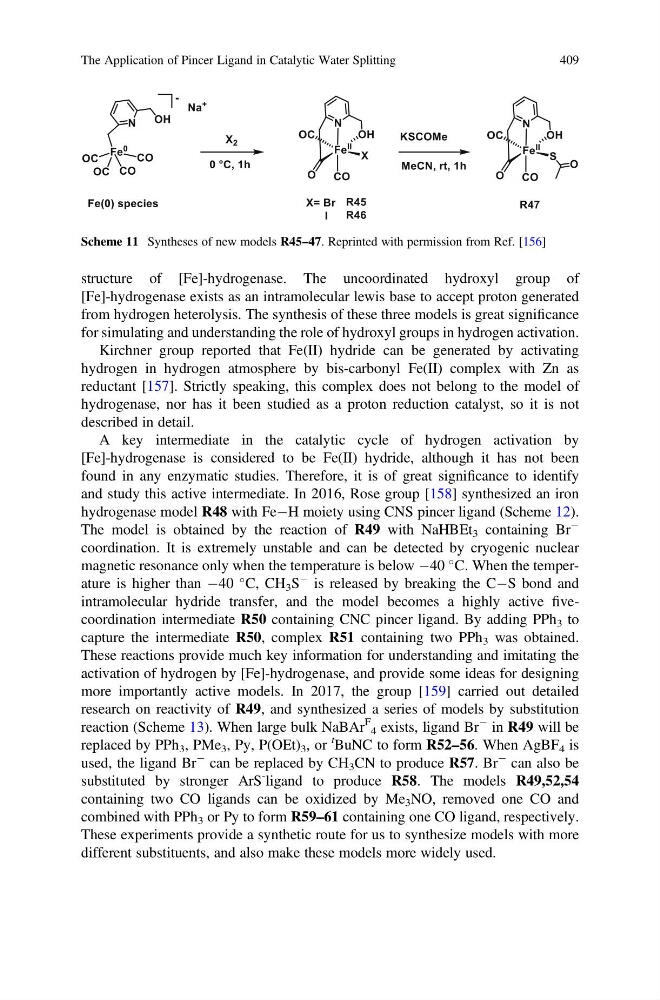
structure of [Fe]-hydrogenase. The uncoordinated hydroxyl group of
[Fe]-hydrogenase exists as an intramolecular lewis base to accept proton generated
from hydrogen heterolysis. The synthesis of these three models is great significance
for simulating and understanding the role of hydroxyl groups in hydrogen activation.
Kirchner group reported that Fe(II) hydride can be generated by activating
hydrogen in hydrogen atmosphere by bis-carbonyl Fe(II) complex with Zn as
reductant [157]. Strictly speaking, this complex does not belong to the model of
hydrogenase, nor has it been studied as a proton reduction catalyst, so it is not
described in detail.
A key intermediate in the catalytic cycle of hydrogen activation by
[Fe]-hydrogenase is considered to be Fe(II) hydride, although it has not been
found in any enzymatic studies. Therefore, it is of great significance to identify
and study this active intermediate. In 2016, Rose group [158] synthesized an iron
hydrogenase model R48 with FeÀH moiety using CNS pincer ligand (Scheme 12).
The model is obtained by the reaction of R49 with NaHBEt 3 containing Br
À
coordination. It is extremely unstable and can be detected by cryogenic nuclear
magnetic resonance only when the temperature is below À40
C. When the temperature is higher than À40
C, CH 3 S
À is released by breaking the CÀS bond and
intramolecular hydride transfer, and the model becomes a highly active fivecoordination intermediate R50 containing CNC pincer ligand. By adding PPh 3 to
capture the intermediate R50, complex R51 containing two PPh 3 was obtained.
These reactions provide much key information for understanding and imitating the
activation of hydrogen by [Fe]-hydrogenase, and provide some ideas for designing
more importantly active models. In 2017, the group [159] carried out detailed
research on reactivity of R49, and synthesized a series of models by substitution
reaction (Scheme 13). When large bulk NaBAr
F
4 exists, ligand Br
À in R49 will be
replaced by PPh 3 , PMe 3 , Py, P(OEt) 3 , or
t
BuNC to form R52–56. When AgBF 4 is
used, the ligand Br
À can be replaced by CH 3 CN to produce R57. Br
À can also be
substituted by stronger ArS
- ligand to produce R58. The models R49,52,54
containing two CO ligands can be oxidized by Me 3 NO, removed one CO and
combined with PPh 3 or Py to form R59–61 containing one CO ligand, respectively.
These experiments provide a synthetic route for us to synthesize models with more
different substituents, and also make these models more widely used.
Scheme 11 Syntheses of new models R45–47. Reprinted with permission from Ref. [156]
The Application of Pincer Ligand in Catalytic Water Splitting
409
[Fe]-hydrogenase exists as an intramolecular lewis base to accept proton generated
from hydrogen heterolysis. The synthesis of these three models is great significance
for simulating and understanding the role of hydroxyl groups in hydrogen activation.
Kirchner group reported that Fe(II) hydride can be generated by activating
hydrogen in hydrogen atmosphere by bis-carbonyl Fe(II) complex with Zn as
reductant [157]. Strictly speaking, this complex does not belong to the model of
hydrogenase, nor has it been studied as a proton reduction catalyst, so it is not
described in detail.
A key intermediate in the catalytic cycle of hydrogen activation by
[Fe]-hydrogenase is considered to be Fe(II) hydride, although it has not been
found in any enzymatic studies. Therefore, it is of great significance to identify
and study this active intermediate. In 2016, Rose group [158] synthesized an iron
hydrogenase model R48 with FeÀH moiety using CNS pincer ligand (Scheme 12).
The model is obtained by the reaction of R49 with NaHBEt 3 containing Br
À
coordination. It is extremely unstable and can be detected by cryogenic nuclear
magnetic resonance only when the temperature is below À40
C. When the temperature is higher than À40
C, CH 3 S
À is released by breaking the CÀS bond and
intramolecular hydride transfer, and the model becomes a highly active fivecoordination intermediate R50 containing CNC pincer ligand. By adding PPh 3 to
capture the intermediate R50, complex R51 containing two PPh 3 was obtained.
These reactions provide much key information for understanding and imitating the
activation of hydrogen by [Fe]-hydrogenase, and provide some ideas for designing
more importantly active models. In 2017, the group [159] carried out detailed
research on reactivity of R49, and synthesized a series of models by substitution
reaction (Scheme 13). When large bulk NaBAr
F
4 exists, ligand Br
À in R49 will be
replaced by PPh 3 , PMe 3 , Py, P(OEt) 3 , or
t
BuNC to form R52–56. When AgBF 4 is
used, the ligand Br
À can be replaced by CH 3 CN to produce R57. Br
À can also be
substituted by stronger ArS
- ligand to produce R58. The models R49,52,54
containing two CO ligands can be oxidized by Me 3 NO, removed one CO and
combined with PPh 3 or Py to form R59–61 containing one CO ligand, respectively.
These experiments provide a synthetic route for us to synthesize models with more
different substituents, and also make these models more widely used.
Scheme 11 Syntheses of new models R45–47. Reprinted with permission from Ref. [156]
The Application of Pincer Ligand in Catalytic Water Splitting
409