

electrode during the catalytic process, and these deposits were the real active substances. These molecules existed only as catalytic precursors.
Activation of hydrogen is an important function of natural [NiFe] hydrogenase. It
is a common method to simulate this function by artificial models. Although many
models [140] can activate hydrogen as well as [NiFe] hydrogenase, the study of
activation mechanism is still incomplete and the capture of key intermediates is still
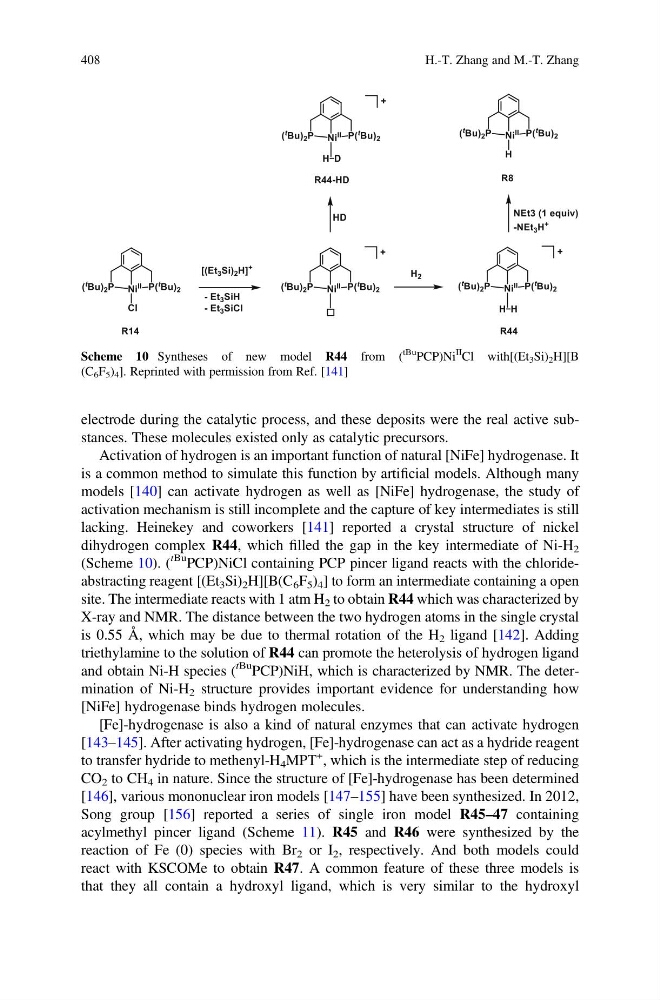
lacking. Heinekey and coworkers [141] reported a crystal structure of nickel
dihydrogen complex R44, which filled the gap in the key intermediate of Ni-H 2
(Scheme 10). (
tBu PCP)NiCl containing PCP pincer ligand reacts with the chlorideabstracting reagent [(Et 3 Si) 2 H][B(C 6 F 5 ) 4 ] to form an intermediate containing a open
site. The intermediate reacts with 1 atm H 2 to obtain R44 which was characterized by
X-ray and NMR. The distance between the two hydrogen atoms in the single crystal
is 0.55 Å, which may be due to thermal rotation of the H 2 ligand [142]. Adding
triethylamine to the solution of R44 can promote the heterolysis of hydrogen ligand
and obtain Ni-H species (
tBu PCP)NiH, which is characterized by NMR. The determination of Ni-H 2 structure provides important evidence for understanding how
[NiFe] hydrogenase binds hydrogen molecules.
[Fe]-hydrogenase is also a kind of natural enzymes that can activate hydrogen
[143–145]. After activating hydrogen, [Fe]-hydrogenase can act as a hydride reagent
to transfer hydride to methenyl-H 4 MPT
+ , which is the intermediate step of reducing
CO 2 to CH 4 in nature. Since the structure of [Fe]-hydrogenase has been determined
[146], various mononuclear iron models [147–155] have been synthesized. In 2012,
Song group [156] reported a series of single iron model R45–47 containing
acylmethyl pincer ligand (Scheme 11). R45 and R46 were synthesized by the
reaction of Fe (0) species with Br 2 or I 2 , respectively. And both models could
react with KSCOMe to obtain R47. A common feature of these three models is
that they all contain a hydroxyl ligand, which is very similar to the hydroxyl
Scheme 10 Syntheses of new model R44 from (
tBu PCP)Ni
II
Cl with[(Et 3 Si) 2 H][B
(C 6 F 5 ) 4 ]. Reprinted with permission from Ref. [141]
408
H.-T. Zhang and M.-T. Zhang
Activation of hydrogen is an important function of natural [NiFe] hydrogenase. It
is a common method to simulate this function by artificial models. Although many
models [140] can activate hydrogen as well as [NiFe] hydrogenase, the study of
activation mechanism is still incomplete and the capture of key intermediates is still
lacking. Heinekey and coworkers [141] reported a crystal structure of nickel
dihydrogen complex R44, which filled the gap in the key intermediate of Ni-H 2
(Scheme 10). (
tBu PCP)NiCl containing PCP pincer ligand reacts with the chlorideabstracting reagent [(Et 3 Si) 2 H][B(C 6 F 5 ) 4 ] to form an intermediate containing a open
site. The intermediate reacts with 1 atm H 2 to obtain R44 which was characterized by
X-ray and NMR. The distance between the two hydrogen atoms in the single crystal
is 0.55 Å, which may be due to thermal rotation of the H 2 ligand [142]. Adding
triethylamine to the solution of R44 can promote the heterolysis of hydrogen ligand
and obtain Ni-H species (
tBu PCP)NiH, which is characterized by NMR. The determination of Ni-H 2 structure provides important evidence for understanding how
[NiFe] hydrogenase binds hydrogen molecules.
[Fe]-hydrogenase is also a kind of natural enzymes that can activate hydrogen
[143–145]. After activating hydrogen, [Fe]-hydrogenase can act as a hydride reagent
to transfer hydride to methenyl-H 4 MPT
+ , which is the intermediate step of reducing
CO 2 to CH 4 in nature. Since the structure of [Fe]-hydrogenase has been determined
[146], various mononuclear iron models [147–155] have been synthesized. In 2012,
Song group [156] reported a series of single iron model R45–47 containing
acylmethyl pincer ligand (Scheme 11). R45 and R46 were synthesized by the
reaction of Fe (0) species with Br 2 or I 2 , respectively. And both models could
react with KSCOMe to obtain R47. A common feature of these three models is
that they all contain a hydroxyl ligand, which is very similar to the hydroxyl
Scheme 10 Syntheses of new model R44 from (
tBu PCP)Ni
II
Cl with[(Et 3 Si) 2 H][B
(C 6 F 5 ) 4 ]. Reprinted with permission from Ref. [141]
408
H.-T. Zhang and M.-T. Zhang