

calcium (Mn 4 Ca) cluster which can be used to catalyze water oxidation to promote
oxygen release [11–14].
6CO 2 þ 12H 2 O ! C 6 H 12 O 6 þ 6O 2 þ 6H 2 O
ð1Þ
Inspired by this natural system, great efforts have been made on artificial photosynthesis systems for water splitting to achieve the conversion of solar energy to
clean and renewable hydrogen energy (Eq. 2). The artificial device needs several
basic but challenging photophysical steps and complex catalytic conversion to
achieve the combination of two half reactions [16–18]: (1) Oxidation of H 2 O to
release O 2 and generate multiple protons and electrons (Eq. 3); (2) Reduction of H
+
to form molecular hydrogen (Eq. 4) [1–3, 6–10].
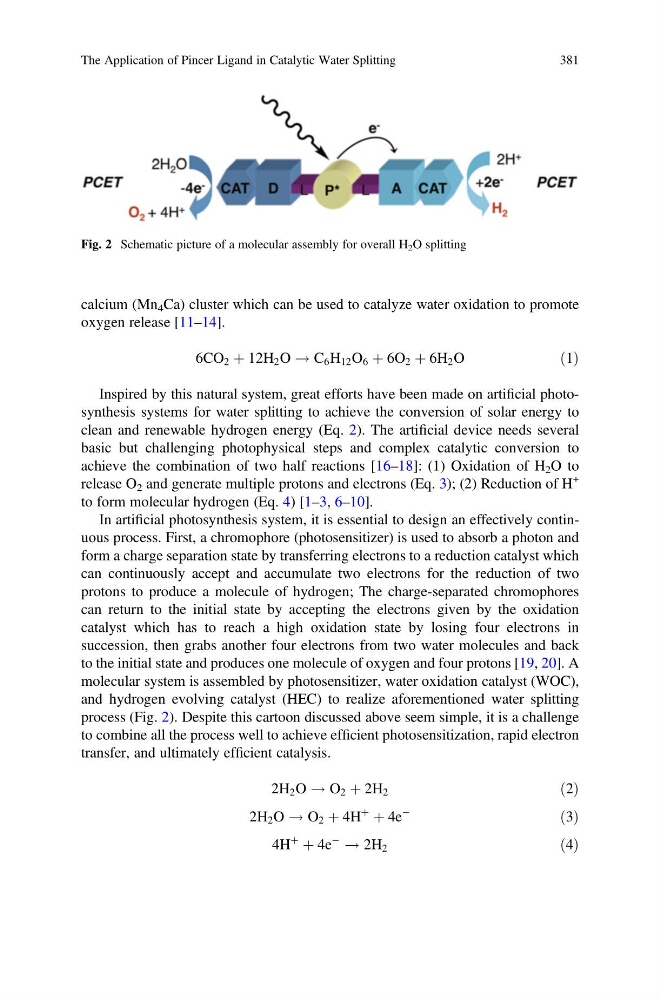
In artificial photosynthesis system, it is essential to design an effectively continuous process. First, a chromophore (photosensitizer) is used to absorb a photon and
form a charge separation state by transferring electrons to a reduction catalyst which
can continuously accept and accumulate two electrons for the reduction of two
protons to produce a molecule of hydrogen; The charge-separated chromophores
can return to the initial state by accepting the electrons given by the oxidation
catalyst which has to reach a high oxidation state by losing four electrons in
succession, then grabs another four electrons from two water molecules and back
to the initial state and produces one molecule of oxygen and four protons [19, 20]. A
molecular system is assembled by photosensitizer, water oxidation catalyst (WOC),
and hydrogen evolving catalyst (HEC) to realize aforementioned water splitting
process (Fig. 2). Despite this cartoon discussed above seem simple, it is a challenge
to combine all the process well to achieve efficient photosensitization, rapid electron
transfer, and ultimately efficient catalysis.
2H 2 O ! O 2 þ 2H 2
ð2Þ
2H 2 O ! O 2 þ 4H
þ
þ 4e
À
ð3Þ
4H
þ
þ 4e
À
! 2H 2
ð4Þ
Fig. 2 Schematic picture of a molecular assembly for overall H 2 O splitting
The Application of Pincer Ligand in Catalytic Water Splitting
381
oxygen release [11–14].
6CO 2 þ 12H 2 O ! C 6 H 12 O 6 þ 6O 2 þ 6H 2 O
ð1Þ
Inspired by this natural system, great efforts have been made on artificial photosynthesis systems for water splitting to achieve the conversion of solar energy to
clean and renewable hydrogen energy (Eq. 2). The artificial device needs several
basic but challenging photophysical steps and complex catalytic conversion to
achieve the combination of two half reactions [16–18]: (1) Oxidation of H 2 O to
release O 2 and generate multiple protons and electrons (Eq. 3); (2) Reduction of H
+
to form molecular hydrogen (Eq. 4) [1–3, 6–10].
In artificial photosynthesis system, it is essential to design an effectively continuous process. First, a chromophore (photosensitizer) is used to absorb a photon and
form a charge separation state by transferring electrons to a reduction catalyst which
can continuously accept and accumulate two electrons for the reduction of two
protons to produce a molecule of hydrogen; The charge-separated chromophores
can return to the initial state by accepting the electrons given by the oxidation
catalyst which has to reach a high oxidation state by losing four electrons in
succession, then grabs another four electrons from two water molecules and back
to the initial state and produces one molecule of oxygen and four protons [19, 20]. A
molecular system is assembled by photosensitizer, water oxidation catalyst (WOC),
and hydrogen evolving catalyst (HEC) to realize aforementioned water splitting
process (Fig. 2). Despite this cartoon discussed above seem simple, it is a challenge
to combine all the process well to achieve efficient photosensitization, rapid electron
transfer, and ultimately efficient catalysis.
2H 2 O ! O 2 þ 2H 2
ð2Þ
2H 2 O ! O 2 þ 4H
þ
þ 4e
À
ð3Þ
4H
þ
þ 4e
À
! 2H 2
ð4Þ
Fig. 2 Schematic picture of a molecular assembly for overall H 2 O splitting
The Application of Pincer Ligand in Catalytic Water Splitting
381