

1 Introduction
The study of catalytic water splitting is one of the most active areas of research
across many sub-disciplines of chemistry [1–10]. To understand the mechanistic
details and design artificial molecular catalysts for both water reduction (Hydrogen
Evolution Reaction, HER) and water oxidation (Oxygen Evolution Reaction, OER)
continue to be a challenge for the development of artificial photosynthetic system.
The search for novel and improved water splitting has led to the development of a
number of homogeneous and heterogeneous catalysts for HER and OER. In the
following sections, this chapter will focus on the summarization of recent development in the rapidly growing field of artificial molecular catalysts with pincer ligand
for both HER and OER.
1.1 Artificial Photosynthesis
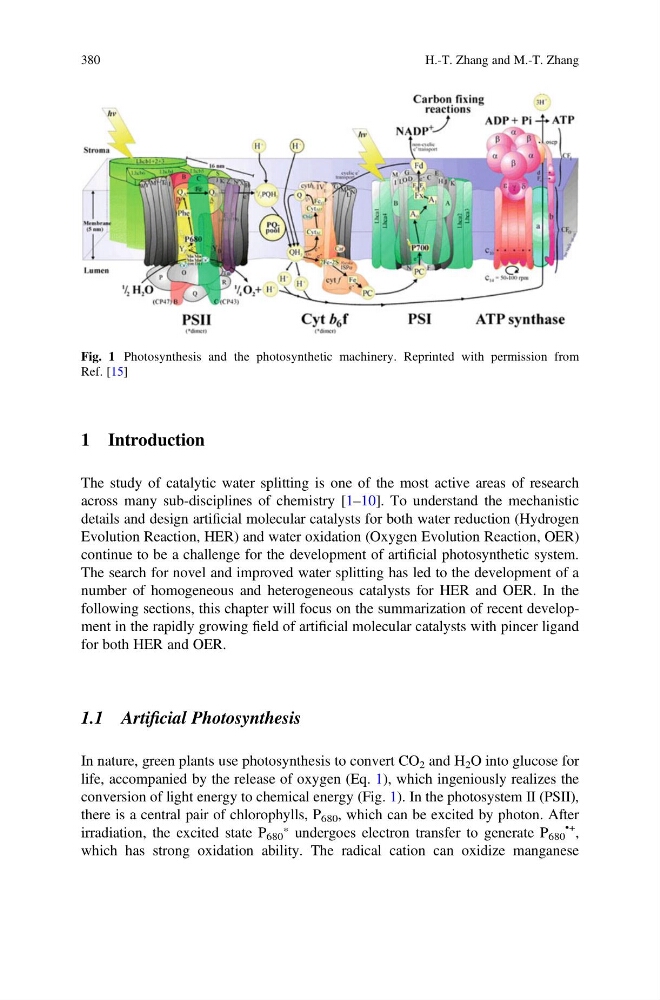
In nature, green plants use photosynthesis to convert CO 2 and H 2 O into glucose for
life, accompanied by the release of oxygen (Eq. 1), which ingeniously realizes the
conversion of light energy to chemical energy (Fig. 1). In the photosystem II (PSII),
there is a central pair of chlorophylls, P 680 , which can be excited by photon. After
irradiation, the excited state P 680
* undergoes electron transfer to generate P 680
•+
,
which has strong oxidation ability. The radical cation can oxidize manganese
Fig. 1 Photosynthesis and the photosynthetic machinery. Reprinted with permission from
Ref. [15]
380
H.-T. Zhang and M.-T. Zhang
The study of catalytic water splitting is one of the most active areas of research
across many sub-disciplines of chemistry [1–10]. To understand the mechanistic
details and design artificial molecular catalysts for both water reduction (Hydrogen
Evolution Reaction, HER) and water oxidation (Oxygen Evolution Reaction, OER)
continue to be a challenge for the development of artificial photosynthetic system.
The search for novel and improved water splitting has led to the development of a
number of homogeneous and heterogeneous catalysts for HER and OER. In the
following sections, this chapter will focus on the summarization of recent development in the rapidly growing field of artificial molecular catalysts with pincer ligand
for both HER and OER.
1.1 Artificial Photosynthesis
In nature, green plants use photosynthesis to convert CO 2 and H 2 O into glucose for
life, accompanied by the release of oxygen (Eq. 1), which ingeniously realizes the
conversion of light energy to chemical energy (Fig. 1). In the photosystem II (PSII),
there is a central pair of chlorophylls, P 680 , which can be excited by photon. After
irradiation, the excited state P 680
* undergoes electron transfer to generate P 680
•+
,
which has strong oxidation ability. The radical cation can oxidize manganese
Fig. 1 Photosynthesis and the photosynthetic machinery. Reprinted with permission from
Ref. [15]
380
H.-T. Zhang and M.-T. Zhang