

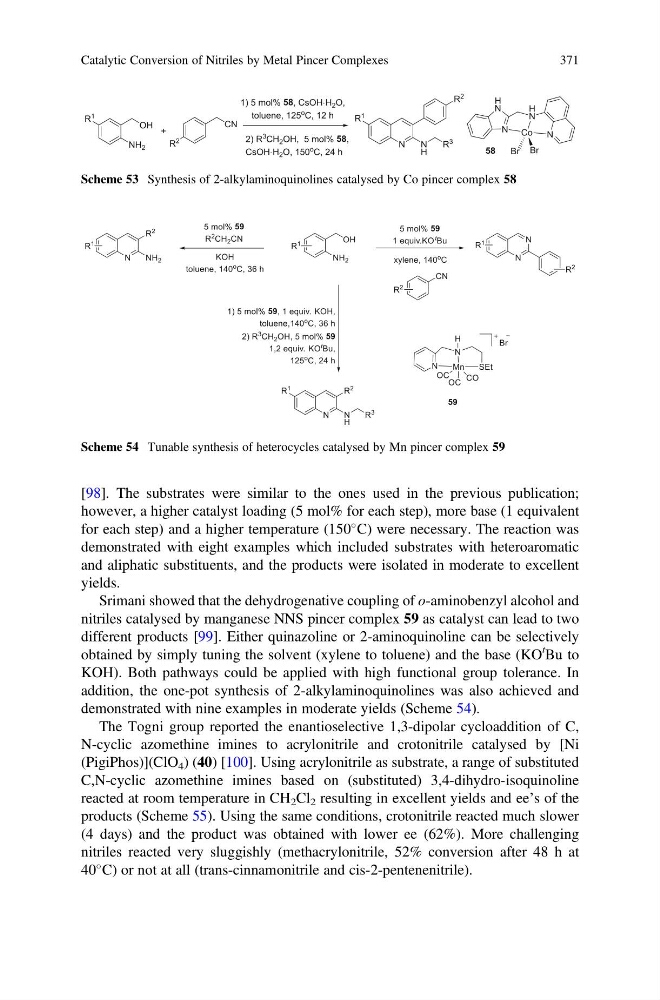
[98]. The substrates were similar to the ones used in the previous publication;
however, a higher catalyst loading (5 mol% for each step), more base (1 equivalent
for each step) and a higher temperature (150
C) were necessary. The reaction was
demonstrated with eight examples which included substrates with heteroaromatic
and aliphatic substituents, and the products were isolated in moderate to excellent
yields.
Srimani showed that the dehydrogenative coupling of o-aminobenzyl alcohol and
nitriles catalysed by manganese NNS pincer complex 59 as catalyst can lead to two
different products [99]. Either quinazoline or 2-aminoquinoline can be selectively
obtained by simply tuning the solvent (xylene to toluene) and the base (KO
t Bu to
KOH). Both pathways could be applied with high functional group tolerance. In
addition, the one-pot synthesis of 2-alkylaminoquinolines was also achieved and
demonstrated with nine examples in moderate yields (Scheme 54).
The Togni group reported the enantioselective 1,3-dipolar cycloaddition of C,
N-cyclic azomethine imines to acrylonitrile and crotonitrile catalysed by [Ni
(PigiPhos)](ClO 4 ) (40) [100]. Using acrylonitrile as substrate, a range of substituted
C,N-cyclic azomethine imines based on (substituted) 3,4-dihydro-isoquinoline
reacted at room temperature in CH 2 Cl 2 resulting in excellent yields and ee’s of the
products (Scheme 55). Using the same conditions, crotonitrile reacted much slower
(4 days) and the product was obtained with lower ee (62%). More challenging
nitriles reacted very sluggishly (methacrylonitrile, 52% conversion after 48 h at
40
C) or not at all (trans-cinnamonitrile and cis-2-pentenenitrile).
Scheme 53 Synthesis of 2-alkylaminoquinolines catalysed by Co pincer complex 58
Scheme 54 Tunable synthesis of heterocycles catalysed by Mn pincer complex 59
Catalytic Conversion of Nitriles by Metal Pincer Complexes
371
however, a higher catalyst loading (5 mol% for each step), more base (1 equivalent
for each step) and a higher temperature (150
C) were necessary. The reaction was
demonstrated with eight examples which included substrates with heteroaromatic
and aliphatic substituents, and the products were isolated in moderate to excellent
yields.
Srimani showed that the dehydrogenative coupling of o-aminobenzyl alcohol and
nitriles catalysed by manganese NNS pincer complex 59 as catalyst can lead to two
different products [99]. Either quinazoline or 2-aminoquinoline can be selectively
obtained by simply tuning the solvent (xylene to toluene) and the base (KO
t Bu to
KOH). Both pathways could be applied with high functional group tolerance. In
addition, the one-pot synthesis of 2-alkylaminoquinolines was also achieved and
demonstrated with nine examples in moderate yields (Scheme 54).
The Togni group reported the enantioselective 1,3-dipolar cycloaddition of C,
N-cyclic azomethine imines to acrylonitrile and crotonitrile catalysed by [Ni
(PigiPhos)](ClO 4 ) (40) [100]. Using acrylonitrile as substrate, a range of substituted
C,N-cyclic azomethine imines based on (substituted) 3,4-dihydro-isoquinoline
reacted at room temperature in CH 2 Cl 2 resulting in excellent yields and ee’s of the
products (Scheme 55). Using the same conditions, crotonitrile reacted much slower
(4 days) and the product was obtained with lower ee (62%). More challenging
nitriles reacted very sluggishly (methacrylonitrile, 52% conversion after 48 h at
40
C) or not at all (trans-cinnamonitrile and cis-2-pentenenitrile).
Scheme 53 Synthesis of 2-alkylaminoquinolines catalysed by Co pincer complex 58
Scheme 54 Tunable synthesis of heterocycles catalysed by Mn pincer complex 59
Catalytic Conversion of Nitriles by Metal Pincer Complexes
371