

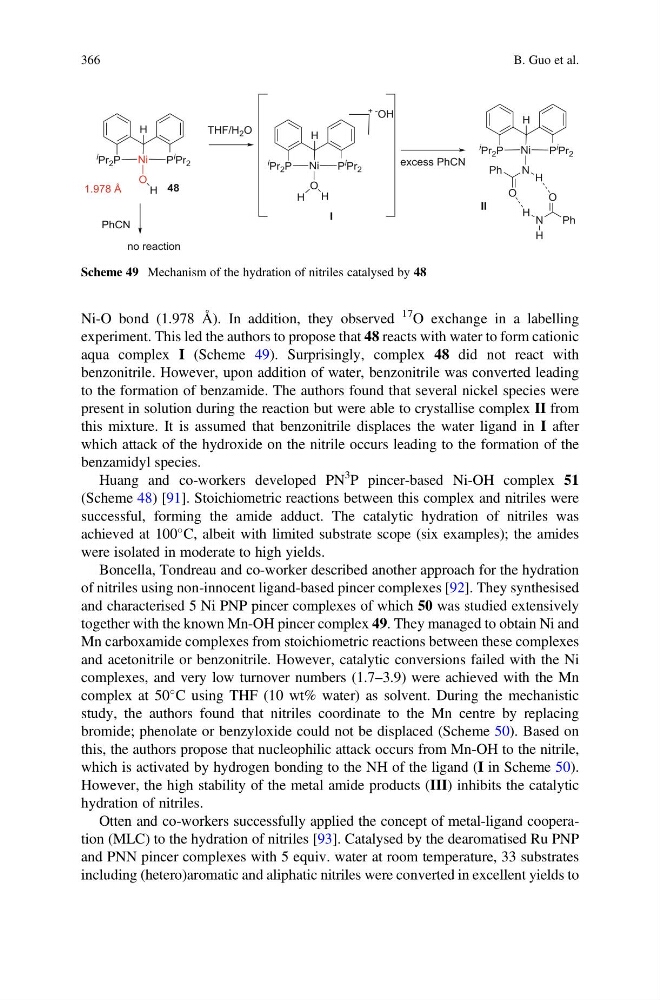
Ni-O bond (1.978 Å). In addition, they observed
17 O exchange in a labelling
experiment. This led the authors to propose that 48 reacts with water to form cationic
aqua complex I (Scheme 49). Surprisingly, complex 48 did not react with
benzonitrile. However, upon addition of water, benzonitrile was converted leading
to the formation of benzamide. The authors found that several nickel species were
present in solution during the reaction but were able to crystallise complex II from
this mixture. It is assumed that benzonitrile displaces the water ligand in I after
which attack of the hydroxide on the nitrile occurs leading to the formation of the
benzamidyl species.
Huang and co-workers developed PN
3 P pincer-based Ni-OH complex 51
(Scheme 48) [91]. Stoichiometric reactions between this complex and nitriles were
successful, forming the amide adduct. The catalytic hydration of nitriles was
achieved at 100
C, albeit with limited substrate scope (six examples); the amides
were isolated in moderate to high yields.
Boncella, Tondreau and co-worker described another approach for the hydration
of nitriles using non-innocent ligand-based pincer complexes [92]. They synthesised
and characterised 5 Ni PNP pincer complexes of which 50 was studied extensively
together with the known Mn-OH pincer complex 49. They managed to obtain Ni and
Mn carboxamide complexes from stoichiometric reactions between these complexes
and acetonitrile or benzonitrile. However, catalytic conversions failed with the Ni
complexes, and very low turnover numbers (1.7–3.9) were achieved with the Mn
complex at 50
C using THF (10 wt% water) as solvent. During the mechanistic
study, the authors found that nitriles coordinate to the Mn centre by replacing
bromide; phenolate or benzyloxide could not be displaced (Scheme 50). Based on
this, the authors propose that nucleophilic attack occurs from Mn-OH to the nitrile,
which is activated by hydrogen bonding to the NH of the ligand (I in Scheme 50).
However, the high stability of the metal amide products (III) inhibits the catalytic
hydration of nitriles.
Otten and co-workers successfully applied the concept of metal-ligand cooperation (MLC) to the hydration of nitriles [93]. Catalysed by the dearomatised Ru PNP
and PNN pincer complexes with 5 equiv. water at room temperature, 33 substrates
including (hetero)aromatic and aliphatic nitriles were converted in excellent yields to
Scheme 49 Mechanism of the hydration of nitriles catalysed by 48
366
B. Guo et al.
17 O exchange in a labelling
experiment. This led the authors to propose that 48 reacts with water to form cationic
aqua complex I (Scheme 49). Surprisingly, complex 48 did not react with
benzonitrile. However, upon addition of water, benzonitrile was converted leading
to the formation of benzamide. The authors found that several nickel species were
present in solution during the reaction but were able to crystallise complex II from
this mixture. It is assumed that benzonitrile displaces the water ligand in I after
which attack of the hydroxide on the nitrile occurs leading to the formation of the
benzamidyl species.
Huang and co-workers developed PN
3 P pincer-based Ni-OH complex 51
(Scheme 48) [91]. Stoichiometric reactions between this complex and nitriles were
successful, forming the amide adduct. The catalytic hydration of nitriles was
achieved at 100
C, albeit with limited substrate scope (six examples); the amides
were isolated in moderate to high yields.
Boncella, Tondreau and co-worker described another approach for the hydration
of nitriles using non-innocent ligand-based pincer complexes [92]. They synthesised
and characterised 5 Ni PNP pincer complexes of which 50 was studied extensively
together with the known Mn-OH pincer complex 49. They managed to obtain Ni and
Mn carboxamide complexes from stoichiometric reactions between these complexes
and acetonitrile or benzonitrile. However, catalytic conversions failed with the Ni
complexes, and very low turnover numbers (1.7–3.9) were achieved with the Mn
complex at 50
C using THF (10 wt% water) as solvent. During the mechanistic
study, the authors found that nitriles coordinate to the Mn centre by replacing
bromide; phenolate or benzyloxide could not be displaced (Scheme 50). Based on
this, the authors propose that nucleophilic attack occurs from Mn-OH to the nitrile,
which is activated by hydrogen bonding to the NH of the ligand (I in Scheme 50).
However, the high stability of the metal amide products (III) inhibits the catalytic
hydration of nitriles.
Otten and co-workers successfully applied the concept of metal-ligand cooperation (MLC) to the hydration of nitriles [93]. Catalysed by the dearomatised Ru PNP
and PNN pincer complexes with 5 equiv. water at room temperature, 33 substrates
including (hetero)aromatic and aliphatic nitriles were converted in excellent yields to
Scheme 49 Mechanism of the hydration of nitriles catalysed by 48
366
B. Guo et al.