

methacrylonitrile with morpholine. To further increase the enantioselectivity of this
reaction, ionic liquids were explored as solvent [76]. Unfortunately, no improvement
w.r.t. the enantioselectivity resulted from this. Nevertheless, the catalytic activity
was significantly enhanced by the ionic liquids: higher TON (up to 300, compared
with 71 in THF), reusable after five recycles and air stable.
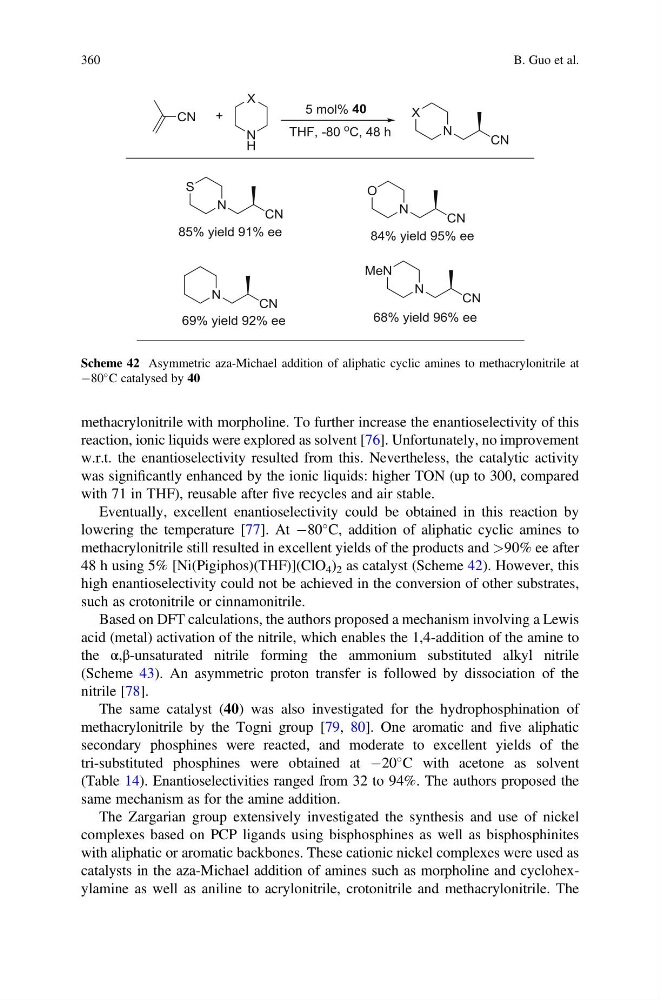
Eventually, excellent enantioselectivity could be obtained in this reaction by
lowering the temperature [77]. At À80
C, addition of aliphatic cyclic amines to
methacrylonitrile still resulted in excellent yields of the products and >90% ee after
48 h using 5% [Ni(Pigiphos)(THF)](ClO 4 ) 2 as catalyst (Scheme 42). However, this
high enantioselectivity could not be achieved in the conversion of other substrates,
such as crotonitrile or cinnamonitrile.
Based on DFT calculations, the authors proposed a mechanism involving a Lewis
acid (metal) activation of the nitrile, which enables the 1,4-addition of the amine to
the α,β-unsaturated nitrile forming the ammonium substituted alkyl nitrile
(Scheme 43). An asymmetric proton transfer is followed by dissociation of the
nitrile [78].
The same catalyst (40) was also investigated for the hydrophosphination of
methacrylonitrile by the Togni group [79, 80]. One aromatic and five aliphatic
secondary phosphines were reacted, and moderate to excellent yields of the
tri-substituted phosphines were obtained at À20
C with acetone as solvent
(Table 14). Enantioselectivities ranged from 32 to 94%. The authors proposed the
same mechanism as for the amine addition.
The Zargarian group extensively investigated the synthesis and use of nickel
complexes based on PCP ligands using bisphosphines as well as bisphosphinites
with aliphatic or aromatic backbones. These cationic nickel complexes were used as
catalysts in the aza-Michael addition of amines such as morpholine and cyclohexylamine as well as aniline to acrylonitrile, crotonitrile and methacrylonitrile. The
Scheme 42 Asymmetric aza-Michael addition of aliphatic cyclic amines to methacrylonitrile at
À80
C catalysed by 40
360
B. Guo et al.
reaction, ionic liquids were explored as solvent [76]. Unfortunately, no improvement
w.r.t. the enantioselectivity resulted from this. Nevertheless, the catalytic activity
was significantly enhanced by the ionic liquids: higher TON (up to 300, compared
with 71 in THF), reusable after five recycles and air stable.
Eventually, excellent enantioselectivity could be obtained in this reaction by
lowering the temperature [77]. At À80
C, addition of aliphatic cyclic amines to
methacrylonitrile still resulted in excellent yields of the products and >90% ee after
48 h using 5% [Ni(Pigiphos)(THF)](ClO 4 ) 2 as catalyst (Scheme 42). However, this
high enantioselectivity could not be achieved in the conversion of other substrates,
such as crotonitrile or cinnamonitrile.
Based on DFT calculations, the authors proposed a mechanism involving a Lewis
acid (metal) activation of the nitrile, which enables the 1,4-addition of the amine to
the α,β-unsaturated nitrile forming the ammonium substituted alkyl nitrile
(Scheme 43). An asymmetric proton transfer is followed by dissociation of the
nitrile [78].
The same catalyst (40) was also investigated for the hydrophosphination of
methacrylonitrile by the Togni group [79, 80]. One aromatic and five aliphatic
secondary phosphines were reacted, and moderate to excellent yields of the
tri-substituted phosphines were obtained at À20
C with acetone as solvent
(Table 14). Enantioselectivities ranged from 32 to 94%. The authors proposed the
same mechanism as for the amine addition.
The Zargarian group extensively investigated the synthesis and use of nickel
complexes based on PCP ligands using bisphosphines as well as bisphosphinites
with aliphatic or aromatic backbones. These cationic nickel complexes were used as
catalysts in the aza-Michael addition of amines such as morpholine and cyclohexylamine as well as aniline to acrylonitrile, crotonitrile and methacrylonitrile. The
Scheme 42 Asymmetric aza-Michael addition of aliphatic cyclic amines to methacrylonitrile at
À80
C catalysed by 40
360
B. Guo et al.