

functional groups including amide, ester, thiol, amine, indole and heterocycles were
tolerated. The authors propose a mechanism in which the nitrile adds across the
ruthenium-nitrogen bond of the activated catalyst I to form a four-membered
metallacycle II containing an imine group (Scheme 27). This complex can isomerise
to the enamide form III in which the NH is exchanged for deuterium to form IV;
isomerisation back to the imine form V and elimination of the nitrile complete the
first deuteration step. The authors observe a species at m/z 669 which they propose
as the protonated form of the fully deuterated adduct V
0 .
However, as discussed in Sect. 3.1 (Scheme 20), Zhang and co-workers
performed DFT calculations on a similar mechanism involving structures II and
III and concluded that the occurrence of such intermediates is highly unlikely in
view of the high barriers that need to be overcome [52]. The species at m/z 669 is
more easily explained by the end-on nitrile adduct VI or by the ketenimide adduct
VIII (Scheme 28; see also structure V in Scheme 22). Deuterium exchange with
D 2 O can either occur by deprotonation at the carbon centre α to the nitrile, the acidity
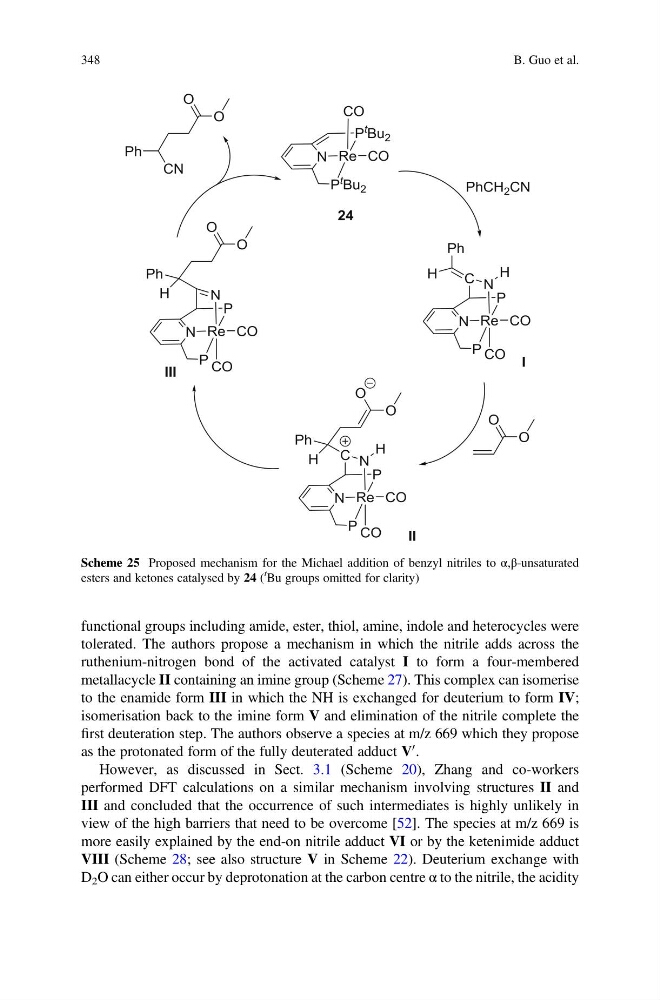
Scheme 25 Proposed mechanism for the Michael addition of benzyl nitriles to α,β-unsaturated
esters and ketones catalysed by 24 (
t
Bu groups omitted for clarity)
348
B. Guo et al.
tolerated. The authors propose a mechanism in which the nitrile adds across the
ruthenium-nitrogen bond of the activated catalyst I to form a four-membered
metallacycle II containing an imine group (Scheme 27). This complex can isomerise
to the enamide form III in which the NH is exchanged for deuterium to form IV;
isomerisation back to the imine form V and elimination of the nitrile complete the
first deuteration step. The authors observe a species at m/z 669 which they propose
as the protonated form of the fully deuterated adduct V
0 .
However, as discussed in Sect. 3.1 (Scheme 20), Zhang and co-workers
performed DFT calculations on a similar mechanism involving structures II and
III and concluded that the occurrence of such intermediates is highly unlikely in
view of the high barriers that need to be overcome [52]. The species at m/z 669 is
more easily explained by the end-on nitrile adduct VI or by the ketenimide adduct
VIII (Scheme 28; see also structure V in Scheme 22). Deuterium exchange with
D 2 O can either occur by deprotonation at the carbon centre α to the nitrile, the acidity
Scheme 25 Proposed mechanism for the Michael addition of benzyl nitriles to α,β-unsaturated
esters and ketones catalysed by 24 (
t
Bu groups omitted for clarity)
348
B. Guo et al.