

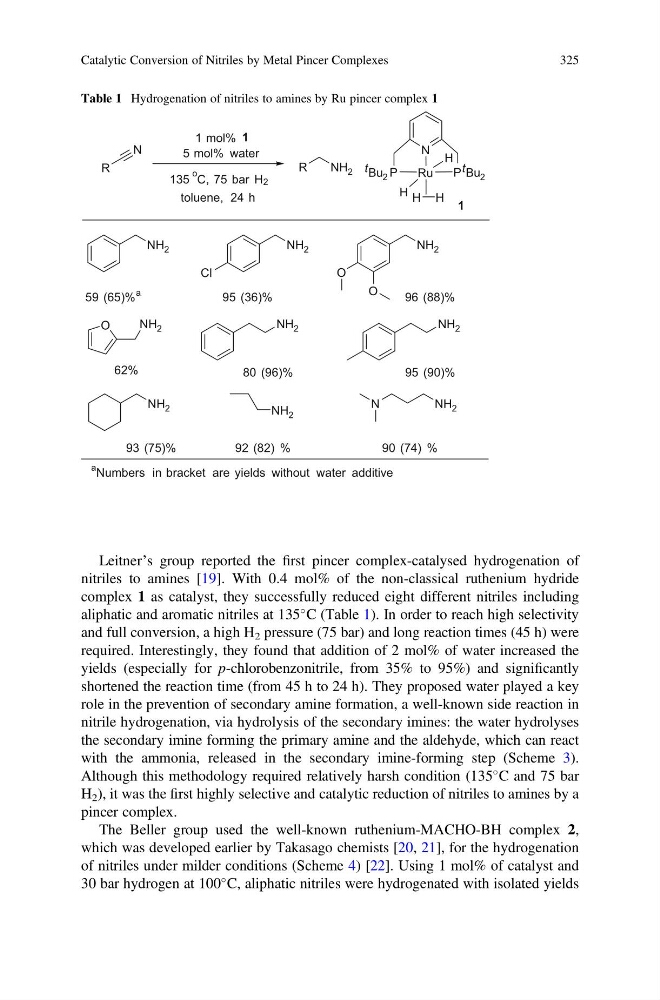
Leitner’s group reported the first pincer complex-catalysed hydrogenation of
nitriles to amines [19]. With 0.4 mol% of the non-classical ruthenium hydride
complex 1 as catalyst, they successfully reduced eight different nitriles including
aliphatic and aromatic nitriles at 135
C (Table 1). In order to reach high selectivity
and full conversion, a high H 2 pressure (75 bar) and long reaction times (45 h) were
required. Interestingly, they found that addition of 2 mol% of water increased the
yields (especially for p-chlorobenzonitrile, from 35% to 95%) and significantly
shortened the reaction time (from 45 h to 24 h). They proposed water played a key
role in the prevention of secondary amine formation, a well-known side reaction in
nitrile hydrogenation, via hydrolysis of the secondary imines: the water hydrolyses
the secondary imine forming the primary amine and the aldehyde, which can react
with the ammonia, released in the secondary imine-forming step (Scheme 3).
Although this methodology required relatively harsh condition (135
C and 75 bar
H 2 ), it was the first highly selective and catalytic reduction of nitriles to amines by a
pincer complex.
The Beller group used the well-known ruthenium-MACHO-BH complex 2,
which was developed earlier by Takasago chemists [20, 21], for the hydrogenation
of nitriles under milder conditions (Scheme 4) [22]. Using 1 mol% of catalyst and
30 bar hydrogen at 100
C, aliphatic nitriles were hydrogenated with isolated yields
Table 1 Hydrogenation of nitriles to amines by Ru pincer complex 1
R
N
R
NH 2
1 mol% 1
5 mol% water
135
o
C, 75 bar H 2
toluene, 24 h
N
t Bu 2 P
P t Bu 2
Ru
H
H
H H
NH 2
59 (65)%
a
NH 2
95 (36)%
Cl
NH 2
O
O
96 (88)%
O
NH 2
62%
NH 2
80 (96)%
NH 2
95 (90)%
NH 2
93 (75)%
NH 2
N
NH 2
90 (74) %
92 (82) %
a Numbers in bracket are yields without water additive
1
Catalytic Conversion of Nitriles by Metal Pincer Complexes
325
nitriles to amines [19]. With 0.4 mol% of the non-classical ruthenium hydride
complex 1 as catalyst, they successfully reduced eight different nitriles including
aliphatic and aromatic nitriles at 135
C (Table 1). In order to reach high selectivity
and full conversion, a high H 2 pressure (75 bar) and long reaction times (45 h) were
required. Interestingly, they found that addition of 2 mol% of water increased the
yields (especially for p-chlorobenzonitrile, from 35% to 95%) and significantly
shortened the reaction time (from 45 h to 24 h). They proposed water played a key
role in the prevention of secondary amine formation, a well-known side reaction in
nitrile hydrogenation, via hydrolysis of the secondary imines: the water hydrolyses
the secondary imine forming the primary amine and the aldehyde, which can react
with the ammonia, released in the secondary imine-forming step (Scheme 3).
Although this methodology required relatively harsh condition (135
C and 75 bar
H 2 ), it was the first highly selective and catalytic reduction of nitriles to amines by a
pincer complex.
The Beller group used the well-known ruthenium-MACHO-BH complex 2,
which was developed earlier by Takasago chemists [20, 21], for the hydrogenation
of nitriles under milder conditions (Scheme 4) [22]. Using 1 mol% of catalyst and
30 bar hydrogen at 100
C, aliphatic nitriles were hydrogenated with isolated yields
Table 1 Hydrogenation of nitriles to amines by Ru pincer complex 1
R
N
R
NH 2
1 mol% 1
5 mol% water
135
o
C, 75 bar H 2
toluene, 24 h
N
t Bu 2 P
P t Bu 2
Ru
H
H
H H
NH 2
59 (65)%
a
NH 2
95 (36)%
Cl
NH 2
O
O
96 (88)%
O
NH 2
62%
NH 2
80 (96)%
NH 2
95 (90)%
NH 2
93 (75)%
NH 2
N
NH 2
90 (74) %
92 (82) %
a Numbers in bracket are yields without water additive
1
Catalytic Conversion of Nitriles by Metal Pincer Complexes
325