

species bearing an alkoxide ligand is more likely than an inner-shell mechanism
requiring loss of one CO ligand [64].
Since a general procedure for the mono-methylation of amines is of great interest,
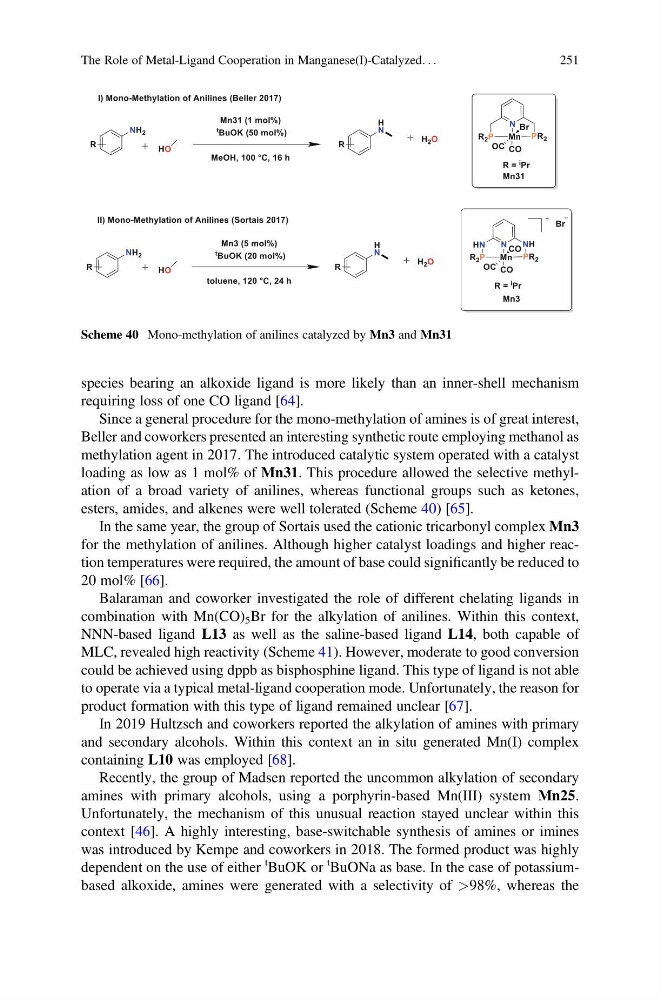
Beller and coworkers presented an interesting synthetic route employing methanol as
methylation agent in 2017. The introduced catalytic system operated with a catalyst
loading as low as 1 mol% of Mn31. This procedure allowed the selective methylation of a broad variety of anilines, whereas functional groups such as ketones,
esters, amides, and alkenes were well tolerated (Scheme 40) [65].
In the same year, the group of Sortais used the cationic tricarbonyl complex Mn3
for the methylation of anilines. Although higher catalyst loadings and higher reaction temperatures were required, the amount of base could significantly be reduced to
20 mol% [66].
Balaraman and coworker investigated the role of different chelating ligands in
combination with Mn(CO) 5 Br for the alkylation of anilines. Within this context,
NNN-based ligand L13 as well as the saline-based ligand L14, both capable of
MLC, revealed high reactivity (Scheme 41). However, moderate to good conversion
could be achieved using dppb as bisphosphine ligand. This type of ligand is not able
to operate via a typical metal-ligand cooperation mode. Unfortunately, the reason for
product formation with this type of ligand remained unclear [67].
In 2019 Hultzsch and coworkers reported the alkylation of amines with primary
and secondary alcohols. Within this context an in situ generated Mn(I) complex
containing L10 was employed [68].
Recently, the group of Madsen reported the uncommon alkylation of secondary
amines with primary alcohols, using a porphyrin-based Mn(III) system Mn25.
Unfortunately, the mechanism of this unusual reaction stayed unclear within this
context [46]. A highly interesting, base-switchable synthesis of amines or imines
was introduced by Kempe and coworkers in 2018. The formed product was highly
dependent on the use of either
t
BuOK or
t BuONa as base. In the case of potassiumbased alkoxide, amines were generated with a selectivity of >98%, whereas the
Scheme 40 Mono-methylation of anilines catalyzed by Mn3 and Mn31
The Role of Metal-Ligand Cooperation in Manganese(I)-Catalyzed. . .
251
requiring loss of one CO ligand [64].
Since a general procedure for the mono-methylation of amines is of great interest,
Beller and coworkers presented an interesting synthetic route employing methanol as
methylation agent in 2017. The introduced catalytic system operated with a catalyst
loading as low as 1 mol% of Mn31. This procedure allowed the selective methylation of a broad variety of anilines, whereas functional groups such as ketones,
esters, amides, and alkenes were well tolerated (Scheme 40) [65].
In the same year, the group of Sortais used the cationic tricarbonyl complex Mn3
for the methylation of anilines. Although higher catalyst loadings and higher reaction temperatures were required, the amount of base could significantly be reduced to
20 mol% [66].
Balaraman and coworker investigated the role of different chelating ligands in
combination with Mn(CO) 5 Br for the alkylation of anilines. Within this context,
NNN-based ligand L13 as well as the saline-based ligand L14, both capable of
MLC, revealed high reactivity (Scheme 41). However, moderate to good conversion
could be achieved using dppb as bisphosphine ligand. This type of ligand is not able
to operate via a typical metal-ligand cooperation mode. Unfortunately, the reason for
product formation with this type of ligand remained unclear [67].
In 2019 Hultzsch and coworkers reported the alkylation of amines with primary
and secondary alcohols. Within this context an in situ generated Mn(I) complex
containing L10 was employed [68].
Recently, the group of Madsen reported the uncommon alkylation of secondary
amines with primary alcohols, using a porphyrin-based Mn(III) system Mn25.
Unfortunately, the mechanism of this unusual reaction stayed unclear within this
context [46]. A highly interesting, base-switchable synthesis of amines or imines
was introduced by Kempe and coworkers in 2018. The formed product was highly
dependent on the use of either
t
BuOK or
t BuONa as base. In the case of potassiumbased alkoxide, amines were generated with a selectivity of >98%, whereas the
Scheme 40 Mono-methylation of anilines catalyzed by Mn3 and Mn31
The Role of Metal-Ligand Cooperation in Manganese(I)-Catalyzed. . .
251