

the in situ generated hydrogen is stored on the metal center in cooperation with the
ligand. The hydrogen can be used for the reduction of the in situ generated unsaturated compounds (e.g., imines or α,β-unsaturated carbonyls). A general reaction
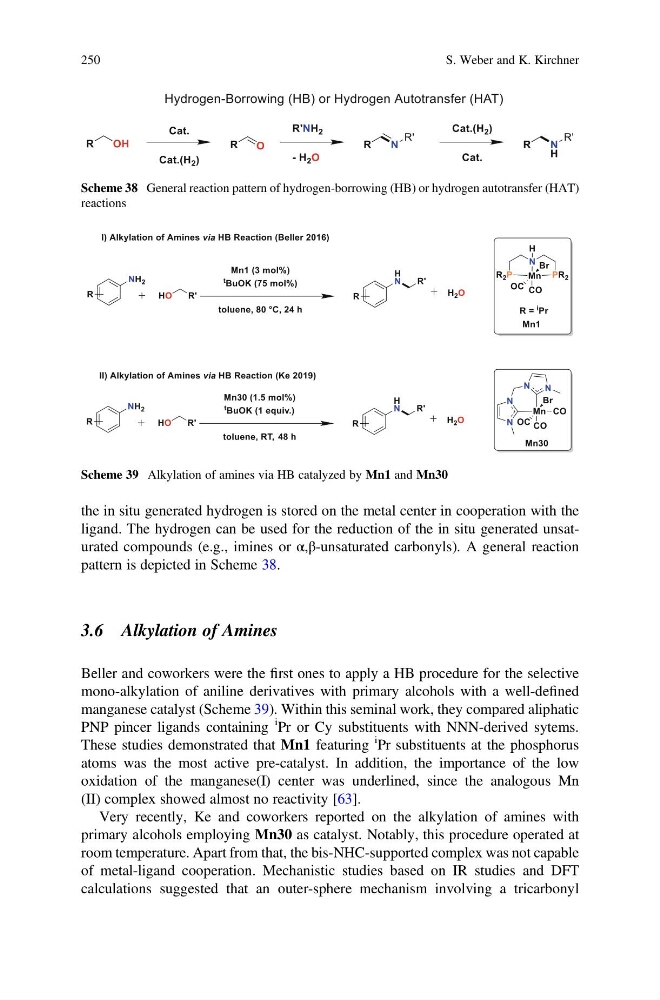
pattern is depicted in Scheme 38.
3.6 Alkylation of Amines
Beller and coworkers were the first ones to apply a HB procedure for the selective
mono-alkylation of aniline derivatives with primary alcohols with a well-defined
manganese catalyst (Scheme 39). Within this seminal work, they compared aliphatic
PNP pincer ligands containing
i Pr or Cy substituents with NNN-derived sytems.
These studies demonstrated that Mn1 featuring
i Pr substituents at the phosphorus
atoms was the most active pre-catalyst. In addition, the importance of the low
oxidation of the manganese(I) center was underlined, since the analogous Mn
(II) complex showed almost no reactivity [63].
Very recently, Ke and coworkers reported on the alkylation of amines with
primary alcohols employing Mn30 as catalyst. Notably, this procedure operated at
room temperature. Apart from that, the bis-NHC-supported complex was not capable
of metal-ligand cooperation. Mechanistic studies based on IR studies and DFT
calculations suggested that an outer-sphere mechanism involving a tricarbonyl
Scheme 38 General reaction pattern of hydrogen-borrowing (HB) or hydrogen autotransfer (HAT)
reactions
Scheme 39 Alkylation of amines via HB catalyzed by Mn1 and Mn30
250
S. Weber and K. Kirchner
ligand. The hydrogen can be used for the reduction of the in situ generated unsaturated compounds (e.g., imines or α,β-unsaturated carbonyls). A general reaction
pattern is depicted in Scheme 38.
3.6 Alkylation of Amines
Beller and coworkers were the first ones to apply a HB procedure for the selective
mono-alkylation of aniline derivatives with primary alcohols with a well-defined
manganese catalyst (Scheme 39). Within this seminal work, they compared aliphatic
PNP pincer ligands containing
i Pr or Cy substituents with NNN-derived sytems.
These studies demonstrated that Mn1 featuring
i Pr substituents at the phosphorus
atoms was the most active pre-catalyst. In addition, the importance of the low
oxidation of the manganese(I) center was underlined, since the analogous Mn
(II) complex showed almost no reactivity [63].
Very recently, Ke and coworkers reported on the alkylation of amines with
primary alcohols employing Mn30 as catalyst. Notably, this procedure operated at
room temperature. Apart from that, the bis-NHC-supported complex was not capable
of metal-ligand cooperation. Mechanistic studies based on IR studies and DFT
calculations suggested that an outer-sphere mechanism involving a tricarbonyl
Scheme 38 General reaction pattern of hydrogen-borrowing (HB) or hydrogen autotransfer (HAT)
reactions
Scheme 39 Alkylation of amines via HB catalyzed by Mn1 and Mn30
250
S. Weber and K. Kirchner