

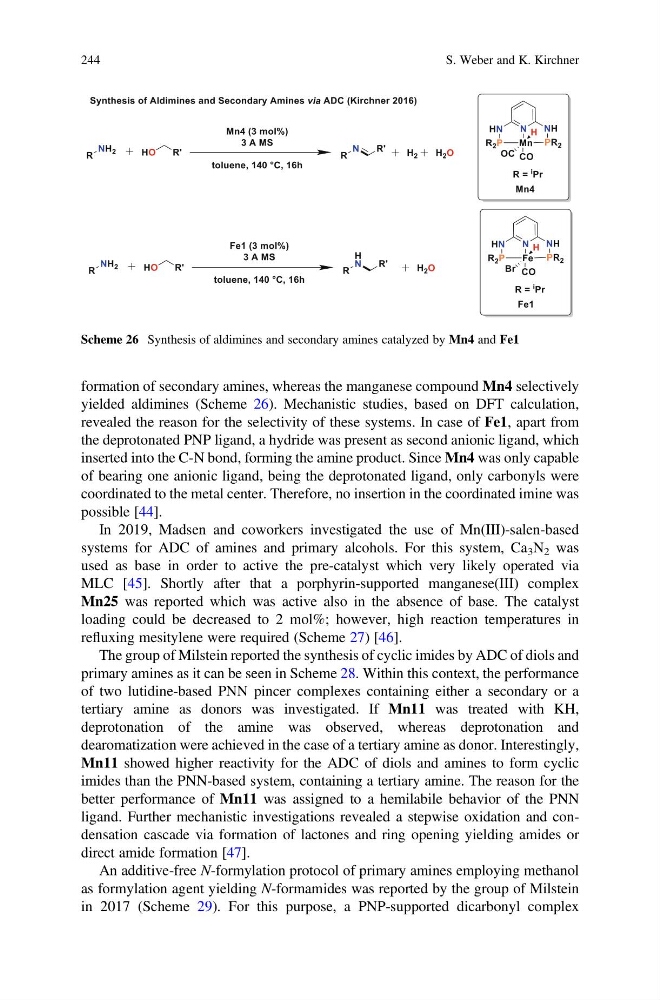
formation of secondary amines, whereas the manganese compound Mn4 selectively
yielded aldimines (Scheme 26). Mechanistic studies, based on DFT calculation,
revealed the reason for the selectivity of these systems. In case of Fe1, apart from
the deprotonated PNP ligand, a hydride was present as second anionic ligand, which
inserted into the C-N bond, forming the amine product. Since Mn4 was only capable
of bearing one anionic ligand, being the deprotonated ligand, only carbonyls were
coordinated to the metal center. Therefore, no insertion in the coordinated imine was
possible [44].
In 2019, Madsen and coworkers investigated the use of Mn(III)-salen-based
systems for ADC of amines and primary alcohols. For this system, Ca 3 N 2 was
used as base in order to active the pre-catalyst which very likely operated via
MLC [45]. Shortly after that a porphyrin-supported manganese(III) complex
Mn25 was reported which was active also in the absence of base. The catalyst
loading could be decreased to 2 mol%; however, high reaction temperatures in
refluxing mesitylene were required (Scheme 27) [46].
The group of Milstein reported the synthesis of cyclic imides by ADC of diols and
primary amines as it can be seen in Scheme 28. Within this context, the performance
of two lutidine-based PNN pincer complexes containing either a secondary or a
tertiary amine as donors was investigated. If Mn11 was treated with KH,
deprotonation of the amine was observed, whereas deprotonation and
dearomatization were achieved in the case of a tertiary amine as donor. Interestingly,
Mn11 showed higher reactivity for the ADC of diols and amines to form cyclic
imides than the PNN-based system, containing a tertiary amine. The reason for the
better performance of Mn11 was assigned to a hemilabile behavior of the PNN
ligand. Further mechanistic investigations revealed a stepwise oxidation and condensation cascade via formation of lactones and ring opening yielding amides or
direct amide formation [47].
An additive-free N-formylation protocol of primary amines employing methanol
as formylation agent yielding N-formamides was reported by the group of Milstein
in 2017 (Scheme 29). For this purpose, a PNP-supported dicarbonyl complex
Scheme 26 Synthesis of aldimines and secondary amines catalyzed by Mn4 and Fe1
244
S. Weber and K. Kirchner
yielded aldimines (Scheme 26). Mechanistic studies, based on DFT calculation,
revealed the reason for the selectivity of these systems. In case of Fe1, apart from
the deprotonated PNP ligand, a hydride was present as second anionic ligand, which
inserted into the C-N bond, forming the amine product. Since Mn4 was only capable
of bearing one anionic ligand, being the deprotonated ligand, only carbonyls were
coordinated to the metal center. Therefore, no insertion in the coordinated imine was
possible [44].
In 2019, Madsen and coworkers investigated the use of Mn(III)-salen-based
systems for ADC of amines and primary alcohols. For this system, Ca 3 N 2 was
used as base in order to active the pre-catalyst which very likely operated via
MLC [45]. Shortly after that a porphyrin-supported manganese(III) complex
Mn25 was reported which was active also in the absence of base. The catalyst
loading could be decreased to 2 mol%; however, high reaction temperatures in
refluxing mesitylene were required (Scheme 27) [46].
The group of Milstein reported the synthesis of cyclic imides by ADC of diols and
primary amines as it can be seen in Scheme 28. Within this context, the performance
of two lutidine-based PNN pincer complexes containing either a secondary or a
tertiary amine as donors was investigated. If Mn11 was treated with KH,
deprotonation of the amine was observed, whereas deprotonation and
dearomatization were achieved in the case of a tertiary amine as donor. Interestingly,
Mn11 showed higher reactivity for the ADC of diols and amines to form cyclic
imides than the PNN-based system, containing a tertiary amine. The reason for the
better performance of Mn11 was assigned to a hemilabile behavior of the PNN
ligand. Further mechanistic investigations revealed a stepwise oxidation and condensation cascade via formation of lactones and ring opening yielding amides or
direct amide formation [47].
An additive-free N-formylation protocol of primary amines employing methanol
as formylation agent yielding N-formamides was reported by the group of Milstein
in 2017 (Scheme 29). For this purpose, a PNP-supported dicarbonyl complex
Scheme 26 Synthesis of aldimines and secondary amines catalyzed by Mn4 and Fe1
244
S. Weber and K. Kirchner