

3 Dehydrogenation and Coupling Reactions
3.1 Acceptorless Dehydrogenative Coupling (ADC) Reactions
An efficient way of using alcohols as carbon source for alkylation of amines is
oxidation of alcohol moieties to the corresponding carbonyl motifs, thereby releasing hydrogen gas. The so-formed carbonyl group forms an imine with the primary
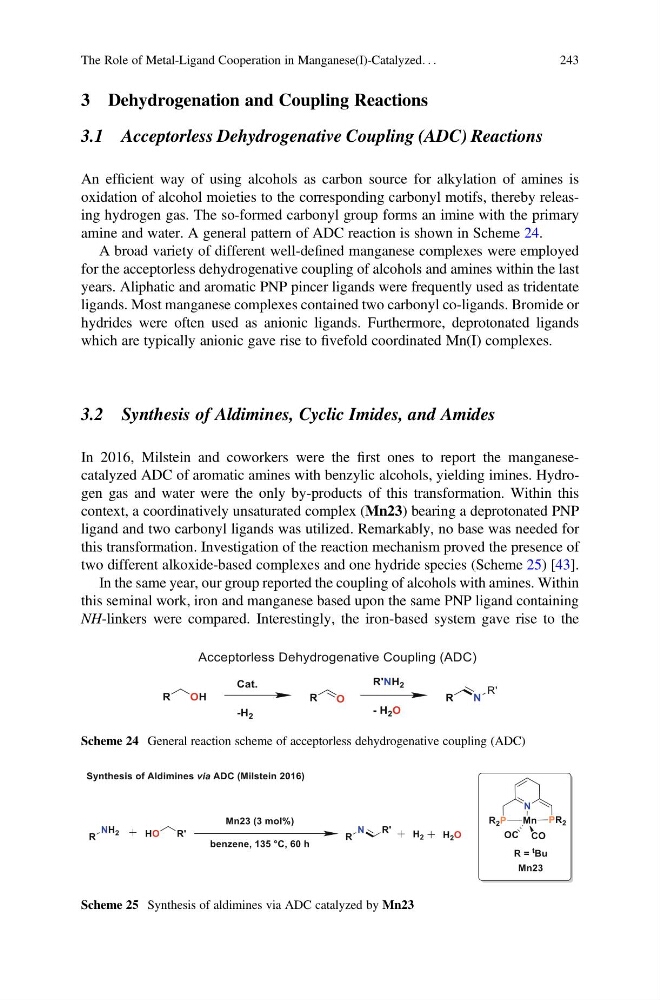
amine and water. A general pattern of ADC reaction is shown in Scheme 24.
A broad variety of different well-defined manganese complexes were employed
for the acceptorless dehydrogenative coupling of alcohols and amines within the last
years. Aliphatic and aromatic PNP pincer ligands were frequently used as tridentate
ligands. Most manganese complexes contained two carbonyl co-ligands. Bromide or
hydrides were often used as anionic ligands. Furthermore, deprotonated ligands
which are typically anionic gave rise to fivefold coordinated Mn(I) complexes.
3.2 Synthesis of Aldimines, Cyclic Imides, and Amides
In 2016, Milstein and coworkers were the first ones to report the manganesecatalyzed ADC of aromatic amines with benzylic alcohols, yielding imines. Hydrogen gas and water were the only by-products of this transformation. Within this
context, a coordinatively unsaturated complex (Mn23) bearing a deprotonated PNP
ligand and two carbonyl ligands was utilized. Remarkably, no base was needed for
this transformation. Investigation of the reaction mechanism proved the presence of
two different alkoxide-based complexes and one hydride species (Scheme 25) [43].
In the same year, our group reported the coupling of alcohols with amines. Within
this seminal work, iron and manganese based upon the same PNP ligand containing
NH-linkers were compared. Interestingly, the iron-based system gave rise to the
Scheme 24 General reaction scheme of acceptorless dehydrogenative coupling (ADC)
Scheme 25 Synthesis of aldimines via ADC catalyzed by Mn23
The Role of Metal-Ligand Cooperation in Manganese(I)-Catalyzed. . .
243
3.1 Acceptorless Dehydrogenative Coupling (ADC) Reactions
An efficient way of using alcohols as carbon source for alkylation of amines is
oxidation of alcohol moieties to the corresponding carbonyl motifs, thereby releasing hydrogen gas. The so-formed carbonyl group forms an imine with the primary
amine and water. A general pattern of ADC reaction is shown in Scheme 24.
A broad variety of different well-defined manganese complexes were employed
for the acceptorless dehydrogenative coupling of alcohols and amines within the last
years. Aliphatic and aromatic PNP pincer ligands were frequently used as tridentate
ligands. Most manganese complexes contained two carbonyl co-ligands. Bromide or
hydrides were often used as anionic ligands. Furthermore, deprotonated ligands
which are typically anionic gave rise to fivefold coordinated Mn(I) complexes.
3.2 Synthesis of Aldimines, Cyclic Imides, and Amides
In 2016, Milstein and coworkers were the first ones to report the manganesecatalyzed ADC of aromatic amines with benzylic alcohols, yielding imines. Hydrogen gas and water were the only by-products of this transformation. Within this
context, a coordinatively unsaturated complex (Mn23) bearing a deprotonated PNP
ligand and two carbonyl ligands was utilized. Remarkably, no base was needed for
this transformation. Investigation of the reaction mechanism proved the presence of
two different alkoxide-based complexes and one hydride species (Scheme 25) [43].
In the same year, our group reported the coupling of alcohols with amines. Within
this seminal work, iron and manganese based upon the same PNP ligand containing
NH-linkers were compared. Interestingly, the iron-based system gave rise to the
Scheme 24 General reaction scheme of acceptorless dehydrogenative coupling (ADC)
Scheme 25 Synthesis of aldimines via ADC catalyzed by Mn23
The Role of Metal-Ligand Cooperation in Manganese(I)-Catalyzed. . .
243