

21-carbaporphyrin 3 (Scheme 52). The molecular design of 3 conserves the virtues
of meso-tetraarylporphyrin 1, including the perfect match between the ionic radii of
an inserted metal and the size of the macrocyclic (CNNN) core opening the route to
original organometallic chemistry in well-defined macrocyclic vessels.
5 Conclusion and Perspectives
In general, the exploration of carbaporphyrinoids enabled addressing several fundamental issues of chemistry, such as the aromaticity of molecules of the Möbius
topology [112, 113], organometallic copper(II) compounds [114, 115], the contraction of the benzene ring to cyclopentadiene [17], or the inclusion of a d-electron
subunit in a π-electron conjugation pathway [4, 116]. Previous studies have shown
that metalloporphyrins act as effective catalysts for oxygenation or C–H bond
functionalization. Their activity and selectivity strongly depend on the central
metal and on the stereoelectronic features of porphyrin ligands
[117, 118]. Metallocarbaporphyrin catalytic activity was correspondingly probed
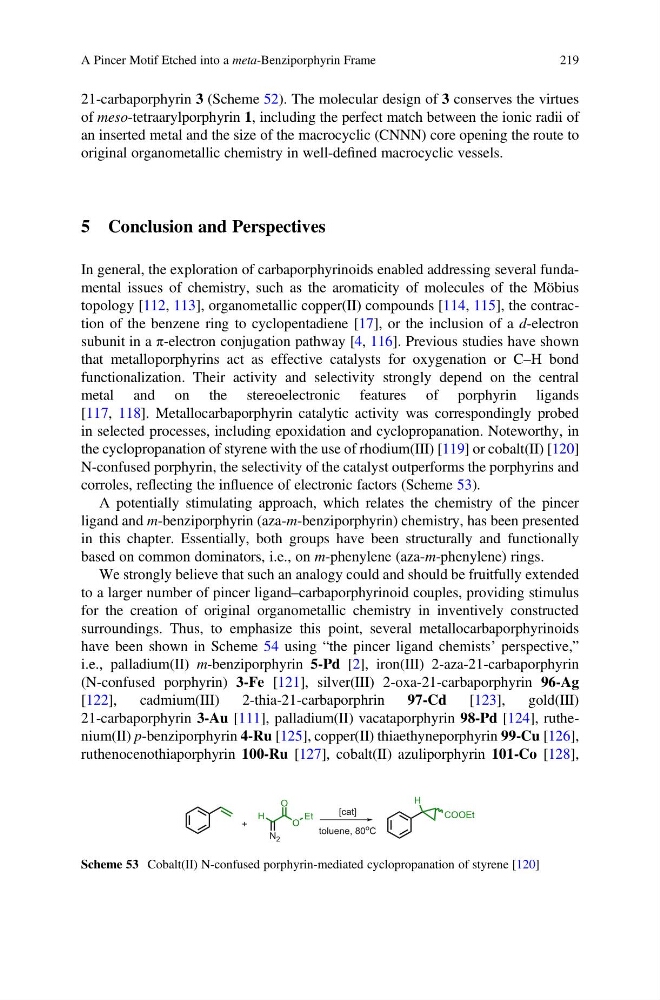
in selected processes, including epoxidation and cyclopropanation. Noteworthy, in
the cyclopropanation of styrene with the use of rhodium(III) [119] or cobalt(II) [120]
N-confused porphyrin, the selectivity of the catalyst outperforms the porphyrins and
corroles, reflecting the influence of electronic factors (Scheme 53).
A potentially stimulating approach, which relates the chemistry of the pincer
ligand and m-benziporphyrin (aza-m-benziporphyrin) chemistry, has been presented
in this chapter. Essentially, both groups have been structurally and functionally
based on common dominators, i.e., on m-phenylene (aza-m-phenylene) rings.
We strongly believe that such an analogy could and should be fruitfully extended
to a larger number of pincer ligand–carbaporphyrinoid couples, providing stimulus
for the creation of original organometallic chemistry in inventively constructed
surroundings. Thus, to emphasize this point, several metallocarbaporphyrinoids
have been shown in Scheme 54 using “the pincer ligand chemists’ perspective,”
i.e., palladium(II) m-benziporphyrin 5-Pd [2], iron(III) 2-aza-21-carbaporphyrin
(N-confused porphyrin) 3-Fe [121], silver(III) 2-oxa-21-carbaporphyrin 96-Ag
[122],
cadmium(III)
2-thia-21-carbaporphrin
97-Cd
[123],
gold(III)
21-carbaporphyrin 3-Au [111], palladium(II) vacataporphyrin 98-Pd [124], ruthenium(II) p-benziporphyrin 4-Ru [125], copper(II) thiaethyneporphyrin 99-Cu [126],
ruthenocenothiaporphyrin 100-Ru [127], cobalt(II) azuliporphyrin 101-Co [128],
N 2
H
O
O
Et
+
H
COOEt
[cat]
toluene, 80
o
C
Scheme 53 Cobalt(II) N-confused porphyrin-mediated cyclopropanation of styrene [120]
A Pincer Motif Etched into a meta-Benziporphyrin Frame
219
of meso-tetraarylporphyrin 1, including the perfect match between the ionic radii of
an inserted metal and the size of the macrocyclic (CNNN) core opening the route to
original organometallic chemistry in well-defined macrocyclic vessels.
5 Conclusion and Perspectives
In general, the exploration of carbaporphyrinoids enabled addressing several fundamental issues of chemistry, such as the aromaticity of molecules of the Möbius
topology [112, 113], organometallic copper(II) compounds [114, 115], the contraction of the benzene ring to cyclopentadiene [17], or the inclusion of a d-electron
subunit in a π-electron conjugation pathway [4, 116]. Previous studies have shown
that metalloporphyrins act as effective catalysts for oxygenation or C–H bond
functionalization. Their activity and selectivity strongly depend on the central
metal and on the stereoelectronic features of porphyrin ligands
[117, 118]. Metallocarbaporphyrin catalytic activity was correspondingly probed
in selected processes, including epoxidation and cyclopropanation. Noteworthy, in
the cyclopropanation of styrene with the use of rhodium(III) [119] or cobalt(II) [120]
N-confused porphyrin, the selectivity of the catalyst outperforms the porphyrins and
corroles, reflecting the influence of electronic factors (Scheme 53).
A potentially stimulating approach, which relates the chemistry of the pincer
ligand and m-benziporphyrin (aza-m-benziporphyrin) chemistry, has been presented
in this chapter. Essentially, both groups have been structurally and functionally
based on common dominators, i.e., on m-phenylene (aza-m-phenylene) rings.
We strongly believe that such an analogy could and should be fruitfully extended
to a larger number of pincer ligand–carbaporphyrinoid couples, providing stimulus
for the creation of original organometallic chemistry in inventively constructed
surroundings. Thus, to emphasize this point, several metallocarbaporphyrinoids
have been shown in Scheme 54 using “the pincer ligand chemists’ perspective,”
i.e., palladium(II) m-benziporphyrin 5-Pd [2], iron(III) 2-aza-21-carbaporphyrin
(N-confused porphyrin) 3-Fe [121], silver(III) 2-oxa-21-carbaporphyrin 96-Ag
[122],
cadmium(III)
2-thia-21-carbaporphrin
97-Cd
[123],
gold(III)
21-carbaporphyrin 3-Au [111], palladium(II) vacataporphyrin 98-Pd [124], ruthenium(II) p-benziporphyrin 4-Ru [125], copper(II) thiaethyneporphyrin 99-Cu [126],
ruthenocenothiaporphyrin 100-Ru [127], cobalt(II) azuliporphyrin 101-Co [128],
N 2
H
O
O
Et
+
H
COOEt
[cat]
toluene, 80
o
C
Scheme 53 Cobalt(II) N-confused porphyrin-mediated cyclopropanation of styrene [120]
A Pincer Motif Etched into a meta-Benziporphyrin Frame
219