

4.6 Contraction: General Remarks
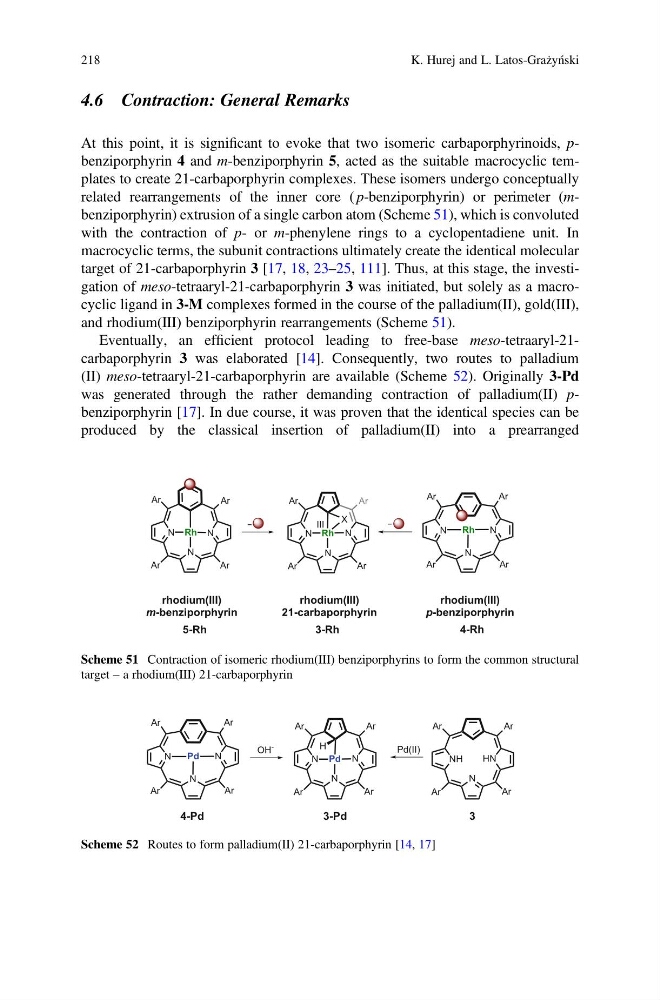
At this point, it is significant to evoke that two isomeric carbaporphyrinoids, pbenziporphyrin 4 and m-benziporphyrin 5, acted as the suitable macrocyclic templates to create 21-carbaporphyrin complexes. These isomers undergo conceptually
related rearrangements of the inner core ( p-benziporphyrin) or perimeter (mbenziporphyrin) extrusion of a single carbon atom (Scheme 51), which is convoluted
with the contraction of p- or m-phenylene rings to a cyclopentadiene unit. In
macrocyclic terms, the subunit contractions ultimately create the identical molecular
target of 21-carbaporphyrin 3 [17, 18, 23–25, 111]. Thus, at this stage, the investigation of meso-tetraaryl-21-carbaporphyrin 3 was initiated, but solely as a macrocyclic ligand in 3-M complexes formed in the course of the palladium(II), gold(III),
and rhodium(III) benziporphyrin rearrangements (Scheme 51).
Eventually, an efficient protocol leading to free-base meso-tetraaryl-21carbaporphyrin 3 was elaborated [14]. Consequently, two routes to palladium
(II) meso-tetraaryl-21-carbaporphyrin are available (Scheme 52). Originally 3-Pd
was generated through the rather demanding contraction of palladium(II) pbenziporphyrin [17]. In due course, it was proven that the identical species can be
produced by the classical insertion of palladium(II) into a prearranged
N
N
N
Ar
Ar
Ar
Ar
Pd
N
HN
NH
Ar
Ar
Ar
Ar
N
N
N
Ar
Ar
Ar
Ar
Pd
H
OH
-
Pd(II)
4-Pd
3-Pd
3
Scheme 52 Routes to form palladium(II) 21-carbaporphyrin [14, 17]
N
N
N
Ar
Ar
Ar
Ar
N
N
N
Ar
Ar
Ar
Ar
N
N
N
Ar
Ar
Ar
Ar
Rh
X
III
Rh
Rh
rhodium(III)
m-benziporphyrin
rhodium(III)
p-benziporphyrin
rhodium(III)
21-carbaporphyrin
5-Rh
3-Rh
4-Rh
Scheme 51 Contraction of isomeric rhodium(III) benziporphyrins to form the common structural
target – a rhodium(III) 21-carbaporphyrin
218
K. Hurej and L. Latos-Grażyński
At this point, it is significant to evoke that two isomeric carbaporphyrinoids, pbenziporphyrin 4 and m-benziporphyrin 5, acted as the suitable macrocyclic templates to create 21-carbaporphyrin complexes. These isomers undergo conceptually
related rearrangements of the inner core ( p-benziporphyrin) or perimeter (mbenziporphyrin) extrusion of a single carbon atom (Scheme 51), which is convoluted
with the contraction of p- or m-phenylene rings to a cyclopentadiene unit. In
macrocyclic terms, the subunit contractions ultimately create the identical molecular
target of 21-carbaporphyrin 3 [17, 18, 23–25, 111]. Thus, at this stage, the investigation of meso-tetraaryl-21-carbaporphyrin 3 was initiated, but solely as a macrocyclic ligand in 3-M complexes formed in the course of the palladium(II), gold(III),
and rhodium(III) benziporphyrin rearrangements (Scheme 51).
Eventually, an efficient protocol leading to free-base meso-tetraaryl-21carbaporphyrin 3 was elaborated [14]. Consequently, two routes to palladium
(II) meso-tetraaryl-21-carbaporphyrin are available (Scheme 52). Originally 3-Pd
was generated through the rather demanding contraction of palladium(II) pbenziporphyrin [17]. In due course, it was proven that the identical species can be
produced by the classical insertion of palladium(II) into a prearranged
N
N
N
Ar
Ar
Ar
Ar
Pd
N
HN
NH
Ar
Ar
Ar
Ar
N
N
N
Ar
Ar
Ar
Ar
Pd
H
OH
-
Pd(II)
4-Pd
3-Pd
3
Scheme 52 Routes to form palladium(II) 21-carbaporphyrin [14, 17]
N
N
N
Ar
Ar
Ar
Ar
N
N
N
Ar
Ar
Ar
Ar
N
N
N
Ar
Ar
Ar
Ar
Rh
X
III
Rh
Rh
rhodium(III)
m-benziporphyrin
rhodium(III)
p-benziporphyrin
rhodium(III)
21-carbaporphyrin
5-Rh
3-Rh
4-Rh
Scheme 51 Contraction of isomeric rhodium(III) benziporphyrins to form the common structural
target – a rhodium(III) 21-carbaporphyrin
218
K. Hurej and L. Latos-Grażyński