

4.5 Contraction of m-Phenylene
In basic conditions, rhodium(III) 22-(μ-acetaldehyde)-m-benziporphyrin 74-Rh,
formed from rhodium(III) m-benziporphyrin 5-Rh(CO), undergoes a fundamental
transformation of the built-in m-phenylene moiety to create rhodium(III) 21-(μ-acetaldehyde)-21-carbaporphyrins 81-Rh, 82-Rh, and 83-Rh (Scheme 45). The
porphyrinoid coordination core supports the formyl-substituted rhodacyclopropane
motif. In the course of contraction, a perimeter carbon atom (C(2) or C(3)) of 5-Rh
(CO) is completely extruded (81-Rh) or conserved as a formyl substituent of the
emerged cyclopentene ring in 82-Rh and 83-Rh [23].
The X-ray-determined molecular structure of 81-Rh resembles the geometry of
regular metalloporphyrins modified by the insertion of a single carbon atom into an
M–N bond (Fig. 6) [110]. In fact, the structural features of 81-Rh bear some
similarity to the molecular geometry of rhodium(III) μ-methylene-21carbaporphyrin generated via the contraction of rhodium(III) p-benziporphyrin
4-RhCO [18]. Thus, the geometry of 81-Rh demonstrates some tetrahedral distortion around the C(21) carbon atom and, in consequence, implies the Rh(III)ÁÁÁη
2 -C
(21)C(25) bonding mode consistent with the formation of the rhodacyclopropane
ring.
The postulated mechanism of contraction involves an OH
À nucleophilic attack at
the C(3) position forming (74-OH)-Rh. The subsequent rearrangement generated
the bicyclo[3.1.0]hexane frame built into the transient 84. In the third stage, the
extrusion of the perimeter carbon atom took place (Scheme 46).
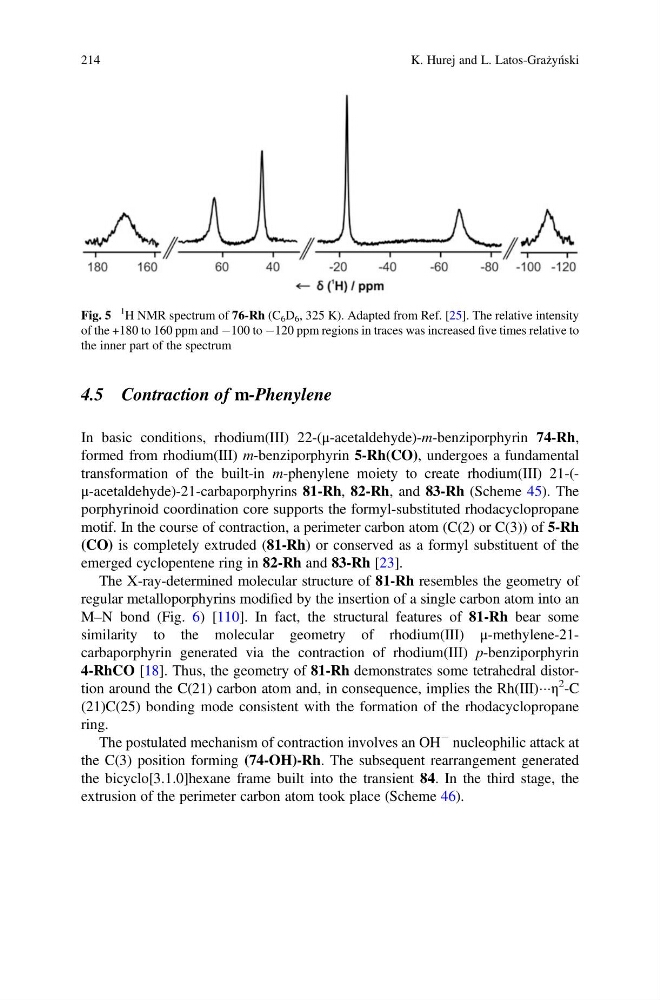
Fig. 5
1
H NMR spectrum of 76-Rh (C 6 D 6 , 325 K). Adapted from Ref. [25]. The relative intensity
of the +180 to 160 ppm and À100 to À120 ppm regions in traces was increased five times relative to
the inner part of the spectrum
214
K. Hurej and L. Latos-Grażyński
In basic conditions, rhodium(III) 22-(μ-acetaldehyde)-m-benziporphyrin 74-Rh,
formed from rhodium(III) m-benziporphyrin 5-Rh(CO), undergoes a fundamental
transformation of the built-in m-phenylene moiety to create rhodium(III) 21-(μ-acetaldehyde)-21-carbaporphyrins 81-Rh, 82-Rh, and 83-Rh (Scheme 45). The
porphyrinoid coordination core supports the formyl-substituted rhodacyclopropane
motif. In the course of contraction, a perimeter carbon atom (C(2) or C(3)) of 5-Rh
(CO) is completely extruded (81-Rh) or conserved as a formyl substituent of the
emerged cyclopentene ring in 82-Rh and 83-Rh [23].
The X-ray-determined molecular structure of 81-Rh resembles the geometry of
regular metalloporphyrins modified by the insertion of a single carbon atom into an
M–N bond (Fig. 6) [110]. In fact, the structural features of 81-Rh bear some
similarity to the molecular geometry of rhodium(III) μ-methylene-21carbaporphyrin generated via the contraction of rhodium(III) p-benziporphyrin
4-RhCO [18]. Thus, the geometry of 81-Rh demonstrates some tetrahedral distortion around the C(21) carbon atom and, in consequence, implies the Rh(III)ÁÁÁη
2 -C
(21)C(25) bonding mode consistent with the formation of the rhodacyclopropane
ring.
The postulated mechanism of contraction involves an OH
À nucleophilic attack at
the C(3) position forming (74-OH)-Rh. The subsequent rearrangement generated
the bicyclo[3.1.0]hexane frame built into the transient 84. In the third stage, the
extrusion of the perimeter carbon atom took place (Scheme 46).
Fig. 5
1
H NMR spectrum of 76-Rh (C 6 D 6 , 325 K). Adapted from Ref. [25]. The relative intensity
of the +180 to 160 ppm and À100 to À120 ppm regions in traces was increased five times relative to
the inner part of the spectrum
214
K. Hurej and L. Latos-Grażyński