

4.4 C–C Bond Activation
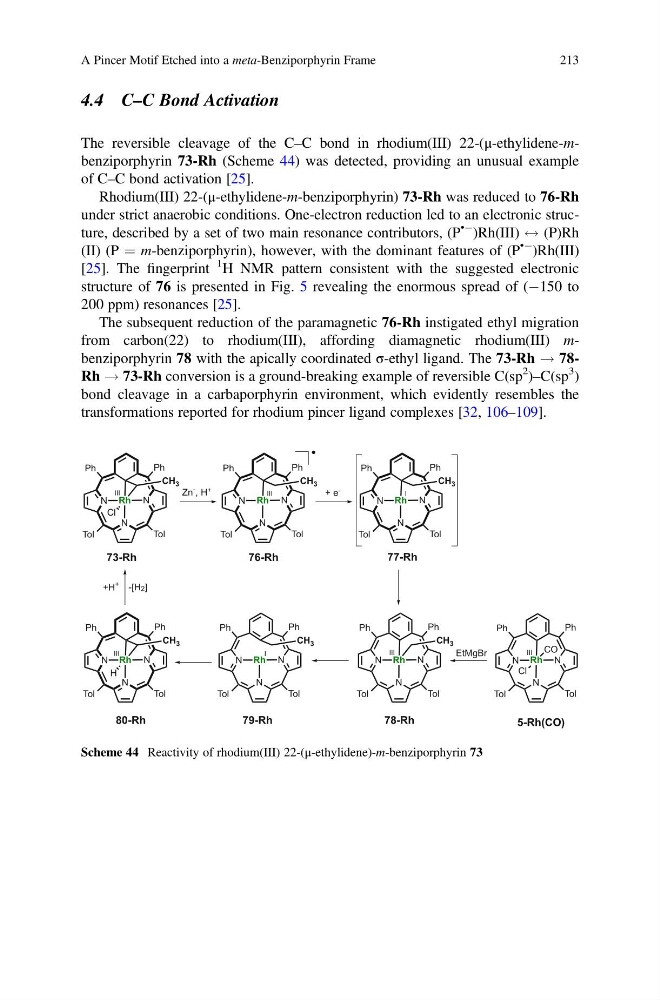
The reversible cleavage of the C–C bond in rhodium(III) 22-(μ-ethylidene-mbenziporphyrin 73-Rh (Scheme 44) was detected, providing an unusual example
of C–C bond activation [25].
Rhodium(III) 22-(μ-ethylidene-m-benziporphyrin) 73-Rh was reduced to 76-Rh
under strict anaerobic conditions. One-electron reduction led to an electronic structure, described by a set of two main resonance contributors, (P
•À )Rh(III) $ (P)Rh
(II) (P ¼ m-benziporphyrin), however, with the dominant features of (P
•À
)Rh(III)
[25]. The fingerprint
1 H NMR pattern consistent with the suggested electronic
structure of 76 is presented in Fig. 5 revealing the enormous spread of (À150 to
200 ppm) resonances [25].
The subsequent reduction of the paramagnetic 76-Rh instigated ethyl migration
from carbon(22) to rhodium(III), affording diamagnetic rhodium(III) mbenziporphyrin 78 with the apically coordinated σ-ethyl ligand. The 73-Rh ! 78Rh ! 73-Rh conversion is a ground-breaking example of reversible C(sp
2 )–C(sp
3 )
bond cleavage in a carbaporphyrin environment, which evidently resembles the
transformations reported for rhodium pincer ligand complexes [32, 106–109].
N
N
N
Ph
Ph
Tol
Tol
Rh
CH 3
N
N
N
Ph
Ph
Tol
Tol
Rh
CH 3
III
Zn
- ,
N
N
N
Ph
Ph
Tol
Tol
Rh
CH 3
I
H +
73-Rh
76-Rh
77-Rh
+ e -
N
N
N
Ph
Ph
Tol
Tol
Rh
CH 3
N
N
N
Ph
Ph
Tol
Tol
Rh
CH 3
I
N
N
N
Ph
Ph
Tol
Tol
Rh
CH 3
H
+H
+ -[H2]
80-Rh
79-Rh
78-Rh
5-Rh(CO)
EtMgBr
Cl
III
III
III
N
N
N
Ph
Ph
Tol
Tol
Rh
CO
Cl
III
Scheme 44 Reactivity of rhodium(III) 22-(μ-ethylidene)-m-benziporphyrin 73
A Pincer Motif Etched into a meta-Benziporphyrin Frame
213
The reversible cleavage of the C–C bond in rhodium(III) 22-(μ-ethylidene-mbenziporphyrin 73-Rh (Scheme 44) was detected, providing an unusual example
of C–C bond activation [25].
Rhodium(III) 22-(μ-ethylidene-m-benziporphyrin) 73-Rh was reduced to 76-Rh
under strict anaerobic conditions. One-electron reduction led to an electronic structure, described by a set of two main resonance contributors, (P
•À )Rh(III) $ (P)Rh
(II) (P ¼ m-benziporphyrin), however, with the dominant features of (P
•À
)Rh(III)
[25]. The fingerprint
1 H NMR pattern consistent with the suggested electronic
structure of 76 is presented in Fig. 5 revealing the enormous spread of (À150 to
200 ppm) resonances [25].
The subsequent reduction of the paramagnetic 76-Rh instigated ethyl migration
from carbon(22) to rhodium(III), affording diamagnetic rhodium(III) mbenziporphyrin 78 with the apically coordinated σ-ethyl ligand. The 73-Rh ! 78Rh ! 73-Rh conversion is a ground-breaking example of reversible C(sp
2 )–C(sp
3 )
bond cleavage in a carbaporphyrin environment, which evidently resembles the
transformations reported for rhodium pincer ligand complexes [32, 106–109].
N
N
N
Ph
Ph
Tol
Tol
Rh
CH 3
N
N
N
Ph
Ph
Tol
Tol
Rh
CH 3
III
Zn
- ,
N
N
N
Ph
Ph
Tol
Tol
Rh
CH 3
I
H +
73-Rh
76-Rh
77-Rh
+ e -
N
N
N
Ph
Ph
Tol
Tol
Rh
CH 3
N
N
N
Ph
Ph
Tol
Tol
Rh
CH 3
I
N
N
N
Ph
Ph
Tol
Tol
Rh
CH 3
H
+H
+ -[H2]
80-Rh
79-Rh
78-Rh
5-Rh(CO)
EtMgBr
Cl
III
III
III
N
N
N
Ph
Ph
Tol
Tol
Rh
CO
Cl
III
Scheme 44 Reactivity of rhodium(III) 22-(μ-ethylidene)-m-benziporphyrin 73
A Pincer Motif Etched into a meta-Benziporphyrin Frame
213