

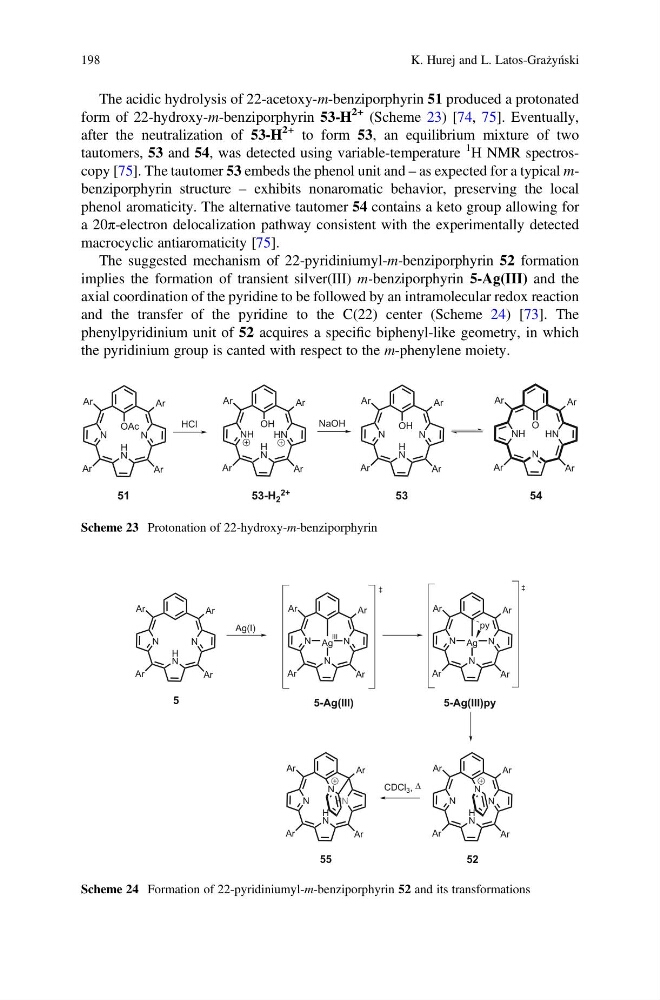
The acidic hydrolysis of 22-acetoxy-m-benziporphyrin 51 produced a protonated
form of 22-hydroxy-m-benziporphyrin 53-H
2+ (Scheme 23) [74, 75]. Eventually,
after the neutralization of 53-H
2+ to form 53, an equilibrium mixture of two
tautomers, 53 and 54, was detected using variable-temperature
1 H NMR spectroscopy [75]. The tautomer 53 embeds the phenol unit and – as expected for a typical mbenziporphyrin structure – exhibits nonaromatic behavior, preserving the local
phenol aromaticity. The alternative tautomer 54 contains a keto group allowing for
a 20π-electron delocalization pathway consistent with the experimentally detected
macrocyclic antiaromaticity [75].
The suggested mechanism of 22-pyridiniumyl-m-benziporphyrin 52 formation
implies the formation of transient silver(III) m-benziporphyrin 5-Ag(III) and the
axial coordination of the pyridine to be followed by an intramolecular redox reaction
and the transfer of the pyridine to the C(22) center (Scheme 24) [73]. The
phenylpyridinium unit of 52 acquires a specific biphenyl-like geometry, in which
the pyridinium group is canted with respect to the m-phenylene moiety.
H
N
N
N
Ar
Ar
Ar
Ar
OAc
HCl
H
N
NH
HN
Ar
Ar
Ar
Ar
OH
NaOH
H
N
N
N
Ar
Ar
Ar
Ar
OH
N
NH
HN
Ar
Ar
Ar
Ar
O
51
53-H 2
2+
53
54
Scheme 23 Protonation of 22-hydroxy-m-benziporphyrin
H
N
N
N
Ar
Ar
Ar
Ar
H
N
N
N
Ar
Ar
Ar
Ar
N
Ag(I)
N
N
N
Ar
Ar
Ar
Ar
Ag
py
N
N
N
Ar
Ar
Ar
Ar
Ag
III
5
5-Ag(III)
5-Ag(III)py
H
N
N
HN
Ar
Ar
Ar
Ar
N
55
52
CDCl 3 , Δ
Scheme 24 Formation of 22-pyridiniumyl-m-benziporphyrin 52 and its transformations
198
K. Hurej and L. Latos-Grażyński
form of 22-hydroxy-m-benziporphyrin 53-H
2+ (Scheme 23) [74, 75]. Eventually,
after the neutralization of 53-H
2+ to form 53, an equilibrium mixture of two
tautomers, 53 and 54, was detected using variable-temperature
1 H NMR spectroscopy [75]. The tautomer 53 embeds the phenol unit and – as expected for a typical mbenziporphyrin structure – exhibits nonaromatic behavior, preserving the local
phenol aromaticity. The alternative tautomer 54 contains a keto group allowing for
a 20π-electron delocalization pathway consistent with the experimentally detected
macrocyclic antiaromaticity [75].
The suggested mechanism of 22-pyridiniumyl-m-benziporphyrin 52 formation
implies the formation of transient silver(III) m-benziporphyrin 5-Ag(III) and the
axial coordination of the pyridine to be followed by an intramolecular redox reaction
and the transfer of the pyridine to the C(22) center (Scheme 24) [73]. The
phenylpyridinium unit of 52 acquires a specific biphenyl-like geometry, in which
the pyridinium group is canted with respect to the m-phenylene moiety.
H
N
N
N
Ar
Ar
Ar
Ar
OAc
HCl
H
N
NH
HN
Ar
Ar
Ar
Ar
OH
NaOH
H
N
N
N
Ar
Ar
Ar
Ar
OH
N
NH
HN
Ar
Ar
Ar
Ar
O
51
53-H 2
2+
53
54
Scheme 23 Protonation of 22-hydroxy-m-benziporphyrin
H
N
N
N
Ar
Ar
Ar
Ar
H
N
N
N
Ar
Ar
Ar
Ar
N
Ag(I)
N
N
N
Ar
Ar
Ar
Ar
Ag
py
N
N
N
Ar
Ar
Ar
Ar
Ag
III
5
5-Ag(III)
5-Ag(III)py
H
N
N
HN
Ar
Ar
Ar
Ar
N
55
52
CDCl 3 , Δ
Scheme 24 Formation of 22-pyridiniumyl-m-benziporphyrin 52 and its transformations
198
K. Hurej and L. Latos-Grażyński