

easily undergoes reversible protonation with trifluoroacetic acid, resulting in the
tricationic form 49. Interestingly, the condensation of 47 and 24-S gave two tautomers of thiapyriporphyrin with a 10% (48-S) and 2% (50) yield [71].
3 m-Benziporphyrins: Transformations
of m-Phenylene Unit
3.1 Inner Core Transformations
R
R
R
R
X
m-Benziporphyrins are prone to undergo a unique transformation when stimulated,
for instance, by the proper choice of an inserted metal cation. Nonetheless, to this
day, a rather limited amount of examples of such reactivity have been reported in the
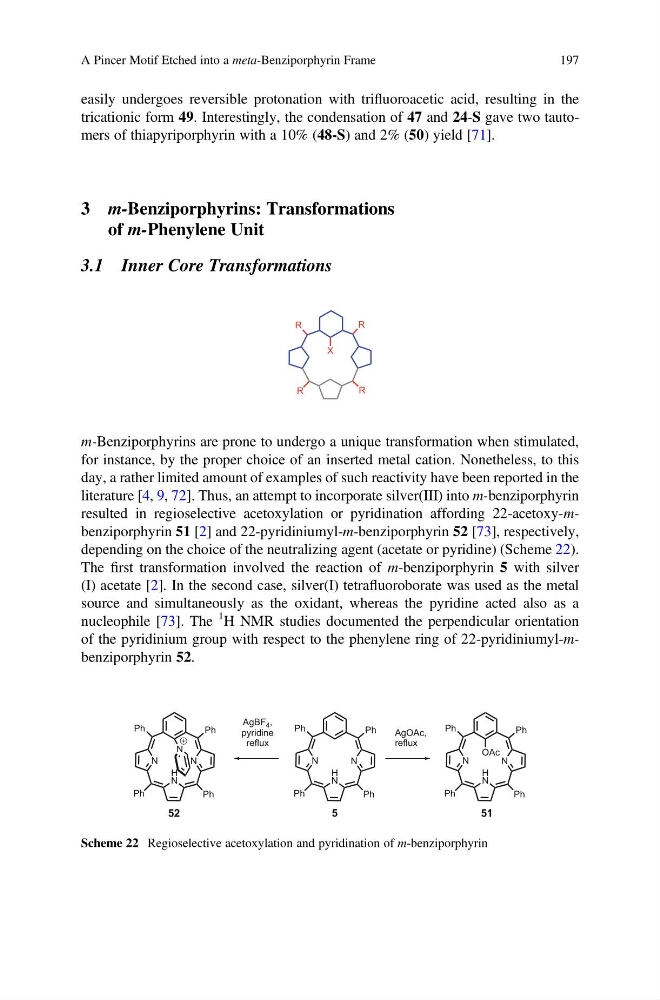
literature [4, 9, 72]. Thus, an attempt to incorporate silver(III) into m-benziporphyrin
resulted in regioselective acetoxylation or pyridination affording 22-acetoxy-mbenziporphyrin 51 [2] and 22-pyridiniumyl-m-benziporphyrin 52 [73], respectively,
depending on the choice of the neutralizing agent (acetate or pyridine) (Scheme 22).
The first transformation involved the reaction of m-benziporphyrin 5 with silver
(I) acetate [2]. In the second case, silver(I) tetrafluoroborate was used as the metal
source and simultaneously as the oxidant, whereas the pyridine acted also as a
nucleophile [73]. The
1 H NMR studies documented the perpendicular orientation
of the pyridinium group with respect to the phenylene ring of 22-pyridiniumyl-mbenziporphyrin 52.
H
N
N
N
Ph
Ph
Ph
Ph
H
N
N
N
Ph
Ph
Ph
Ph
N
51
52
H
N
N
N
Ph
Ph
Ph
Ph
OAc
AgOAc,
reflux
AgBF 4 ,
pyridine
reflux
5
Scheme 22 Regioselective acetoxylation and pyridination of m-benziporphyrin
A Pincer Motif Etched into a meta-Benziporphyrin Frame
197
tricationic form 49. Interestingly, the condensation of 47 and 24-S gave two tautomers of thiapyriporphyrin with a 10% (48-S) and 2% (50) yield [71].
3 m-Benziporphyrins: Transformations
of m-Phenylene Unit
3.1 Inner Core Transformations
R
R
R
R
X
m-Benziporphyrins are prone to undergo a unique transformation when stimulated,
for instance, by the proper choice of an inserted metal cation. Nonetheless, to this
day, a rather limited amount of examples of such reactivity have been reported in the
literature [4, 9, 72]. Thus, an attempt to incorporate silver(III) into m-benziporphyrin
resulted in regioselective acetoxylation or pyridination affording 22-acetoxy-mbenziporphyrin 51 [2] and 22-pyridiniumyl-m-benziporphyrin 52 [73], respectively,
depending on the choice of the neutralizing agent (acetate or pyridine) (Scheme 22).
The first transformation involved the reaction of m-benziporphyrin 5 with silver
(I) acetate [2]. In the second case, silver(I) tetrafluoroborate was used as the metal
source and simultaneously as the oxidant, whereas the pyridine acted also as a
nucleophile [73]. The
1 H NMR studies documented the perpendicular orientation
of the pyridinium group with respect to the phenylene ring of 22-pyridiniumyl-mbenziporphyrin 52.
H
N
N
N
Ph
Ph
Ph
Ph
H
N
N
N
Ph
Ph
Ph
Ph
N
51
52
H
N
N
N
Ph
Ph
Ph
Ph
OAc
AgOAc,
reflux
AgBF 4 ,
pyridine
reflux
5
Scheme 22 Regioselective acetoxylation and pyridination of m-benziporphyrin
A Pincer Motif Etched into a meta-Benziporphyrin Frame
197