

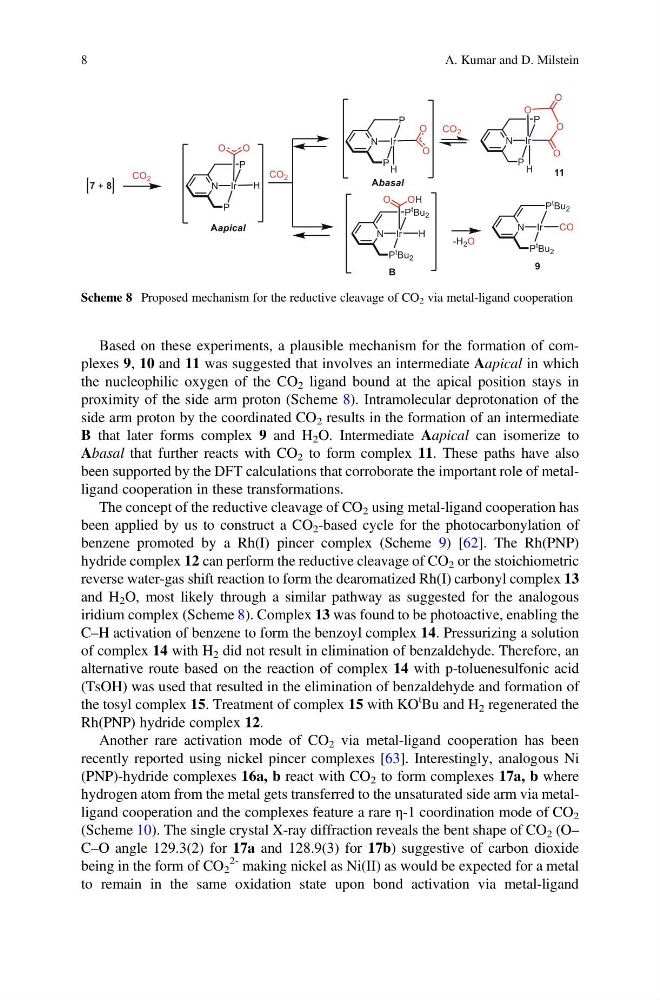
Based on these experiments, a plausible mechanism for the formation of complexes 9, 10 and 11 was suggested that involves an intermediate Aapical in which
the nucleophilic oxygen of the CO 2 ligand bound at the apical position stays in
proximity of the side arm proton (Scheme 8). Intramolecular deprotonation of the
side arm proton by the coordinated CO 2 results in the formation of an intermediate
B that later forms complex 9 and H 2 O. Intermediate Aapical can isomerize to
Abasal that further reacts with CO 2 to form complex 11. These paths have also
been supported by the DFT calculations that corroborate the important role of metalligand cooperation in these transformations.
The concept of the reductive cleavage of CO 2 using metal-ligand cooperation has
been applied by us to construct a CO 2 -based cycle for the photocarbonylation of
benzene promoted by a Rh(I) pincer complex (Scheme 9) [62]. The Rh(PNP)
hydride complex 12 can perform the reductive cleavage of CO 2 or the stoichiometric
reverse water-gas shift reaction to form the dearomatized Rh(I) carbonyl complex 13
and H 2 O, most likely through a similar pathway as suggested for the analogous
iridium complex (Scheme 8). Complex 13 was found to be photoactive, enabling the
C–H activation of benzene to form the benzoyl complex 14. Pressurizing a solution
of complex 14 with H 2 did not result in elimination of benzaldehyde. Therefore, an
alternative route based on the reaction of complex 14 with p-toluenesulfonic acid
(TsOH) was used that resulted in the elimination of benzaldehyde and formation of
the tosyl complex 15. Treatment of complex 15 with KO
t Bu and H 2 regenerated the
Rh(PNP) hydride complex 12.
Another rare activation mode of CO 2 via metal-ligand cooperation has been
recently reported using nickel pincer complexes [63]. Interestingly, analogous Ni
(PNP)-hydride complexes 16a, b react with CO 2 to form complexes 17a, b where
hydrogen atom from the metal gets transferred to the unsaturated side arm via metalligand cooperation and the complexes feature a rare η-1 coordination mode of CO 2
(Scheme 10). The single crystal X-ray diffraction reveals the bent shape of CO 2 (O–
C–O angle 129.3(2) for 17a and 128.9(3) for 17b) suggestive of carbon dioxide
being in the form of CO 2
2- making nickel as Ni(II) as would be expected for a metal
to remain in the same oxidation state upon bond activation via metal-ligand
Scheme 8 Proposed mechanism for the reductive cleavage of CO 2 via metal-ligand cooperation
8
A. Kumar and D. Milstein
the nucleophilic oxygen of the CO 2 ligand bound at the apical position stays in
proximity of the side arm proton (Scheme 8). Intramolecular deprotonation of the
side arm proton by the coordinated CO 2 results in the formation of an intermediate
B that later forms complex 9 and H 2 O. Intermediate Aapical can isomerize to
Abasal that further reacts with CO 2 to form complex 11. These paths have also
been supported by the DFT calculations that corroborate the important role of metalligand cooperation in these transformations.
The concept of the reductive cleavage of CO 2 using metal-ligand cooperation has
been applied by us to construct a CO 2 -based cycle for the photocarbonylation of
benzene promoted by a Rh(I) pincer complex (Scheme 9) [62]. The Rh(PNP)
hydride complex 12 can perform the reductive cleavage of CO 2 or the stoichiometric
reverse water-gas shift reaction to form the dearomatized Rh(I) carbonyl complex 13
and H 2 O, most likely through a similar pathway as suggested for the analogous
iridium complex (Scheme 8). Complex 13 was found to be photoactive, enabling the
C–H activation of benzene to form the benzoyl complex 14. Pressurizing a solution
of complex 14 with H 2 did not result in elimination of benzaldehyde. Therefore, an
alternative route based on the reaction of complex 14 with p-toluenesulfonic acid
(TsOH) was used that resulted in the elimination of benzaldehyde and formation of
the tosyl complex 15. Treatment of complex 15 with KO
t Bu and H 2 regenerated the
Rh(PNP) hydride complex 12.
Another rare activation mode of CO 2 via metal-ligand cooperation has been
recently reported using nickel pincer complexes [63]. Interestingly, analogous Ni
(PNP)-hydride complexes 16a, b react with CO 2 to form complexes 17a, b where
hydrogen atom from the metal gets transferred to the unsaturated side arm via metalligand cooperation and the complexes feature a rare η-1 coordination mode of CO 2
(Scheme 10). The single crystal X-ray diffraction reveals the bent shape of CO 2 (O–
C–O angle 129.3(2) for 17a and 128.9(3) for 17b) suggestive of carbon dioxide
being in the form of CO 2
2- making nickel as Ni(II) as would be expected for a metal
to remain in the same oxidation state upon bond activation via metal-ligand
Scheme 8 Proposed mechanism for the reductive cleavage of CO 2 via metal-ligand cooperation
8
A. Kumar and D. Milstein