

similar to the CO 2 activation reported by Berke using Mo and W complexes [56] and
that recently reported by Hazari and Bernskoetter using an Fe complex [57]
containing macho type PNP ligands.
These complexes based on Fe, Re and Mn have also been utilized for the
hydrogenation of CO 2 to formic acid and its reverse reaction – dehydrogenation of
formic acid to CO 2 and H 2 [53, 54]. Additionally, several other pincer complexes
that can exhibit metal-ligand cooperation (amido/amino mode) have been reported to
catalyse hydrogenation of CO 2 to formic acid and the dehydrogenation of formic
acid to CO 2 and H 2 [58–60].
A rather unique reactivity of CO 2 with a pincer complex has been recently
reported by us where an iridium PNP pincer complex can perform the reductive
cleavage of CO 2 to CO and H 2 O, a proton and a hydride coming from the pincer
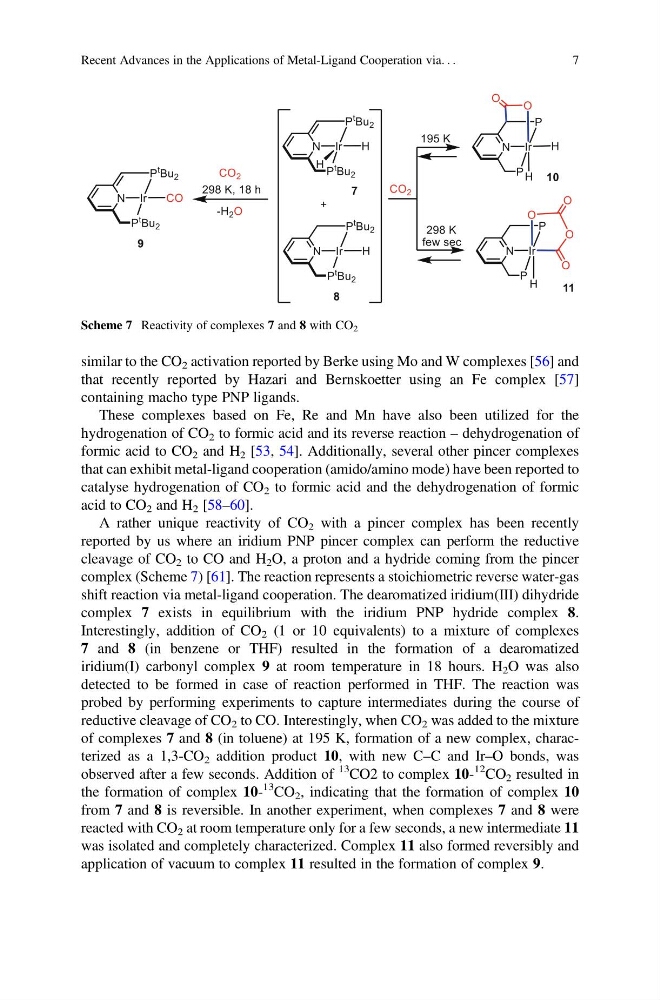
complex (Scheme 7) [61]. The reaction represents a stoichiometric reverse water-gas
shift reaction via metal-ligand cooperation. The dearomatized iridium(III) dihydride
complex 7 exists in equilibrium with the iridium PNP hydride complex 8.
Interestingly, addition of CO 2 (1 or 10 equivalents) to a mixture of complexes
7 and 8 (in benzene or THF) resulted in the formation of a dearomatized
iridium(I) carbonyl complex 9 at room temperature in 18 hours. H 2 O was also
detected to be formed in case of reaction performed in THF. The reaction was
probed by performing experiments to capture intermediates during the course of
reductive cleavage of CO 2 to CO. Interestingly, when CO 2 was added to the mixture
of complexes 7 and 8 (in toluene) at 195 K, formation of a new complex, characterized as a 1,3-CO 2 addition product 10, with new C–C and Ir–O bonds, was
observed after a few seconds. Addition of
13
CO2 to complex 1012 CO 2 resulted in
the formation of complex 1013 CO 2 , indicating that the formation of complex 10
from 7 and 8 is reversible. In another experiment, when complexes 7 and 8 were
reacted with CO 2 at room temperature only for a few seconds, a new intermediate 11
was isolated and completely characterized. Complex 11 also formed reversibly and
application of vacuum to complex 11 resulted in the formation of complex 9.
Scheme 7 Reactivity of complexes 7 and 8 with CO 2
Recent Advances in the Applications of Metal-Ligand Cooperation via. . .
7
that recently reported by Hazari and Bernskoetter using an Fe complex [57]
containing macho type PNP ligands.
These complexes based on Fe, Re and Mn have also been utilized for the
hydrogenation of CO 2 to formic acid and its reverse reaction – dehydrogenation of
formic acid to CO 2 and H 2 [53, 54]. Additionally, several other pincer complexes
that can exhibit metal-ligand cooperation (amido/amino mode) have been reported to
catalyse hydrogenation of CO 2 to formic acid and the dehydrogenation of formic
acid to CO 2 and H 2 [58–60].
A rather unique reactivity of CO 2 with a pincer complex has been recently
reported by us where an iridium PNP pincer complex can perform the reductive
cleavage of CO 2 to CO and H 2 O, a proton and a hydride coming from the pincer
complex (Scheme 7) [61]. The reaction represents a stoichiometric reverse water-gas
shift reaction via metal-ligand cooperation. The dearomatized iridium(III) dihydride
complex 7 exists in equilibrium with the iridium PNP hydride complex 8.
Interestingly, addition of CO 2 (1 or 10 equivalents) to a mixture of complexes
7 and 8 (in benzene or THF) resulted in the formation of a dearomatized
iridium(I) carbonyl complex 9 at room temperature in 18 hours. H 2 O was also
detected to be formed in case of reaction performed in THF. The reaction was
probed by performing experiments to capture intermediates during the course of
reductive cleavage of CO 2 to CO. Interestingly, when CO 2 was added to the mixture
of complexes 7 and 8 (in toluene) at 195 K, formation of a new complex, characterized as a 1,3-CO 2 addition product 10, with new C–C and Ir–O bonds, was
observed after a few seconds. Addition of
13
CO2 to complex 1012 CO 2 resulted in
the formation of complex 1013 CO 2 , indicating that the formation of complex 10
from 7 and 8 is reversible. In another experiment, when complexes 7 and 8 were
reacted with CO 2 at room temperature only for a few seconds, a new intermediate 11
was isolated and completely characterized. Complex 11 also formed reversibly and
application of vacuum to complex 11 resulted in the formation of complex 9.
Scheme 7 Reactivity of complexes 7 and 8 with CO 2
Recent Advances in the Applications of Metal-Ligand Cooperation via. . .
7