

More recently, heteroleptic versions were also investigated, particularly for M
(Cp 2 )(tpy) complexes based on early transition metals [78, 79]. The accompanying
variations in the different bonds within conjugated 1,4-azadiene fragments can be
captured using a structural parameter Δ, which relates C–C and C–N bond lengths
(either experimentally determined or computationally assessed) to the level of ligand
reduction. Sarkar and co-workers showed that the introduction of electron-donating
dimethylamino groups on the periphery of the tpy backbone may induce ligand
dissociation during reductive redox-chemistry in homoleptic Ru-bis(tpy) complexes
[80]. Dechambenoit very recently reported a ‘fused’ dinucleating bis-terpyridinetype ligand and the resulting magnetochemistry of its bis-Co
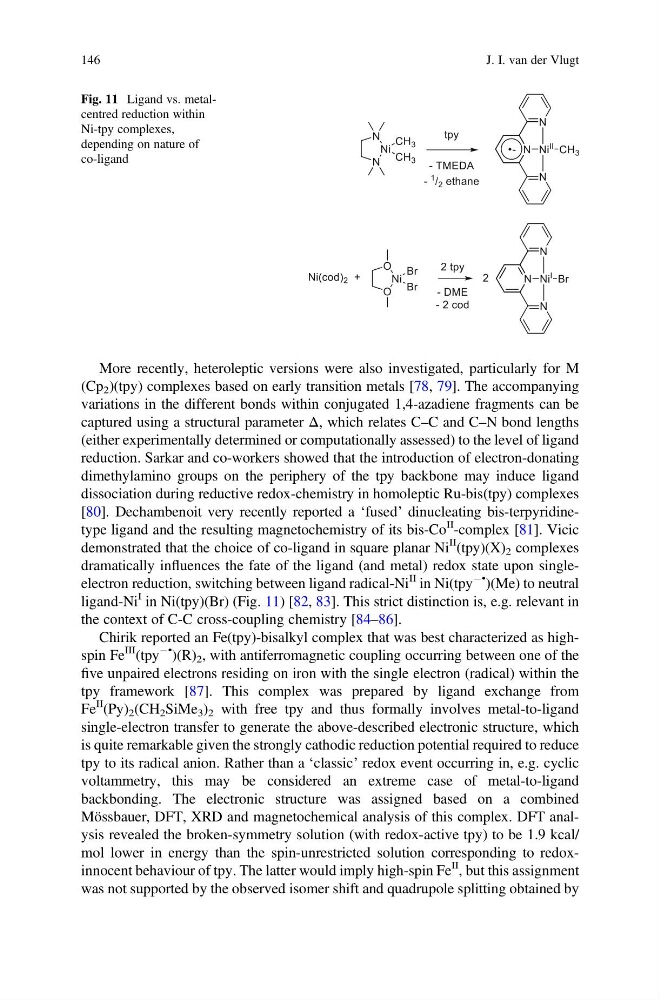
II -complex [81]. Vicic
demonstrated that the choice of co-ligand in square planar Ni
II (tpy)(X) 2 complexes
dramatically influences the fate of the ligand (and metal) redox state upon singleelectron reduction, switching between ligand radical-Ni
II in Ni(tpy
À• )(Me) to neutral
ligand-Ni
I in Ni(tpy)(Br) (Fig. 11) [82, 83]. This strict distinction is, e.g. relevant in
the context of C-C cross-coupling chemistry [84–86].
Chirik reported an Fe(tpy)-bisalkyl complex that was best characterized as highspin Fe
III (tpy
À•
)(R) 2 , with antiferromagnetic coupling occurring between one of the
five unpaired electrons residing on iron with the single electron (radical) within the
tpy framework [87]. This complex was prepared by ligand exchange from
Fe
II (Py) 2 (CH 2 SiMe 3 ) 2 with free tpy and thus formally involves metal-to-ligand
single-electron transfer to generate the above-described electronic structure, which
is quite remarkable given the strongly cathodic reduction potential required to reduce
tpy to its radical anion. Rather than a ‘classic’ redox event occurring in, e.g. cyclic
voltammetry, this may be considered an extreme case of metal-to-ligand
backbonding. The electronic structure was assigned based on a combined
Mössbauer, DFT, XRD and magnetochemical analysis of this complex. DFT analysis revealed the broken-symmetry solution (with redox-active tpy) to be 1.9 kcal/
mol lower in energy than the spin-unrestricted solution corresponding to redoxinnocent behaviour of tpy. The latter would imply high-spin Fe
II , but this assignment
was not supported by the observed isomer shift and quadrupole splitting obtained by
Fig. 11 Ligand vs. metalcentred reduction within
Ni-tpy complexes,
depending on nature of
co-ligand
146
J. I. van der Vlugt
(Cp 2 )(tpy) complexes based on early transition metals [78, 79]. The accompanying
variations in the different bonds within conjugated 1,4-azadiene fragments can be
captured using a structural parameter Δ, which relates C–C and C–N bond lengths
(either experimentally determined or computationally assessed) to the level of ligand
reduction. Sarkar and co-workers showed that the introduction of electron-donating
dimethylamino groups on the periphery of the tpy backbone may induce ligand
dissociation during reductive redox-chemistry in homoleptic Ru-bis(tpy) complexes
[80]. Dechambenoit very recently reported a ‘fused’ dinucleating bis-terpyridinetype ligand and the resulting magnetochemistry of its bis-Co
II -complex [81]. Vicic
demonstrated that the choice of co-ligand in square planar Ni
II (tpy)(X) 2 complexes
dramatically influences the fate of the ligand (and metal) redox state upon singleelectron reduction, switching between ligand radical-Ni
II in Ni(tpy
À• )(Me) to neutral
ligand-Ni
I in Ni(tpy)(Br) (Fig. 11) [82, 83]. This strict distinction is, e.g. relevant in
the context of C-C cross-coupling chemistry [84–86].
Chirik reported an Fe(tpy)-bisalkyl complex that was best characterized as highspin Fe
III (tpy
À•
)(R) 2 , with antiferromagnetic coupling occurring between one of the
five unpaired electrons residing on iron with the single electron (radical) within the
tpy framework [87]. This complex was prepared by ligand exchange from
Fe
II (Py) 2 (CH 2 SiMe 3 ) 2 with free tpy and thus formally involves metal-to-ligand
single-electron transfer to generate the above-described electronic structure, which
is quite remarkable given the strongly cathodic reduction potential required to reduce
tpy to its radical anion. Rather than a ‘classic’ redox event occurring in, e.g. cyclic
voltammetry, this may be considered an extreme case of metal-to-ligand
backbonding. The electronic structure was assigned based on a combined
Mössbauer, DFT, XRD and magnetochemical analysis of this complex. DFT analysis revealed the broken-symmetry solution (with redox-active tpy) to be 1.9 kcal/
mol lower in energy than the spin-unrestricted solution corresponding to redoxinnocent behaviour of tpy. The latter would imply high-spin Fe
II , but this assignment
was not supported by the observed isomer shift and quadrupole splitting obtained by
Fig. 11 Ligand vs. metalcentred reduction within
Ni-tpy complexes,
depending on nature of
co-ligand
146
J. I. van der Vlugt