

4.6 Reemission of Incident Ions
67
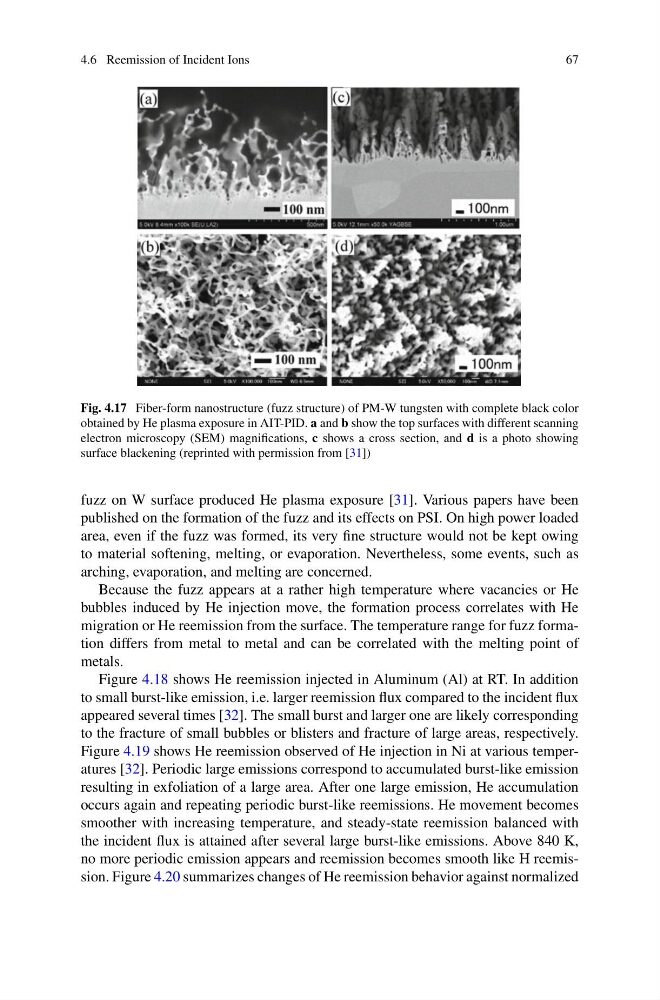
Fig. 4.17 Fiber-form nanostructure (fuzz structure) of PM-W tungsten with complete black color
obtained by He plasma exposure in AIT-PID. a and b show the top surfaces with different scanning
electron microscopy (SEM) magnifications, c shows a cross section, and d is a photo showing
surface blackening (reprinted with permission from [31])
fuzz on W surface produced He plasma exposure [31]. Various papers have been
published on the formation of the fuzz and its effects on PSI. On high power loaded
area, even if the fuzz was formed, its very fine structure would not be kept owing
to material softening, melting, or evaporation. Nevertheless, some events, such as
arching, evaporation, and melting are concerned.
Because the fuzz appears at a rather high temperature where vacancies or He
bubbles induced by He injection move, the formation process correlates with He
migration or He reemission from the surface. The temperature range for fuzz formation differs from metal to metal and can be correlated with the melting point of
metals.
Figure 4.18 shows He reemission injected in Aluminum (Al) at RT. In addition
to small burst-like emission, i.e. larger reemission flux compared to the incident flux
appeared several times [32]. The small burst and larger one are likely corresponding
to the fracture of small bubbles or blisters and fracture of large areas, respectively.
Figure 4.19 shows He reemission observed of He injection in Ni at various temperatures [32]. Periodic large emissions correspond to accumulated burst-like emission
resulting in exfoliation of a large area. After one large emission, He accumulation
occurs again and repeating periodic burst-like reemissions. He movement becomes
smoother with increasing temperature, and steady-state reemission balanced with
the incident flux is attained after several large burst-like emissions. Above 840 K,
no more periodic emission appears and reemission becomes smooth like H reemission. Figure 4.20 summarizes changes of He reemission behavior against normalized
67
Fig. 4.17 Fiber-form nanostructure (fuzz structure) of PM-W tungsten with complete black color
obtained by He plasma exposure in AIT-PID. a and b show the top surfaces with different scanning
electron microscopy (SEM) magnifications, c shows a cross section, and d is a photo showing
surface blackening (reprinted with permission from [31])
fuzz on W surface produced He plasma exposure [31]. Various papers have been
published on the formation of the fuzz and its effects on PSI. On high power loaded
area, even if the fuzz was formed, its very fine structure would not be kept owing
to material softening, melting, or evaporation. Nevertheless, some events, such as
arching, evaporation, and melting are concerned.
Because the fuzz appears at a rather high temperature where vacancies or He
bubbles induced by He injection move, the formation process correlates with He
migration or He reemission from the surface. The temperature range for fuzz formation differs from metal to metal and can be correlated with the melting point of
metals.
Figure 4.18 shows He reemission injected in Aluminum (Al) at RT. In addition
to small burst-like emission, i.e. larger reemission flux compared to the incident flux
appeared several times [32]. The small burst and larger one are likely corresponding
to the fracture of small bubbles or blisters and fracture of large areas, respectively.
Figure 4.19 shows He reemission observed of He injection in Ni at various temperatures [32]. Periodic large emissions correspond to accumulated burst-like emission
resulting in exfoliation of a large area. After one large emission, He accumulation
occurs again and repeating periodic burst-like reemissions. He movement becomes
smoother with increasing temperature, and steady-state reemission balanced with
the incident flux is attained after several large burst-like emissions. Above 840 K,
no more periodic emission appears and reemission becomes smooth like H reemission. Figure 4.20 summarizes changes of He reemission behavior against normalized