

66
4 Responses of Plasma-Facing Surface to Power Load Given by Radiation …
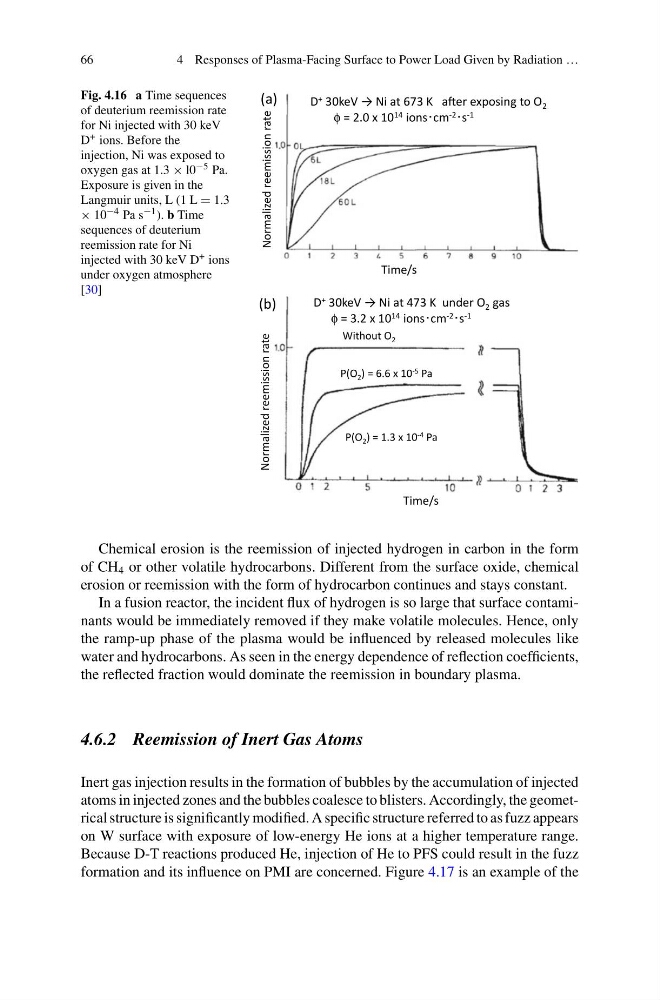
Fig. 4.16 a Time sequences
of deuterium reemission rate
for Ni injected with 30 keV
D + ions. Before the
injection, Ni was exposed to
oxygen gas at 1.3 × l0 −5 Pa.
Exposure is given in the
Langmuir units, L (1 L = 1.3
× 10 −4 Pa s −1 ). b Time
sequences of deuterium
reemission rate for Ni
injected with 30 keV D + ions
under oxygen atmosphere
[30]
D + 30keV → Ni at 673 K aer exposing to O 2
φ = 2.0 x 10 14 ions cm -2 s -1
(a)
(b)
Time/s
Normalized reemission rate
Time/s
Normalized reemission rate
D + 30keV → Ni at 473 K under O 2 gas
φ = 3.2 x 10 14 ions cm -2 s -1
P(O 2 ) = 6.6 x 10 -5 Pa
P(O 2 ) = 1.3 x 10 -4 Pa
Without O 2
Chemical erosion is the reemission of injected hydrogen in carbon in the form
of CH 4 or other volatile hydrocarbons. Different from the surface oxide, chemical
erosion or reemission with the form of hydrocarbon continues and stays constant.
In a fusion reactor, the incident flux of hydrogen is so large that surface contaminants would be immediately removed if they make volatile molecules. Hence, only
the ramp-up phase of the plasma would be influenced by released molecules like
water and hydrocarbons. As seen in the energy dependence of reflection coefficients,
the reflected fraction would dominate the reemission in boundary plasma.
4.6.2 Reemission of Inert Gas Atoms
Inert gas injection results in the formation of bubbles by the accumulation of injected
atoms in injected zones and the bubbles coalesce to blisters. Accordingly, the geometrical structure is significantly modified. A specific structure referred to as fuzz appears
on W surface with exposure of low-energy He ions at a higher temperature range.
Because D-T reactions produced He, injection of He to PFS could result in the fuzz
formation and its influence on PMI are concerned. Figure 4.17 is an example of the
4 Responses of Plasma-Facing Surface to Power Load Given by Radiation …
Fig. 4.16 a Time sequences
of deuterium reemission rate
for Ni injected with 30 keV
D + ions. Before the
injection, Ni was exposed to
oxygen gas at 1.3 × l0 −5 Pa.
Exposure is given in the
Langmuir units, L (1 L = 1.3
× 10 −4 Pa s −1 ). b Time
sequences of deuterium
reemission rate for Ni
injected with 30 keV D + ions
under oxygen atmosphere
[30]
D + 30keV → Ni at 673 K aer exposing to O 2
φ = 2.0 x 10 14 ions cm -2 s -1
(a)
(b)
Time/s
Normalized reemission rate
Time/s
Normalized reemission rate
D + 30keV → Ni at 473 K under O 2 gas
φ = 3.2 x 10 14 ions cm -2 s -1
P(O 2 ) = 6.6 x 10 -5 Pa
P(O 2 ) = 1.3 x 10 -4 Pa
Without O 2
Chemical erosion is the reemission of injected hydrogen in carbon in the form
of CH 4 or other volatile hydrocarbons. Different from the surface oxide, chemical
erosion or reemission with the form of hydrocarbon continues and stays constant.
In a fusion reactor, the incident flux of hydrogen is so large that surface contaminants would be immediately removed if they make volatile molecules. Hence, only
the ramp-up phase of the plasma would be influenced by released molecules like
water and hydrocarbons. As seen in the energy dependence of reflection coefficients,
the reflected fraction would dominate the reemission in boundary plasma.
4.6.2 Reemission of Inert Gas Atoms
Inert gas injection results in the formation of bubbles by the accumulation of injected
atoms in injected zones and the bubbles coalesce to blisters. Accordingly, the geometrical structure is significantly modified. A specific structure referred to as fuzz appears
on W surface with exposure of low-energy He ions at a higher temperature range.
Because D-T reactions produced He, injection of He to PFS could result in the fuzz
formation and its influence on PMI are concerned. Figure 4.17 is an example of the